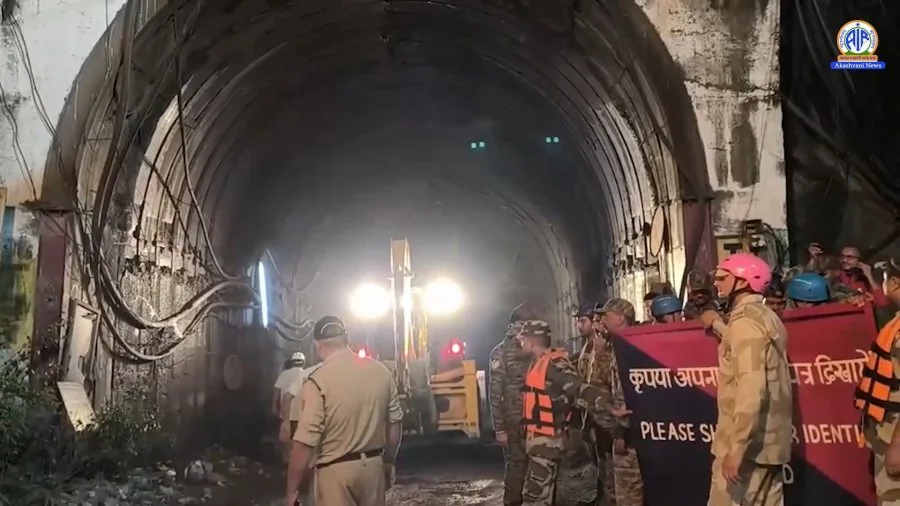
A tunnel under construction at the Vishnugad-Pipalkoti hydroelectric project in Chamoli district, Uttarakhand, India, collapsed late on August 13 after a landslide caused water and debris to flood the tunnel, trapping workers inside [1, 2, 3]. At least 7 workers died in the accident [1, 2, 3].
The number of workers rescued alive varies among sources. According to s1 and s2, 12 have been rescued while 3 remain missing. Source s3 reports 20 rescued and 2 missing [1, 2, 3]. Injuries are also reported, with s2 stating 13 injured and s3 saying 14 suffered injuries [2, 3].
Rescue efforts involve India's National Disaster Response Force (NDRF), Indo-Tibetan Border Police, fire services, the State Disaster Management Authority, and other agencies working continuously to evacuate those still trapped [1, 2, 3]. NDRF commander Amrit Lal Meena said, "When our team reached the site and started the operation, there was a lot of water inside the tunnel and water was also seeping from the sides. Since then, the water level has increased considerably" [1].
Chief Minister of Uttarakhand, Pushkar Singh Dhami, described the effort as a "war-like rescue operation" and said, "Evacuating every worker safely is our top priority" [2].
Heavy monsoon rains and the resulting landslides are believed to have contributed to the collapse [2, 3]. Tunnel construction accidents are common in India due to rapid infrastructure growth, fragile geology, safety lapses, and extreme weather [1, 2, 3]. In July, a similar incident in Sikkim killed 20 workers during tunnel construction at another hydro project [2, 3]. In 2023, Uttarakhand experienced a tunnel collapse trapping 41 workers underground for 17 days before rescue [2, 3].
The rescue operation remains underway to locate and evacuate the remaining workers. Authorities continue to monitor conditions closely as they work against rising water levels and unstable terrain [1, 2, 3].