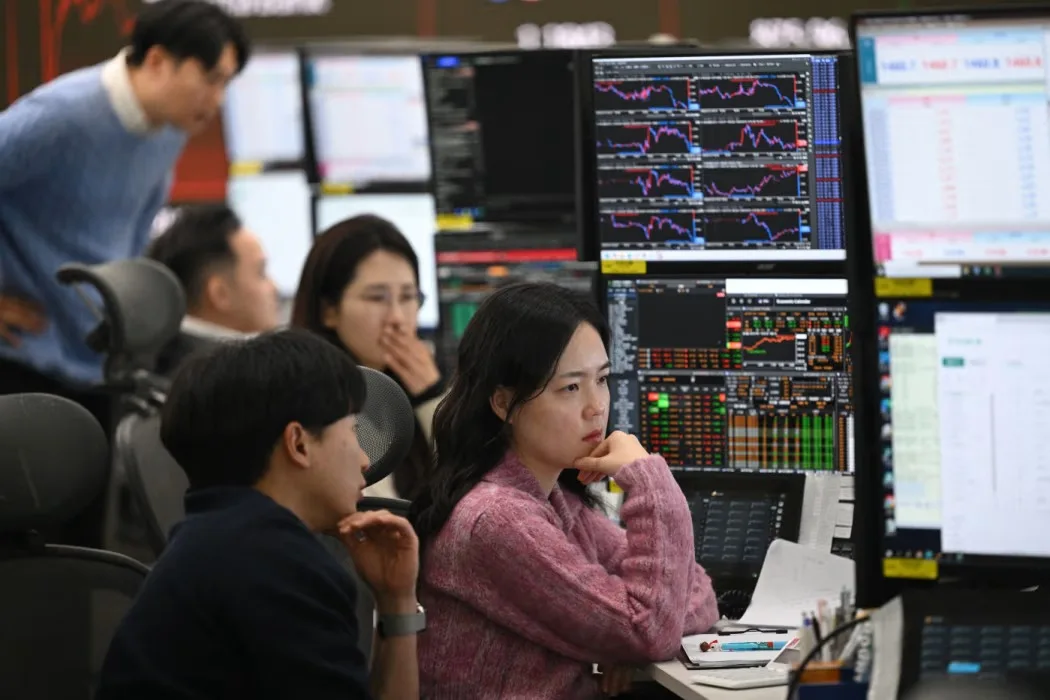
South Korea’s KOSPI index fell sharply over 6% at open on June 5, triggering a circuit breaker and halting programmatic sell orders for 5 minutes starting at 9:08 a.m. local time to curb extreme volatility [1, 2, 3, 4, 5]. Semiconductor stocks suffered heavily, with Samsung Electronics shares dropping nearly 7% and SK Hynix tumbling between 8% and 9.9% during the sell-off [1, 2, 6]. Finance Minister Koo Yun-cheol voiced concerns over leveraged stock investments and said authorities will act against herd behavior in the markets [1].
Taiwan’s stock market also felt the impact, with the index plunging about 1,468 points (3.2%) intraday before recovering some losses to close down 606 points (1.33%) at 45,070.94 points on June 5 [7, 8]. Major Taiwanese semiconductor and memory companies such as Nanya Technology, Winbond, and UMC saw severe declines, with some hitting daily limit-down levels [7, 5, 9, 6].
Japan's Nikkei index opened down 1.85% (about 1,200 points) but partially recovered to close the morning session with a 1.2% drop [1, 10].
The sell-off traces back to Broadcom’s June 4 Q2 earnings announcement, which disappointed investors with revenue and outlook falling below expectations. Broadcom shares plunged 12-13% in U.S. markets, sparking global losses across semiconductor stocks including Micron Technology, which dropped nearly 8% the same day [2, 3, 11, 4, 5, 12, 6]. Other U.S. semiconductor shares such as Nvidia and ARM also declined sharply due to concerns over AI chip sales following Broadcom’s earnings miss [2, 11, 4, 6].
South Korea’s stock market has been structurally vulnerable given the heavy concentration of Samsung Electronics and SK Hynix in the rally. Analysts noted the correction reflects profit-taking and market rotation, but the long-term demand for AI infrastructure remains intact [11, 6]. However, the sharp depreciation of the Korean won to a 17-year low against the U.S. dollar today at 1,549.79 KRW/USD is adding pressure to Korean stocks [11, 6].
Investor participation surged in 2026 with many young and elderly opening brokerage accounts in Taiwan and South Korea, some reportedly borrowing to buy stocks [1, 10, 7]. Margin loan balances in South Korea peaked at 38 trillion KRW on May 29 before recent declines in brokerage deposits, signaling potential risks from leveraged positions [9]. Eugene Asset Management’s CIO Ha SeokKeun said, “I am more concerned about overheated market positions rather than deteriorating fundamentals. Increased volatility and consolidation are expected over the next one to two months.” [9]
Despite the turmoil, Taiwan Semiconductor Manufacturing Co. (TSMC) remains resilient and is expected to benefit from sustained AI demand with positive revenue and capital expenditure outlooks [9, 6].
By midday June 5, KOSPI hovered around 8,164 points, down about 5.5% from the previous close [12]. The sell-off on June 5 highlights the ongoing market sensitivity after Broadcom’s report and sets the stage for continued volatility in global semiconductor sectors.