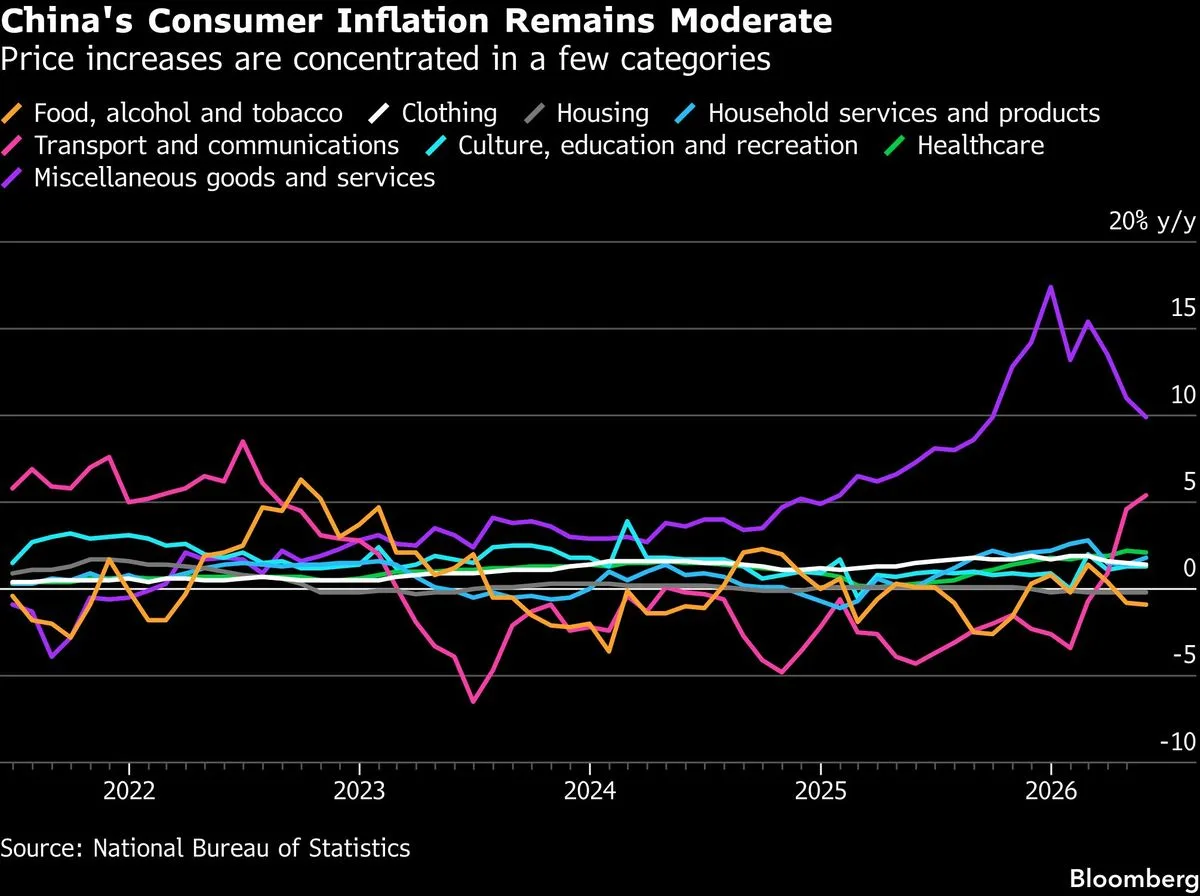
China's consumer price index (CPI) rose 1.0% year-on-year in June 2026, slower than May's 1.2% and below economists' median forecast of 1.1% [1, 2, 3, 4, 5, 6]. The core CPI, which excludes volatile food and energy prices, also slowed to 1.0% from 1.1% in May, marking its slowest pace since January 2026 [1, 2, 3, 5, 6]. Food prices continued to decline, falling about 1.6% year-on-year in June compared to a 1.7% drop in May [5, 6].
The producer price index (PPI) rose 4.1% year-on-year in June, up from 3.9% in May and matching market expectations [1, 2, 7, 3, 4, 5, 6]. However, factory gate prices fell 0.3% month-on-month in June, the first monthly decline since July 2025 [1, 2, 7, 3, 6]. The Purchasing Managers' Index (PMI) for June also showed easing input cost inflation to a six-month low and the output price sub-index contracted for the first time in 2026, signaling pullbacks in industrial prices upstream and downstream [5].
Dong Lijuan, a statistician with the National Bureau of Statistics, attributed some of the moderation to global crude oil prices falling in June, which reduced costs in related sectors in China [1]. Despite a recent rise in global oil, chip, and metal prices, weak consumer spending has restrained factories' ability to pass higher input costs onto consumers, pressuring both inflation and corporate profits [1, 2, 7, 3, 4, 6]. Julian Evans-Pritchard of Capital Economics noted that while US-Iran tensions might add some upward inflation pressure in narrow areas, inflation is expected to return near zero once energy supply normalizes [7].
China likely exited a roughly three-year economy-wide deflationary period in the fourth quarter of 2025, helped by booming investment in artificial intelligence and shocks to Middle East oil prices [1, 2, 7, 4, 5, 6]. Export prices are also rising at the fastest pace since early 2023, reversing years of contraction [1, 4].
Following the release of the June price data on July 9, 2026, China's 10-year government bond yield remained steady at 1.73%, while the onshore yuan rose 0.1% against the US dollar, becoming the best-performing Asian currency that day [1, 2, 7, 3].
The International Monetary Fund raised its forecast for China's 2026 GDP growth to 4.6%, up from 4.4%, citing strong high-tech manufacturing, exports, and public infrastructure investment [5, 6]. China’s official growth target for 2026 remains at a modest 4.5% to 5% [5, 6].