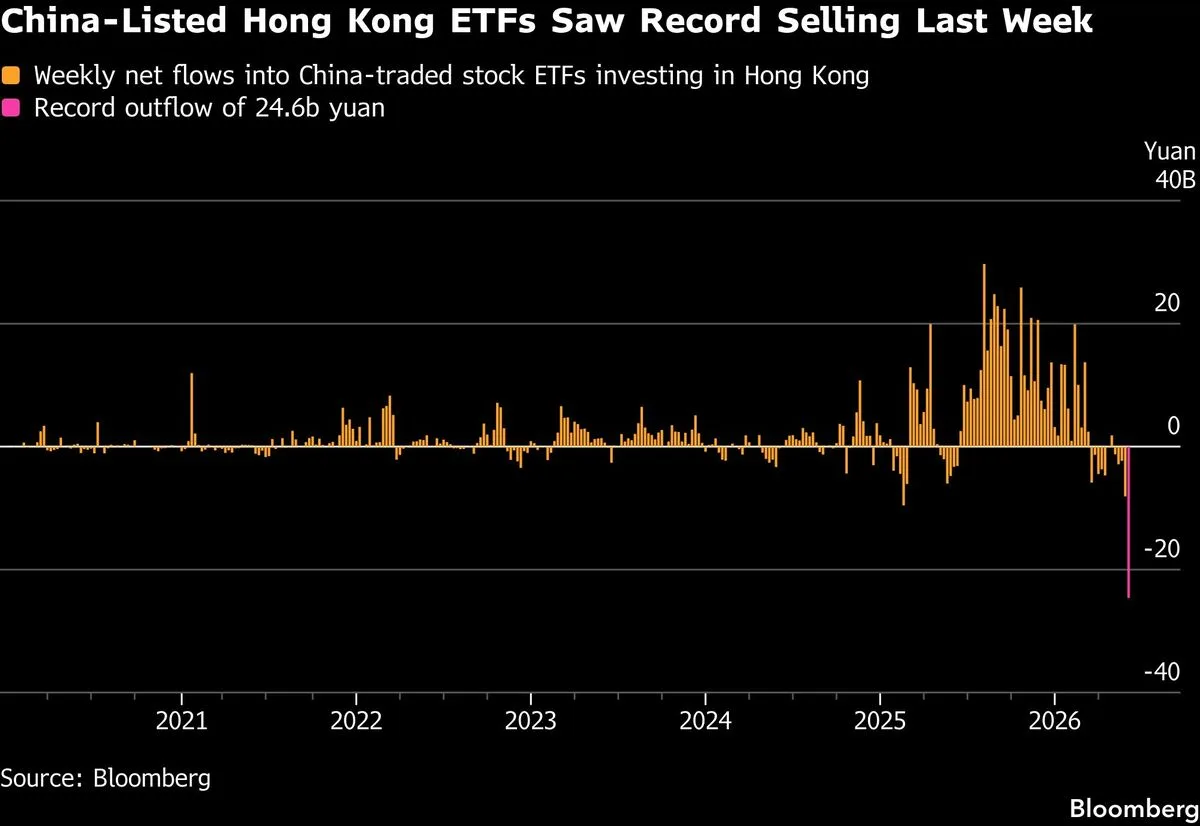
Chinese mainland investors recorded a net sell-off of HK$3.6 billion (approximately US$459.5 million) of Hong Kong stocks via the southbound trading link in May 2026, marking their first monthly outflow since June 2023 [1, 2]. Mainland listed exchange-traded funds (ETFs) focused on Hong Kong equities saw record weekly outflows of around 25 billion yuan (about US$3.7 billion) in the last week of May 2026 [3, 4].
Investor sentiment has shifted after Hong Kong stocks underperformed mainland Chinese onshore equities for four consecutive months, altering portfolio flows [3, 4]. Funds moved increasingly toward mainland-listed semiconductors and artificial intelligence (AI)-related shares viewed as poised to benefit from rapid AI sector growth [3, 1, 4]. Morgan Stanley and Citigroup analysts pointed to stronger earnings momentum and more accommodative mainland policies supporting A shares, particularly in technology and AI sectors [1].
Goldman Sachs downgraded Hong Kong H shares to market-weight on June 1-2, 2026, citing higher opportunity cost of overweighting them and lowered earnings growth forecasts for 2026-27. Analysts said, "We lower H shares to market-weight as the ‘opportunity cost’ for staying overweight has gone up. China is an integral part of the global AI universe," and added, "Index construction matters." They recommended engaging the market via thematic alpha picks or revisiting broad beta exposure later once profit growth improves [3, 1, 4].
Despite a 10% surge in Tencent’s Hong Kong H shares on June 2, reportedly due to AI agent progress on WeChat, investors sold HK$2.1 billion of Tencent shares the same day [3, 4]. The Hang Seng Tech Index rose 4.7%, but mainland ETFs tracking the index saw record outflows. One ChinaAMC ETF recorded a 1 billion yuan withdrawal on June 2 alone [3, 1, 4]. Some sources differ on the scale of ETF outflows, with one citing 25 billion yuan over a week, another noting 6 billion yuan specifically for Hang Seng Tech Index ETFs [3, 1, 4].
For much of 2026, mainland investors treated Hong Kong stocks more as tactical trading vehicles than long-term holdings, with flows weighted toward ETFs rather than direct stock purchases [2].
Mainland investors’ net selling of Hong Kong equities in May ends a nearly three-year streak of net inflows and highlights a clear rotation toward mainland AI and semiconductor shares. The next key market development will be watching mainland profit growth trends and earnings reports later this year, which Goldman Sachs said will guide further positioning on Hong Kong stocks [3, 4].