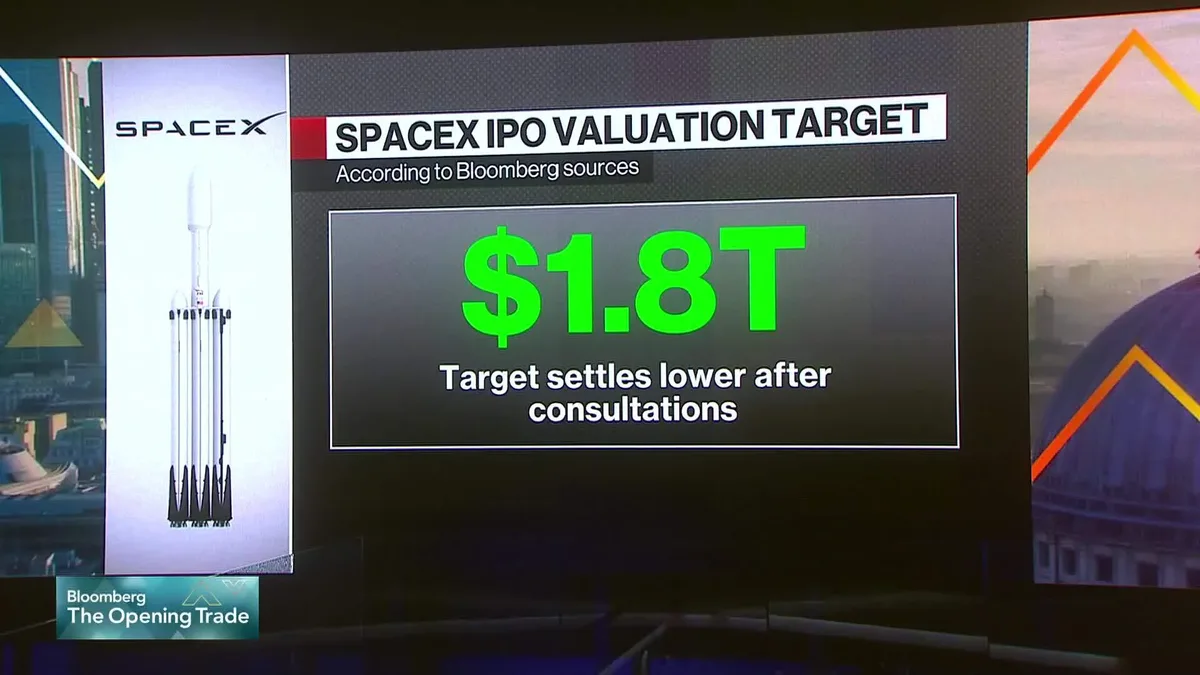
SpaceX is targeting a valuation of at least $1.8 trillion in its initial public offering, marking a reduction from its earlier target above $2 trillion set in April 2026. The adjustment follows consultations with advisers and investors as the company prepares to launch formal IPO marketing on June 4, with share pricing expected around June 11 or 12 on Nasdaq [1, 2, 3, 4].
If successful, the IPO could raise as much as $75 billion, which would be the largest in history by fundraising amount [5, 6, 2].
Financial documents filed on May 20 revealed SpaceX’s 2025 revenue reached $18.7 billion, up from $14 billion in 2024. However, the company swung from a profit of $791 million in 2024 to a loss of $4.94 billion in 2025 [2].
SpaceX also expanded its portfolio by acquiring xAI in February 2026, which includes the Grok chatbot and social media platform X [2]. Morningstar analyst Nicolas Owens downplayed Grok's market position, saying, "We don't see Grok as one of the leading AI labs today," and estimated SpaceX's valuation at $780 billion—less than half the IPO target. He added, "We think the company has been significantly overvalued and investors will have opportunities to buy the stock at more attractive levels after the IPO" [4].
Elon Musk currently holds super voting rights with 85.1% control of SpaceX prior to the IPO [7]. Early investor Peter Diamandis described a merger between SpaceX and Tesla as inevitable post-IPO, saying, "I put it not as a matter of if but only a matter of when those companies come together" [7].
The IPO roadshow marketing is expected to begin on June 4, 2026, with final pricing and debut anticipated between June 11 and 12 [2, 4].