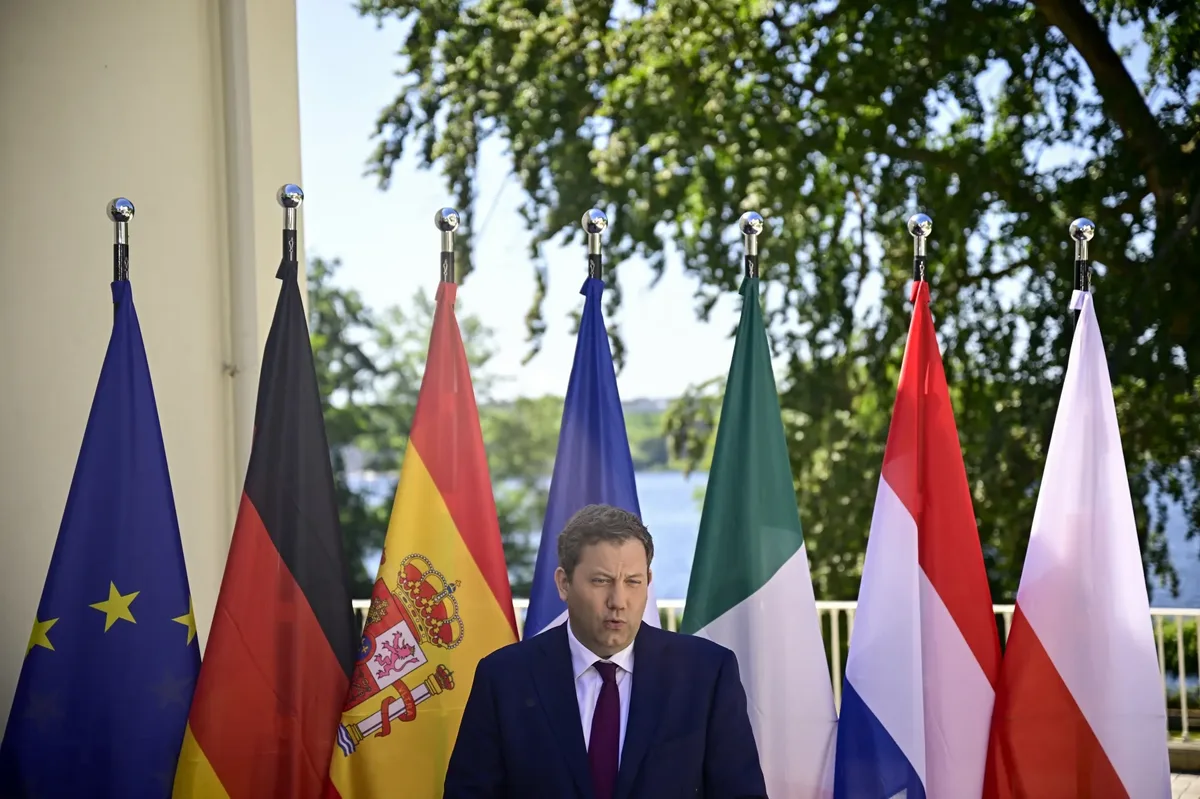
Finance ministers from the EU’s six largest economies met in Berlin on May 28, 2026, and agreed on a plan to create a capital markets union with centralized supervision across the bloc [1, 2, 3]. The six countries—Germany, France, Italy, Spain, the Netherlands, and Poland—represent about 70% of the EU’s population [2].
Under the agreement, supervision of significant market infrastructure will transfer to the European Securities and Markets Authority (ESMA) headquartered in Paris [2, 3]. The ministers emphasized that ESMA’s governance must combine expertise, supervisory experience, and geographical balance to ensure effective oversight [2, 3].
The union aims to improve financing for local companies and promote cross-border investment within the EU [1, 2]. The move also seeks to bolster the EU’s competitiveness against the US and China amid weak growth in Europe [2, 3].
Centralizing supervision requires approval by a qualified majority of at least 15 EU countries representing 65% of the EU population [2]. Some countries, including Ireland and Luxembourg, initially opposed transferring such powers, and Germany was initially hesitant as well [2].
German Finance Minister Lars Klingbeil said the agreement signals the largest EU economies are leaving national self-interest behind. "The fact that the EU’s six largest economies are prepared to leave national self-interest behind and move forward together is an important signal for the entire European Union," he said [2]. Spanish Finance Minister Carlos Cuerpo called the deal "a decisive step towards a true savings and investment union" that Europe needs amid uncertain international conditions [2].
This agreement follows a European Commission plan presented in December 2025 to better integrate EU capital markets [2, 3]. Germany’s finance minister expects the capital markets integration package to be adopted by the end of 2026 [2].