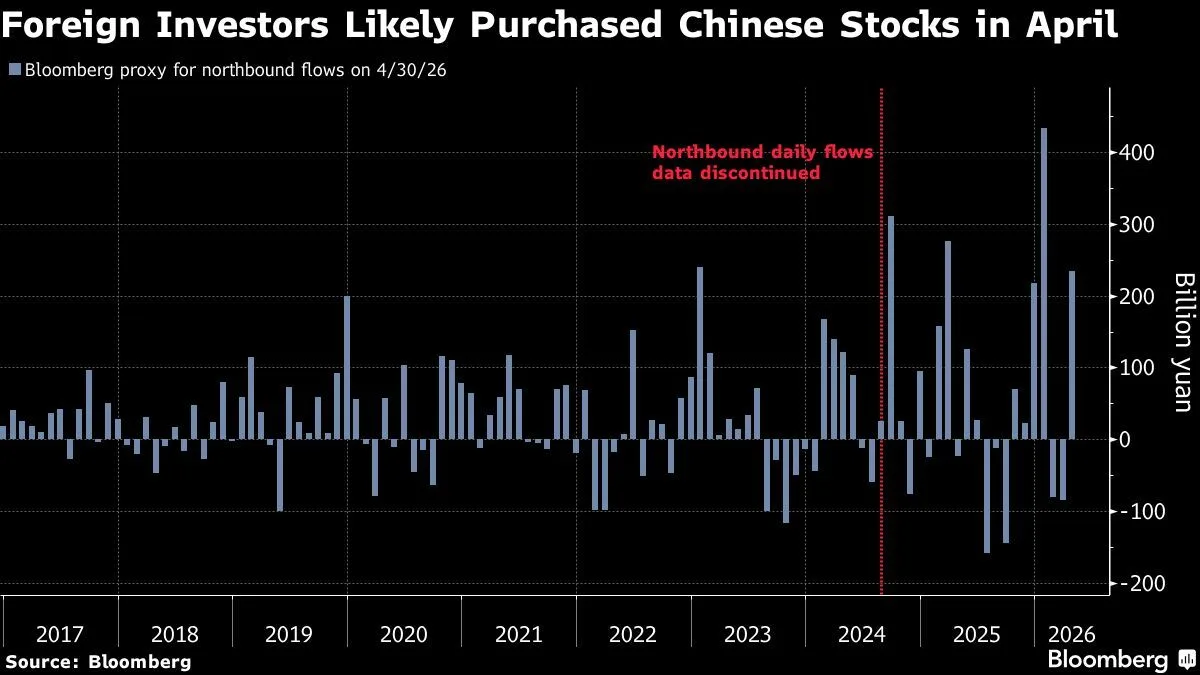
Foreign investors returned to mainland Chinese equities in April 2026 after an initial selloff triggered by the Iran war, investing an estimated net 200 billion yuan (about US$29 billion), the largest inflow since January 2026 [1, 2, 3]. China's CSI 300 index rose 8% during April and extended gains by 0.9% in early May, reflecting positive investor sentiment [2, 3].
The inflows coincided with a broader technology rally fueled by gains in AI-driven productivity [2, 3]. Private equity activity surged, focusing on tech and AI sectors. On Hong Kong's main board, 37 companies raised nearly US$13.26 billion in the quarter ending March 31, 2026, a fivefold increase from earlier periods [4]. Gary Chan, head of private equity at Sun Hung Kai & Co, described the timing as "still an attractive moment" from a valuation perspective [4]. Alex Ying of CDIB Capital International added that investors "would like to see a bit more exits" to further boost confidence [4].
Analysts from Morgan Stanley reported China's AI industry is shifting from technology catch-up to value capture, leveraging speed, cost efficiency, and application integration. The narrative "has shifted decisively from training to inference, from technology to application, and from potential to real earnings," they said [5]. China is rapidly scaling and commercializing AI faster than other countries, supported by strong manufacturing capabilities, supply chain depth, and real-world data availability. Government backing through the 15th Five-Year Plan is institutionalizing robotics as a strategic industry [5].
The inflows and stock gains underscore confidence in China's evolving tech landscape and its leadership in AI commercialization. The next key event will be upcoming earnings reports for Q2, which investors will watch closely for confirmation of sustained growth and profitability in the tech sector.