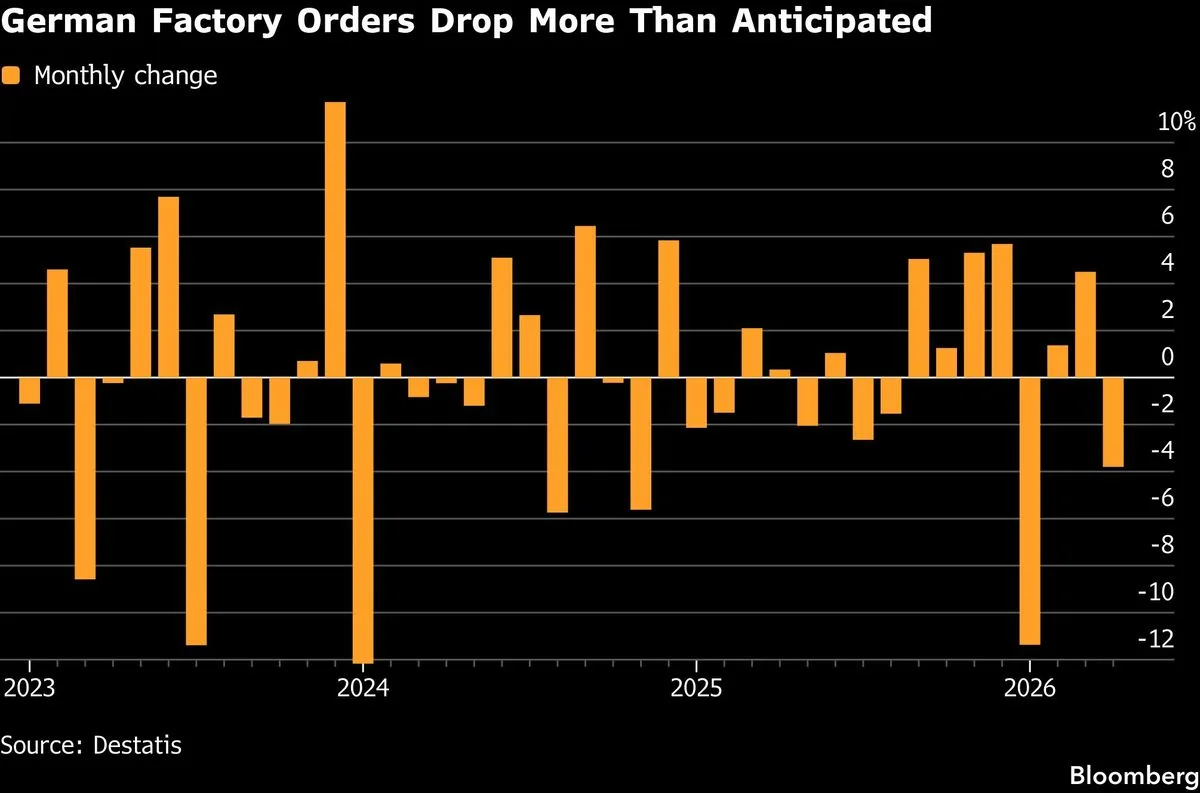
German factory orders decreased by 3.8% month-on-month in April 2026, significantly worse than the expected 2% decline [1, 2]. The downturn was driven by weaker demand in the automotive, electrical equipment, and machinery sectors [1]. Despite the setback, factory orders in March were revised upward to a 4.5% monthly gain, from an earlier estimate of 4.3% [1, 2].
On a seasonally adjusted year-on-year basis, factory orders rose by 1.6% in April, falling short of the forecasted 4.8% growth [2]. Meanwhile, German exports increased 0.9% quarter-on-quarter, outperforming expectations that predicted a 0.5% decline [3]. Industrial output also saw a modest 0.4% quarterly rise in April, rebounding from a 0.7% fall in the previous quarter [3].
The Economy Ministry noted growing signs that rising energy and commodity prices, combined with heightened geopolitical uncertainty, are reducing demand, especially for capital goods. "There are growing signs that rising energy and commodity prices, as well as significantly heightened geopolitical uncertainty, are increasingly leading to lower demand, particularly for capital goods," the ministry said [1].
The German economy expanded 0.3% in the first quarter of 2026 but faces risks of contraction for the second quarter amid inflation pressures and the ongoing Middle East conflict [1]. Joerg Kraemer, chief economist at Commerzbank, projected the economy will "probably contract slightly" in Q2 [1]. Eurozone trade tensions and anticipated European Central Bank interest rate hikes add further pressure on industrial demand [1].
Germany’s €500 billion infrastructure fund has had a sluggish start, limiting near-term stimulus effects that could otherwise support growth [1]. However, some analysts see positive signs amid the challenges. Data from April indicate early signs of a low-point recovery in manufacturing, according to one source noting better-than-expected export and industrial output figures [3].
German factory orders in April provide a mixed picture of the industrial sector’s outlook, balancing weak demand in key manufacturing areas against resilience in exports and output. The data will be key to assessing how the economy weathers ongoing global and domestic risks in the coming months.