South Korea’s central bank, the Bank of Korea, and the Financial Supervisory Service started joint on-site and off-site examinations of major foreign exchange banks on June 10 to investigate trading activities affecting the Korean won’s stability [1, 2, 3]. Authorities aim to identify whether banks engaged in manipulative trades to distort exchange rates for improper gains [1, 2, 3].
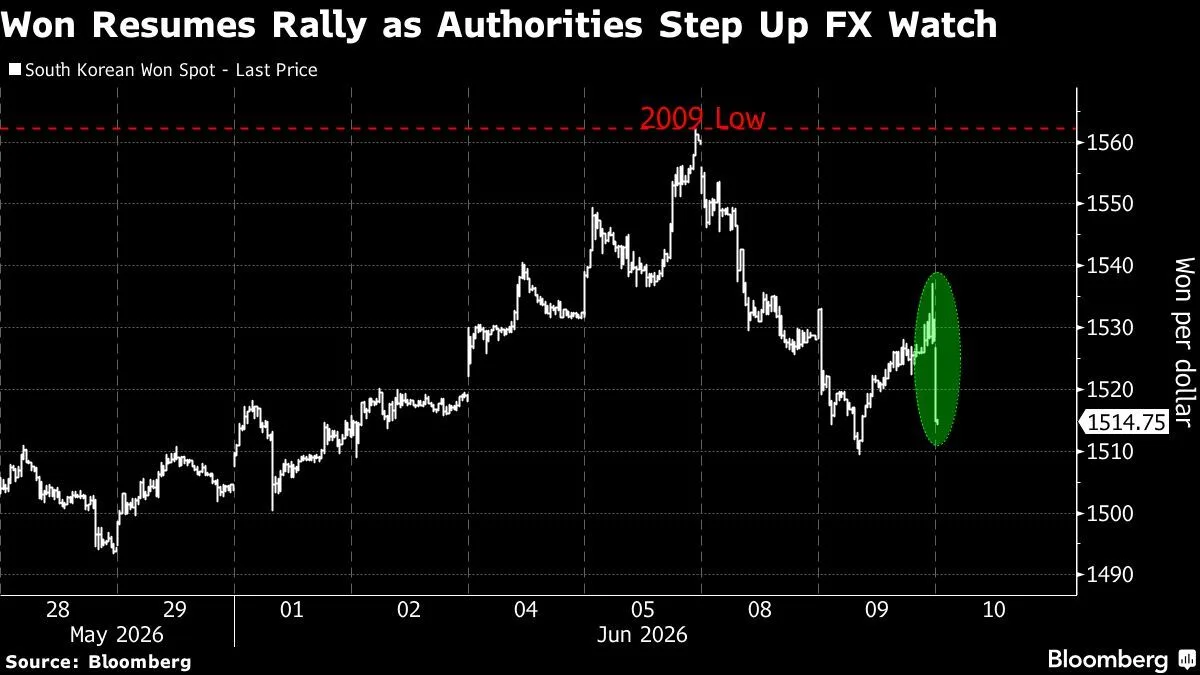
This is the first coordinated FX bank inspection in 14 years [1, 2, 3]. It follows a steep depreciation of the won earlier this month, which fell to its weakest level since 2009, hitting around 1540-1560 won per US dollar before partially recovering after the inspection announcement [1, 4, 5, 6, 7]. The won had declined more than 6% year-to-date by early June, making it among Asia’s weakest currencies [4, 5, 6, 7]. On the day inspections began, the won briefly rose 0.9%, reaching about 1514 KRW/USD [1, 2, 3].
The authorities’ move builds on findings by Korean Customs, which uncovered approximately 415.4 billion won in illegal foreign exchange transactions at 38 companies between January and May 2026 [2, 3]. South Korea also saw large foreign investor stock sell-offs in early June, with significant net foreign outflows from the stock market amounting to roughly $740 billion year-to-date [4, 8, 5, 6].
Amid mounting pressure on the won, the government convened an emergency cross-ministerial meeting on June 7 to enhance regulatory scrutiny targeting speculative FX trading and unilateral market actions [1, 9]. Treasury Minister Koo Yun-cheol said the government would “maintain high vigilance over market volatility and will not tolerate excessive fluctuations or single-sided concentrated trading that destabilizes the Korean won” [9].
Market analysts pointed to external factors driving the won’s weakness, such as a strong dollar, Middle East tensions, and capital outflows. Shinhan Bank Chief Economist Seo Jae-yong noted that despite government efforts, controlling the exchange rate remained difficult given these external pressures [8]. Hanwha Investment & Securities economist Choi Kwi-ho predicted the won could weaken further to around 1550 before the end of the year due to ongoing foreign selling and hawkish US interest rate expectations [4].
Bank of Korea and Financial Supervisory Service inspections will continue as part of stepped-up regulatory efforts to ensure stability. Authorities aim to limit speculative trades that may worsen won volatility amid a challenging external environment [1, 2, 3].