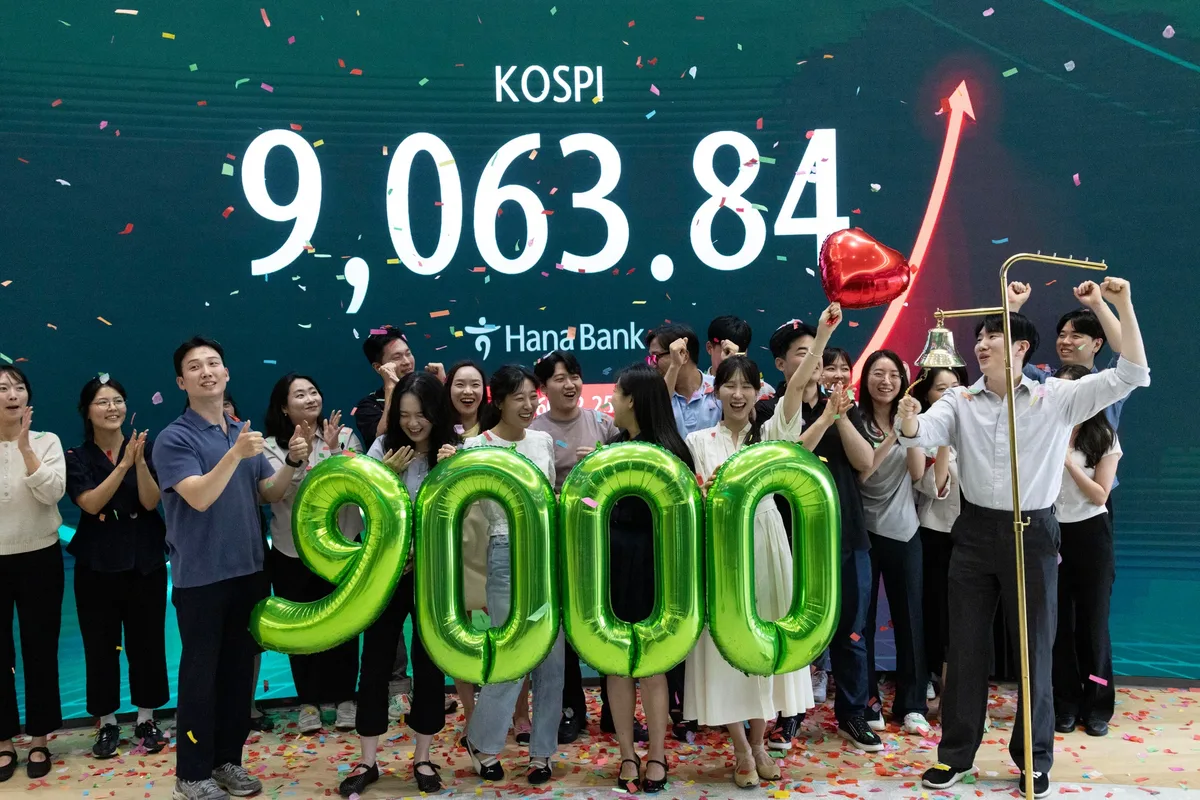
The South Korean KOSPI index surpassed 9000 points for the first time in its history on June 18, 2026, closing at a record high of 9063.84 points after rising 2.25% or 199.60 points during the day [1]. Some sources reported the intraday high at 9008.84 points [2], while others noted a peak as high as 9385.59 points [3]. The index has gained over 110% year-to-date, with estimates varying between 110% and 119% [4, 3].
The rally was led by chipmakers, which account for over half of the KOSPI’s market value [1]. Shares of Samsung Electronics rose between 1.5% and 4.62%, depending on the source [1, 2, 3], while SK Hynix shares surged roughly 5% to over 6%, reaching record highs and driving much of the market’s gains [1, 2, 3]. Optimism about artificial intelligence (AI) semiconductor demand and shipments of next-generation high-bandwidth memory chips fueled investor enthusiasm [1, 2, 3].
Foreign investors were net buyers on June 18, purchasing 1.3 trillion won worth of stock, adding further momentum to the rally [1, 3]. Meanwhile, the South Korean won weakened about 0.76% against the US dollar on the same day [1].
Some major non-chip stocks saw declines, including LG Energy Solution (-3.85%), Hyundai Motor (-2.75%), and Kia (-4.51%) [1]. Despite strong gains in the KOSPI, the KOSDAQ index, which focuses on tech stocks, fell 3.06% during the day [3].
Geopolitical developments also supported market optimism. Easing tensions in the Middle East following a US-Iran peace memorandum were cited as factors driving positive sentiment [2, 3].
The rally intensified feelings of 'stock market depression' among South Korean workers without shares. One unnamed worker said, "I fear missing this investment opportunity and feel like I get poorer the more I work," while an investor cautioned, "Making money in the market isn't easy; you have to pick the right stocks, or else you suffer" [5].
On June 19, 2026, the total market capitalization of the South Korean stock market exceeded 80 trillion won for the first time [6]. Analysts warned that the recent gains are increasingly concentrated among a few large chipmakers, raising concerns about market concentration risks [3].