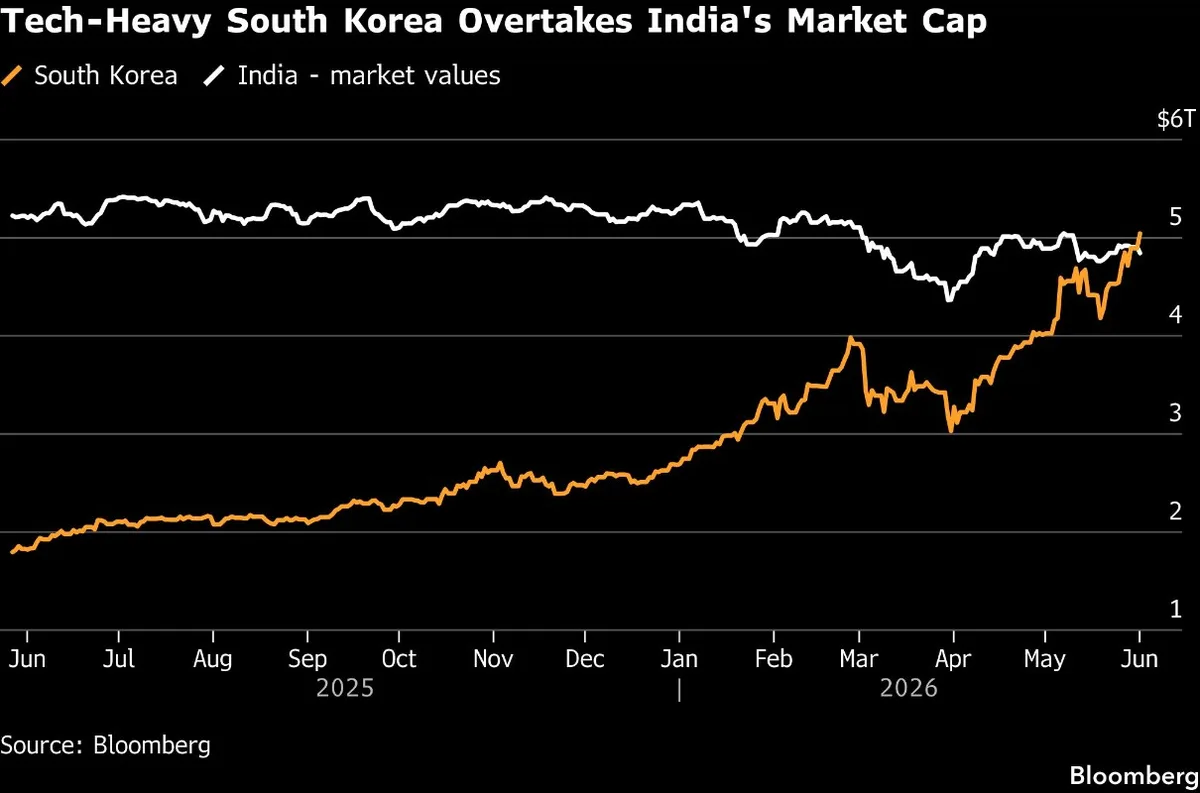
South Korea's equity market capitalization soared 86% in 2026 to around US$5 trillion, overtaking India to become the world's sixth-largest stock market as of June 1 [1, 2, 3]. The surge was led by Samsung Electronics and SK Hynix, both joining the US$1 trillion valuation club amid a boom in AI memory chip demand [3, 2, 4]. The KOSPI index has risen more than 100% this year, powered largely by dominance in AI memory chips [3, 1].
Samsung Electronics alone surpassed a market cap of 2,000 trillion Korean won (approx. US$1.5 trillion) in early June, becoming the first Korean company to reach this milestone by ordinary shares and ranking as the world's 11th largest listed company by value, ahead of Berkshire Hathaway and Micron Technology [2]. Samsung and SK Hynix also deepened strategic investment ties with US AI firms including a $65 billion funding round with Anthropic [2, 4].
South Korea has passed other developed markets such as Canada, Germany, the UK, and France to climb to sixth place globally in stock market size [3, 1]. While India's economy remains larger with roughly US$4.15 trillion GDP versus South Korea's US$1.93 trillion, India’s stock market cap fell to about US$4.8 trillion in 2026 due to rupee depreciation, record foreign outflows, high inflation, and lack of direct AI infrastructure companies [3, 5, 6]. India has also missed semiconductor investment opportunities due to policy hesitation and bureaucracy [7, 8].
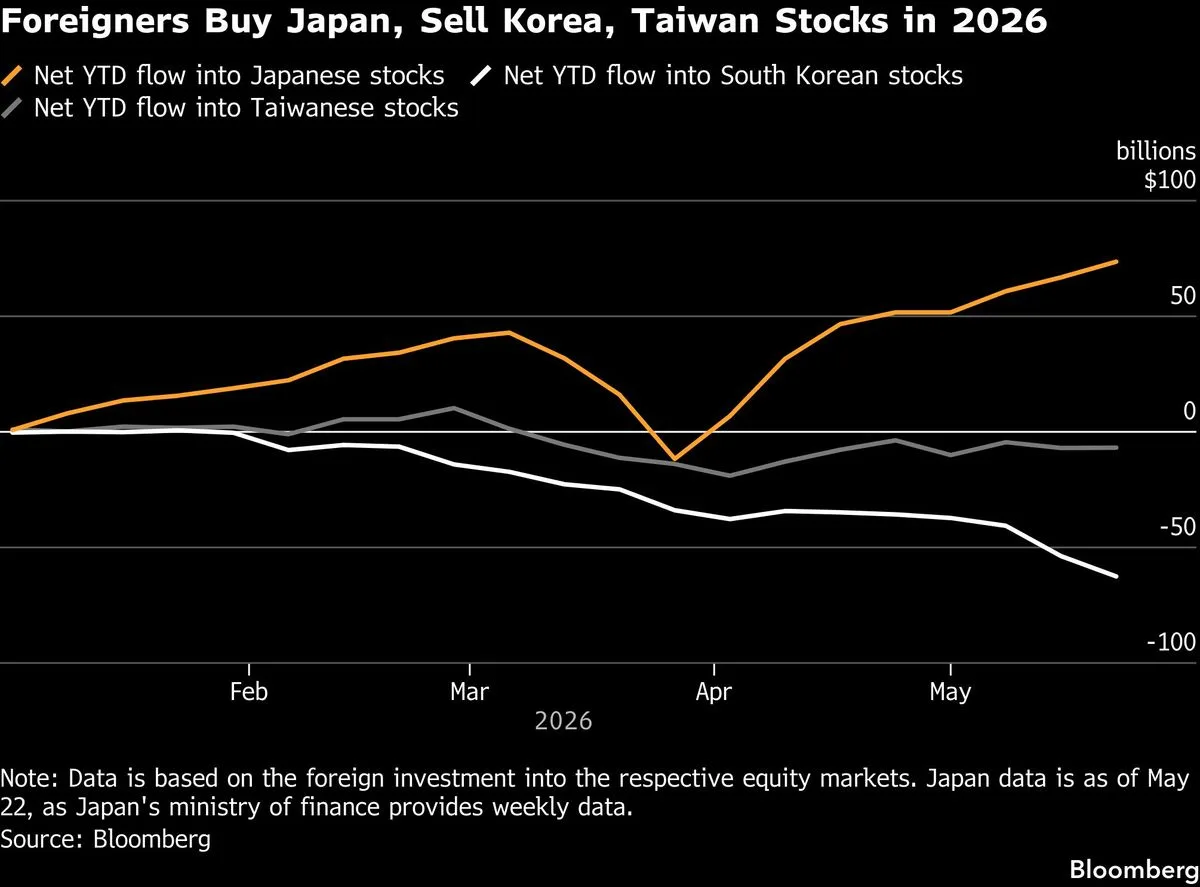
Foreign investors sold about US$70 billion of Korean shares this year through May, while Japan attracted US$73.6 billion in inflows thanks to corporate governance reforms and broader AI-related exposure, making Japan "the most investable Asia market after all," according to GAO Capital CEO Chauwei Yak [9]. South Korea's rally remains heavily dependent on the memory chip cycle and tech stocks, raising doubts about sustainability without corporate governance reforms, said Ross McGarry of Asset Value Investors [3].
The stock market rise has boosted the social status and attractiveness of workers at Samsung and SK Hynix, with competition for semiconductor programs at Korean universities extremely high, at nearly 31 applicants per place for SK Hynix [10]. A matchmaking executive noted the adjustment reflected growing recognition that semiconductor employees’ pay rivals licensed professionals [10].
Taiwan also recently surpassed India, becoming the world's fifth-largest stock market on May 26 [1, 11]. On June 2, Samsung Electronics hit a new stock price high, pushing its market value past the 2,000 trillion won mark [2, 4].