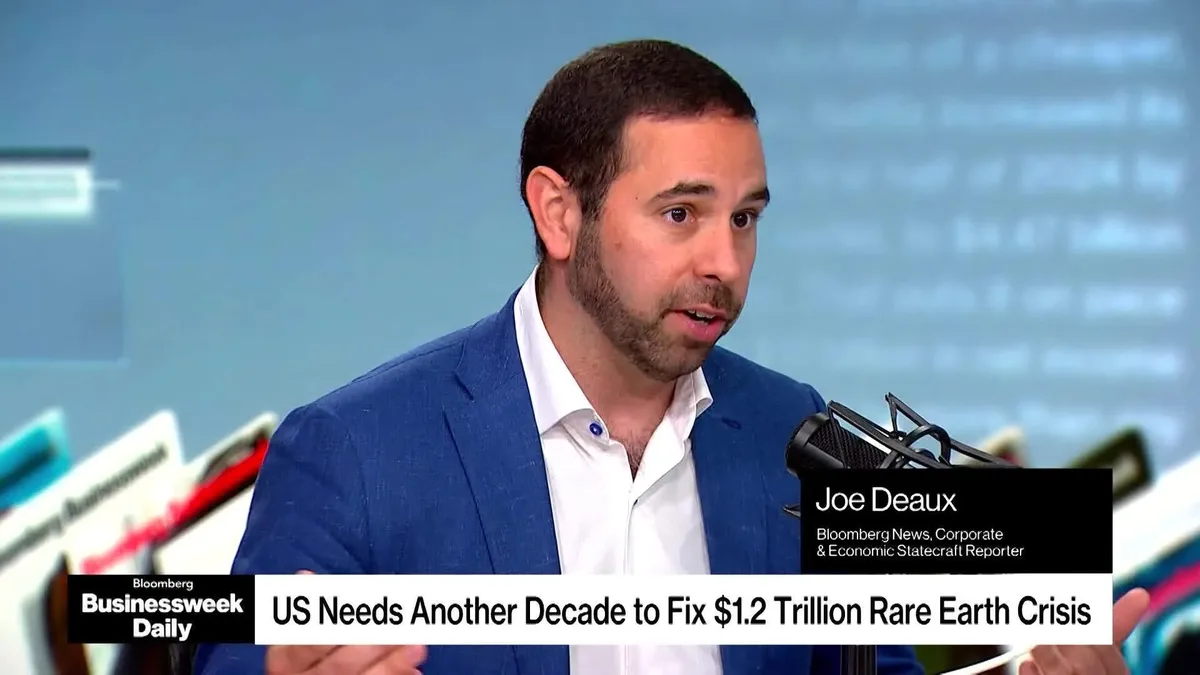
The United States faces a decade-long challenge to fix the $1.2 trillion rare earth supply crisis caused by China's global dominance, according to recent reports [1, 2]. Beijing controls much of the market and uses this leverage in geopolitical disputes [1, 2].
China holds a near-monopoly on critical heavy rare earth elements like dysprosium and terbium, which are essential for high-performance magnets and military applications. Analysts project that China’s hold on these minerals will last at least until the mid-2030s [2]. By 2035, countries outside China are expected to meet less than 20% of global demand for these key elements [2].
The US and its allies have invested billions to build new mining, refining, and processing facilities aimed at reducing dependence on China’s rare earths [2]. However, meaningful diversification will take longer than many anticipate, said Michel Van Hoey, a senior partner at McKinsey [2].
China’s chokehold is expected to loosen earlier on more abundant light rare earth elements used in consumer electronics, possibly by decade’s end [2]. Still, the US has likely drawn down over half of its prewar stockpile of critical munitions containing heavy rare earths amid the ongoing Iran conflict, exposing vulnerabilities [2].
Japan offers an example of the difficulty in breaking free from Chinese supply dominance. Despite over a decade of efforts, China still accounts for 76% of Japan’s rare earth imports [2]. Projections around rare earth supply also depend on how future demand evolves and whether new technologies emerge to reduce the need for heavy rare earths in magnets [2].
Key market data reinforcing this outlook appeared earlier this year in reports from McKinsey, CRU Group, and Benchmark Mineral Intelligence, which confirmed China's continued dominance through the mid-2030s [2]. President Donald Trump pledged in November 2025 to end US reliance on Chinese rare earths within 18 months, a deadline that now appears optimistic [2].
Bloomberg highlighted these challenges in a May 15 report assessing the hurdles the US faces to resolve its rare earth crisis over the next decade [1]. The next major data update on rare earth supply and demand is expected later this year.