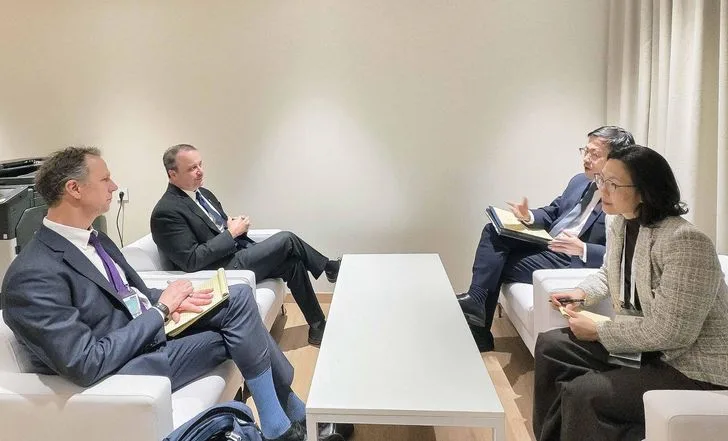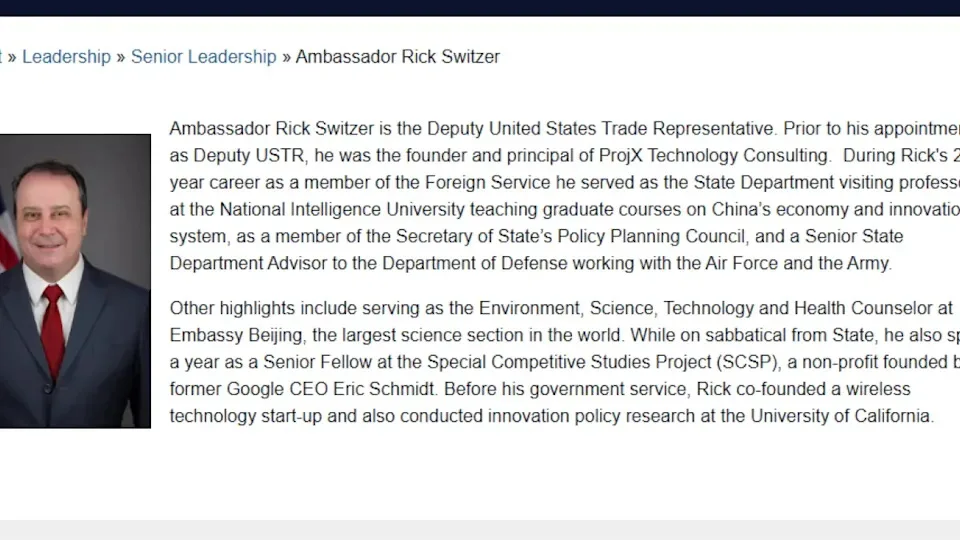
US Deputy Trade Representative Rick Switzer met South Korea’s Trade Minister Yeo Han-koo in June 2026 and requested that the US receive a share of the large profits made by SK hynix and Samsung Electronics due to the booming AI chip market [1, 2, 3, 4, 5, 6]. An industry source explained the US position as based on American companies purchasing large volumes of Korean semiconductors, contributing to Korean firms’ earnings. The source said, "If the Korean chipmakers’ partner firms in Korea are entitled to parts of the profits, the American ones are, too" [1].
South Korea’s Ministry of Trade, Industry and Resources officials responded cautiously, stating they are unaware of details or unable to comment, emphasizing that industry matters should follow principles of commercial reasonableness. One ministry official said, "Korean companies have already announced investments through business roundtables in line with last year's tariff agreements, and they have also made substantial investments over the years" [1]. Another official confirmed that South Korean firms had announced investment plans in the US following the 2025 tariff agreement and that semiconductor matters currently have no new updates [2, 3].
South Korean semiconductor exports surged to record levels in 2026, reaching $192.43 billion in the first half, a 162.5% increase from $73.31 billion in the same period last year [1, 3, 4, 5, 6]. Exports to the US totaled $26.4 billion, up 91.3% year-over-year. In June 2026 alone, exports hit $44.82 billion, nearly tripling from a year earlier, while exports to the US rose 377.2% to $6.49 billion [1, 3, 4, 5, 6].
US government agencies including USTR, Commerce, and Treasury have not publicly confirmed or commented on the US profit-sharing request [1, 2, 3, 4, 5, 6]. US Commerce Secretary Howard Lutnick has publicly encouraged Samsung and SK hynix to expand semiconductor manufacturing investment in the US to support reshoring efforts but noted neither company has current plans for advanced DRAM or NAND fabs on US soil [3, 4, 5, 6]. Lutnick stated, "I hope Samsung Electronics and SK hynix further establish DRAM or NAND flash memory plants in the United States to support the US semiconductor localization policy" [6].
Within South Korea, there is ongoing internal debate on how to define and allocate so-called "excess" or "super" profits from the AI chip boom among subcontractors, contributors, or possibly the public [1, 2, 3, 4, 5].
The US request marks a new point in complex trade and investment talks. South Korea continues to assess commercial factors while balancing government and corporate positions. There is no announced deadline or public follow-up meeting yet on the profit-sharing discussion as of August 2026.