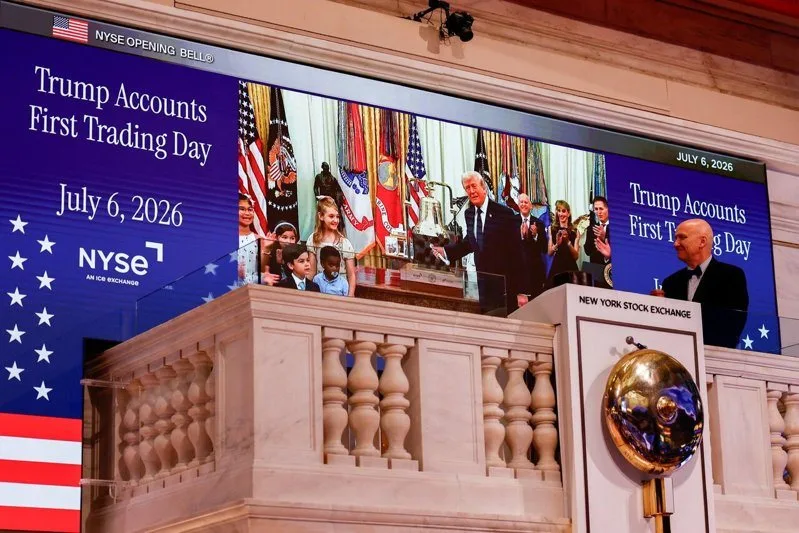
The US stock market closed higher on July 6, 2026, driven by gains in artificial intelligence (AI) and technology shares. The Dow Jones Industrial Average rose 155.84 points, or 0.3%, to 53,055.91. The S&P 500 increased 54.19 points, or 0.7%, to 7,537.43, and the Nasdaq Composite gained 288.49 points, or 1.1%, closing at 26,121.16 [1, 2].
Semiconductor stocks rebounded after recent declines. The Philadelphia Semiconductor Index rose 2.2% following two days of heavy losses [1]. Broadcom shares jumped 3.7% after extending a chip development agreement with Apple through 2031. Intel, Micron, and Taiwan Semiconductor Manufacturing Company (TSMC) ADR shares also rose, with TSMC up 4.1%. Nvidia shares increased 0.4% despite earlier reports of PCB manufacturing delays affecting its Kyber NVL144 platform. Nvidia denied the delays, stating, "我們的產品路線圖如期推進" (Our product roadmap is progressing on schedule) [1, 3].
Views on the semiconductor and AI sectors diverged. Morgan Stanley strategists warned that semiconductor momentum is weakening as investors shift funds toward AI cloud providers, cautioning that the rally is fragile if the Federal Reserve maintains higher interest rates longer. Conversely, investors like Joe Gilbert of Integrity Asset Management expressed confidence, saying, "投資人似乎並未因AI與半導體股可能失去主導地位而感到不安,今天的走勢再次證明,幾條負面消息還不足以動搖信心" (Investors seem unshaken by concerns about AI and semiconductor leadership, and today's gains show several negative factors are insufficient to dent confidence) [1, 4, 3].
On the economic front, a Federal Reserve official, Waller, said inflation has replaced employment as the primary policy challenge. Market participants focused on upcoming Fed meeting minutes for clues on interest rate direction [1]. The US 10-year Treasury yield edged up to 4.479%. Commodity prices were mixed: Brent crude declined 0.2% to $71.99 per barrel, gold rose 1.03% to $4,155.10 per ounce, and Bitcoin climbed 1.54% to $63,684.85 [1].
Microsoft announced layoffs of about 4,800 employees, roughly 2.1% of its global workforce, primarily impacting its Xbox division with 3,200 job cuts. The stock fell nearly 1% amid the restructuring news [1, 3].
Asia-Pacific markets showed mixed results on July 6. South Korea’s Kospi experienced a slight decline following volatile swings. Japan’s Nikkei dipped 0.01%. Markets in Shanghai, Sydney, and Taipei closed down, while Hong Kong, Manila, Jakarta, and Wellington saw moderate gains [5, 4]. Taiwan’s stock market opened higher but fell to close down 224.23 points, or 0.48%, at 46,556.39 amid heavy trading volume exceeding 1.19 trillion NT dollars. Technology sector leadership shifted within mid- and small-cap stocks, including defense and diode segments. Taiwan’s UMC reported June revenue growth of 22.85% year-over-year to 23.125 billion NT dollars, boosting investor optimism [5, 4, 2].
Continuous active trading and large price swings in Taiwan reflect investor anxiety amid Fed policy concerns, geopolitical tensions, and shifting capital flows [5, 4, 2]. US logistics giant Evergreen Group’s Zhang Guohua is under investigation for suspected insider trading related to stock transactions ahead of major announcements [5, 4].
In corporate developments, AI company Anthropic signed a 20-year, $19 billion lease agreement with cryptocurrency miner TeraWulf for AI infrastructure facilities. TeraWulf shares rose 4.9% [1].
Looking ahead, Samsung Electronics is set to announce preliminary Q2 earnings on July 7. SpaceX will join the Nasdaq 100 index the same day, with related ETFs and funds expected to buy shares after market close. SK Hynix plans a $29 billion US listing on Nasdaq scheduled for July 10 [1].