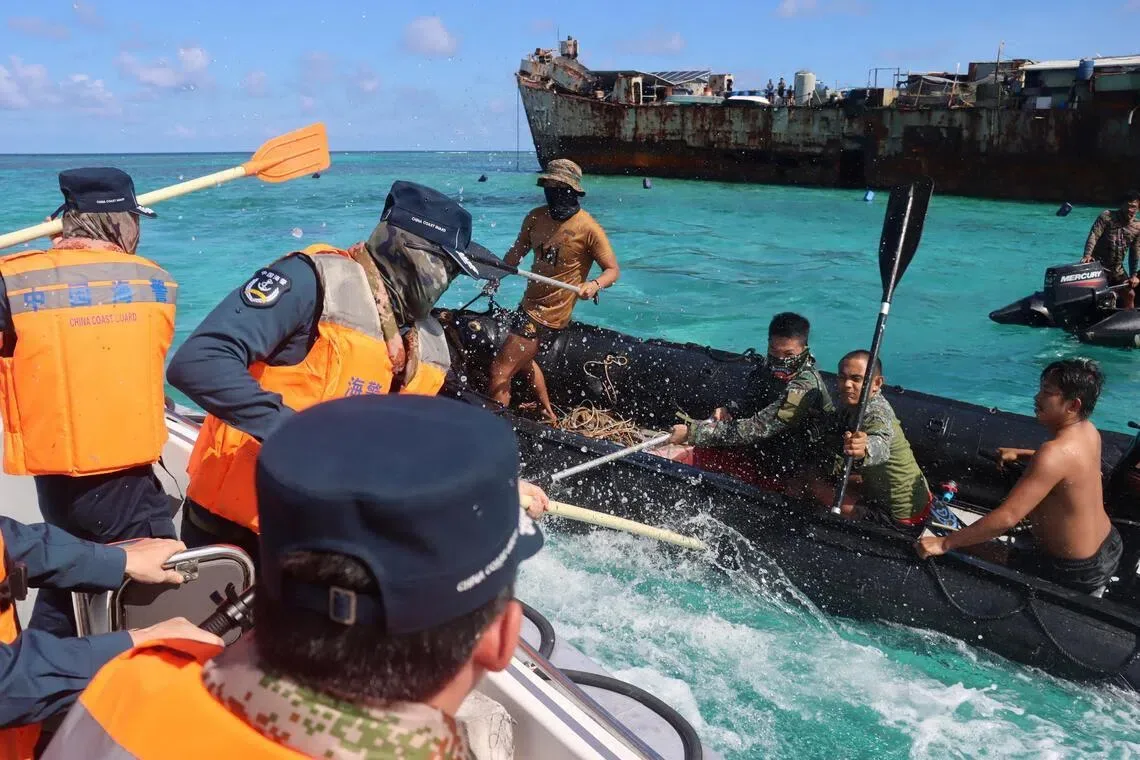
Chinese Coast Guard personnel injured a Filipino sailor with a wooden baton during an encounter on July 20, 2026, near the grounded Philippine Navy ship BRP Sierra Madre on Second Thomas Shoal in the disputed South China Sea [1, 2, 3, 4, 5]. The Chinese rigid-hull inflatable boat carrying eight men approached a Philippine vessel closely, took photos and videos, and was then driven away by two Philippine rubber boats before the clash [1, 2, 4, 5]. The Philippine military described the actions of the Chinese personnel as violent and aggressive, forming part of "a clear pattern of provocative behavior" in the area [1, 2, 5]. The incident caused injury to the Filipino sailor and damaged a Philippine rubber boat [1, 2, 4, 5].
The Philippine Foreign Ministry condemned the act of violence as unacceptable and announced diplomatic actions to address the incident [2, 6]. The Philippines also called on China’s maritime forces to halt their "illegal, coercive, aggressive and deceptive actions" and comply with a 2016 arbitral award affirming Philippine maritime rights [2].
China responded by summoning the Philippine ambassador on July 21, 2026, to protest the incident, accusing the Philippines of "deliberate provocation" at Ren’ai Reef (Second Thomas Shoal) [6]. The Chinese Foreign Ministry claimed the Philippines "provoked first" and accused Manila of distorting facts and "maliciously hyping the issue" [6, 4].
The shoal lies within the Philippines’ 200-nautical mile Exclusive Economic Zone and is about 1,300 kilometers from mainland China [2]. The dispute has a history of clashes, including a violent skirmish in June 2024 when Chinese personnel armed with knives and sticks attacked Filipino troops attempting to resupply the Philippine garrison on Second Thomas Shoal, injuring a Filipino sailor [1, 4, 5]. A provisional deal was reached in July 2024 allowing resupply missions to the grounded BRP Sierra Madre [1, 4, 5].
The United States condemned China’s actions as dangerous and aggressive on July 21, 2026, calling on China to immediately cease destabilizing conduct [7]. US Secretary of State Marco Rubio arrived in Manila the same day for the ASEAN summit amid rising tensions. Rubio warned the waters’ freedom was not guaranteed and stressed the risks to US and ASEAN states’ sovereignty and security if China’s control expands [6, 7].
The July 20 clash marks another escalation in maritime tensions between China and the Philippines around Second Thomas Shoal. The Philippines and China remain at odds over who provoked the incident, with Manila accusing the Chinese Coast Guard of attack after close photographic approaches and China accusing the Philippines of deliberate collisions against its patrol boat [1, 2, 6, 3, 4, 5, 7]. The diplomatic dispute and military presence in the area continue to test fragile arrangements established since 2024.
The next scheduled event is ongoing diplomatic discussions and the ASEAN summit in Manila where the South China Sea tensions are expected to be a key issue [6, 7].