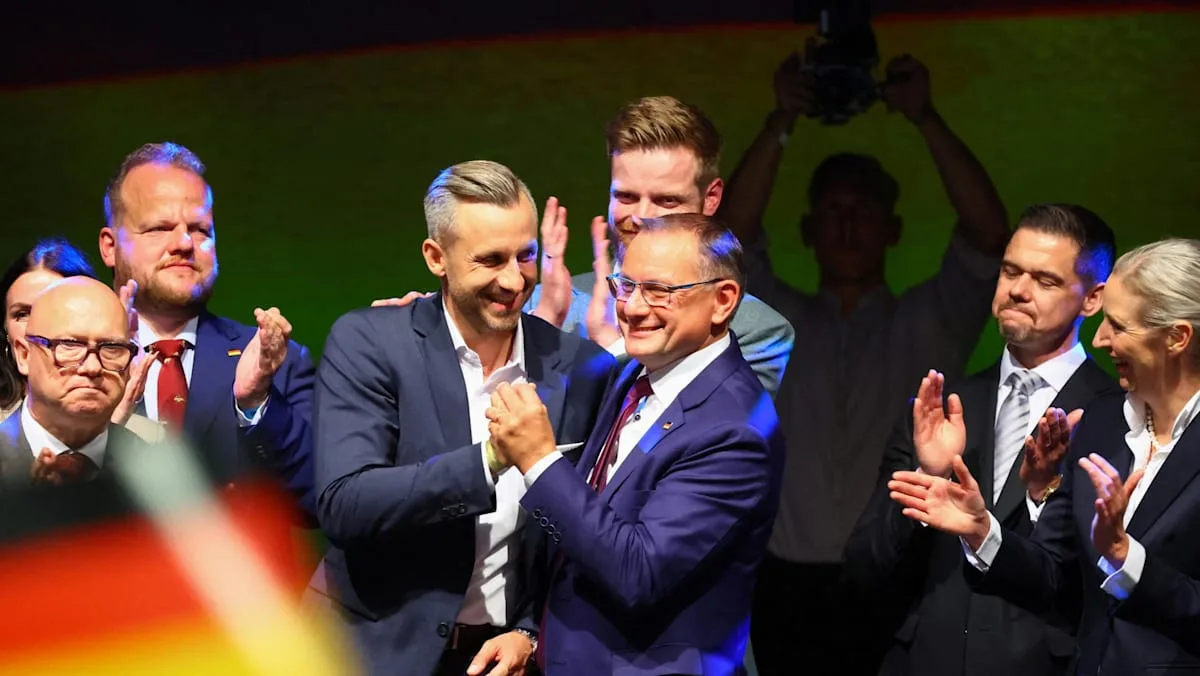
The Alternative for Germany (AfD) secured between 43.8% and 44% of votes in the Saxony-Anhalt state election held on September 6, emerging as the largest party but lacking an outright majority in the 83-seat parliament [1, 2, 3, 4, 5, 6]. AfD won 39 seats, three fewer than the 42 required for a majority [1, 4, 5, 6]. The party’s local leader, Ulrich Siegmund, called the result "historic" and said voters sent a clear signal for political change, declaring, "We have made history. The electorate wants change, and they want us to lead it" [3].
The Christian Democratic Union (CDU), previously the strongest party in Saxony-Anhalt, suffered heavy losses, falling from 37.1% and 37 seats to approximately 17.2% of votes and 15 seats [1, 3, 4, 5, 6]. Other parties include the Social Democrats (SPD) with about 9.3%, the Greens at 8.6-8.9%, the Left party 8.6-9%, and the left-wing populist BSW crossing the 5% threshold with an estimated 5.1% to 5.3% and five seats [3, 4, 5, 6]. The FDP failed to reach 3%, losing parliamentary representation [3, 4, 5, 6].
Voter turnout was high at roughly 78%, significantly up from the previous election’s 60% turnout [1, 3, 4]. AfD remains classified by German intelligence as a far-right extremist group, but its leaders deny this designation [1, 4, 6]. National AfD figures Alice Weidel and Tino Chrupalla hailed the result as a major breakthrough and an indicator of momentum toward the 2029 federal elections. Weidel said, "The voters have given our party a clear mandate to govern" [1, 3, 5, 6].
Other main German parties maintain a "firewall" policy, refusing cooperation with AfD to keep the far-right out of government [1, 3, 5, 6]. The small BSW party could hold the balance of power in coalition talks [1, 3, 5, 6]. AfD opposes immigration, supports reintroducing Russian gas imports, and backs conservative cultural measures, including banning rainbow flags in schools [1, 3, 4].
The election shocked European politicians. French officials expressed deep concern, with Radoslaw Sikorski stating, "They were just a few votes short of an absolute majority; this is very worrying." Benjamin Haddad called it "a clear and very worrying alarm for the outside world," warning of the global rise of populism [2]. Russia framed the result as a defeat for pro-Western governments [2, 4, 5]. Former US President Donald Trump reshared the results on his social platform without comment; European far-right leaders quickly congratulated the AfD [1, 3].
Saxony-Anhalt, with a population of about 2.1 million, witnessed its first far-right election win of this scale since World War II [1, 2, 3, 4]. AfD’s Siegmund predicted that in a new election, their vote share could rise to 50-55% [1].
Preliminary official results confirming these outcomes were released on September 7, and coalition negotiations are expected to begin soon given no party won a majority [1, 5, 6].