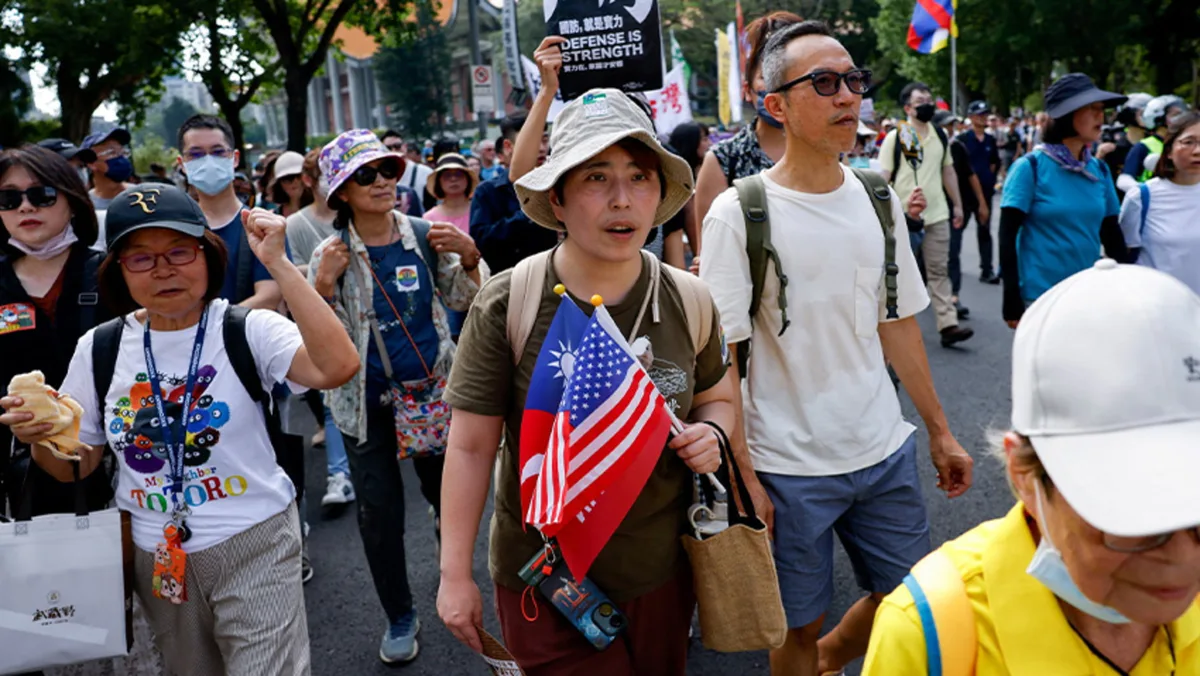
Hundreds of people rallied in central Taipei on May 23 to support government efforts to increase defence spending following Parliament's decision to approve only two-thirds of the US$40 billion requested by President Lai Ching-te [1, 2]. The protest, organized by human rights and pro-independence groups, featured slogans calling for stronger national defence amid rising tensions with China [1, 2].
The opposition-controlled Parliament passed a spending package funding only US-made arms but excluded domestically produced equipment like drones. Lawmakers cited unclear proposals and corruption risks as reasons for withholding full funding [1, 2]. The government now aims to secure approval for the remaining funds, which include the new "T-Dome" integrated air defence system [1, 2].
Opinions about the scale of the rally vary. Some sources describe the crowd as numbering in the hundreds, while others report thousands gathering to demand higher defence spending amid increased Chinese military pressure and news that the US paused a US$14 billion arms sale to Taiwan to conserve munitions for its war on Iran [1, 3, 2].
Participants stressed the need for strong defences against China. Wang Hsing-huan, chairman of Taiwan Statebuilding Party, said, "True peace requires national defence. Only by strengthening our national defence can we ensure Taiwan’s freedom" [1]. Angela Yen, a civil engineer at the rally, stated, "We need to protect ourselves against China’s expansion. China and Taiwan are two different countries" [1].
Despite backing defence spending, opposition leaders warn against unchecked budget increases. Kuomintang chairwoman Cheng Li-wun said, "Taiwan is not without money, but must not spend recklessly. Taiwan should invest in peace, not war, and not send the next generation to serve as soldiers and fight" [1]. Cheng met Chinese President Xi Jinping in Beijing in April this year amid ongoing cross-strait tensions [1, 2].
Taiwan’s government rejects Beijing’s sovereignty claims, affirming only the Taiwanese people can decide their future [1, 2]. The government will continue pressing Parliament to approve the remainder of the defence budget to strengthen national air defences and other capabilities [1, 2].