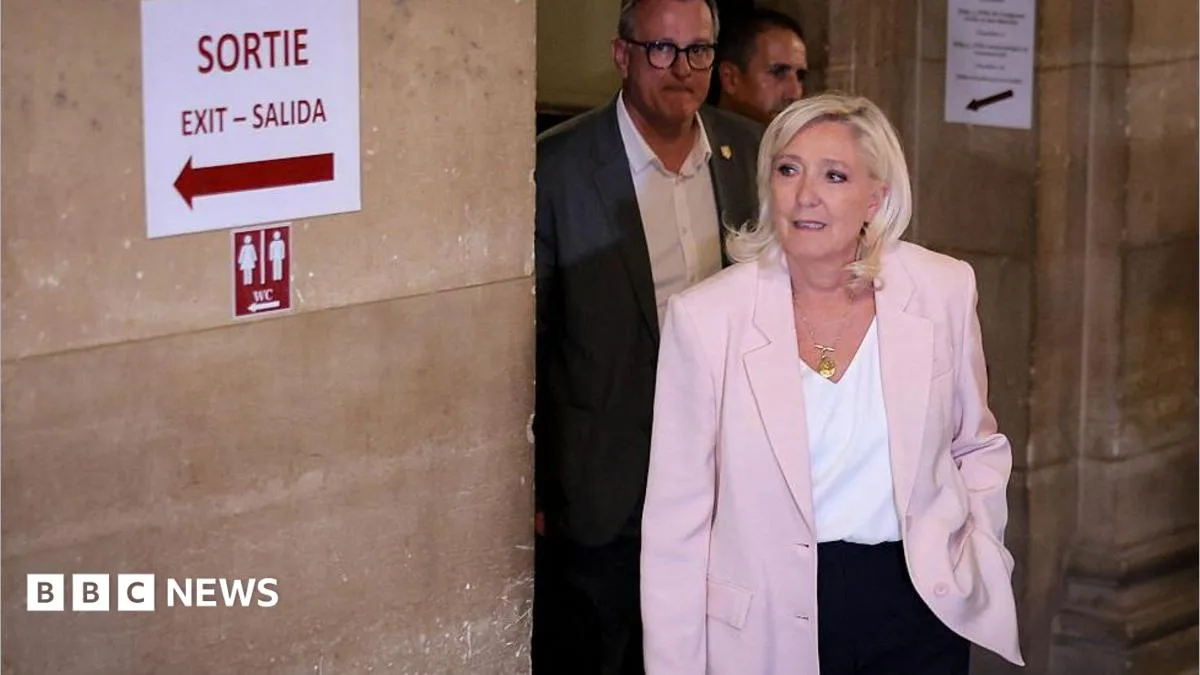
Marine Le Pen was found guilty by a Paris appeal court on July 7, 2026, of misusing around €4.4 million in EU funds through a fake jobs scheme between 2004 and 2016. The funds, intended for parliamentary assistants, were used to pay National Rally party staff instead [1, 2, 3, 4, 5, 6, 7, 8].
The court upheld Le Pen's conviction but shortened her ban on holding public office from five years to 45 months, with 30 months suspended. The ban was backdated to March 2025 [1, 6, 7, 8]. She was sentenced to three years in prison; two years were suspended and one year is to be served at home with an electronic ankle tag [1, 6, 7, 8].
Despite the conviction and legal penalties, the court ruled Le Pen is eligible to run in the 2027 French presidential election [1, 2, 6, 7]. Le Pen, 57, announced her candidacy and declared she will appeal the decision to France's highest court, the Court of Cassation [2, 9, 5].
However, Le Pen has raised doubts about whether she can effectively campaign while wearing an electronic ankle tag. "I can't campaign with a tag. I want to pursue all legal avenues to defend my innocence in this case," she said [2]. She added, "If I’m allowed to be a candidate but am effectively prevented from campaigning freely, then you understand that wouldn’t be possible" [7]. Her lawyer said they are "partially satisfied" and considering the decision closely before issuing a further statement [10].
National Rally party colleagues deny wrongdoing, calling the case a political witch-hunt [2, 4, 5, 8]. Thomas Ménagé, an RN lawmaker, said, "It would be a kind of personal grief if it happened... However unfair the verdict is, we'll accept the decision, we're not revolutionaries" [11].
Le Pen's protege Jordan Bardella, 30, party president, is seen as the likely alternative candidate if Le Pen withdraws [1, 2, 11, 12, 6, 7, 10]. The National Rally remains the largest single party in parliament and maintains strong polling support [3, 11, 12, 5, 8].
Le Pen has run for president three times before, twice losing runoffs to Emmanuel Macron, who is ineligible to run again in 2027 [1, 3, 5].
The legal saga began with the alleged misuse of EU parliamentary funds from 2004 to 2016 to pay party staff instead of assistants [1, 2, 4, 5, 8]. In March 2025, a lower court convicted Le Pen, imposing a five-year electoral ban and a four-year prison sentence with two years suspended [4, 12, 5, 8]. The appeal court ruling on July 7, 2026, reduced penalties but imposed house arrest with an electronic tag [1, 12, 5, 6, 7, 10, 8].
Le Pen's next step is to file her appeal with the Court of Cassation, which will review the case before the 2027 presidential campaign intensifies [2, 9, 5].