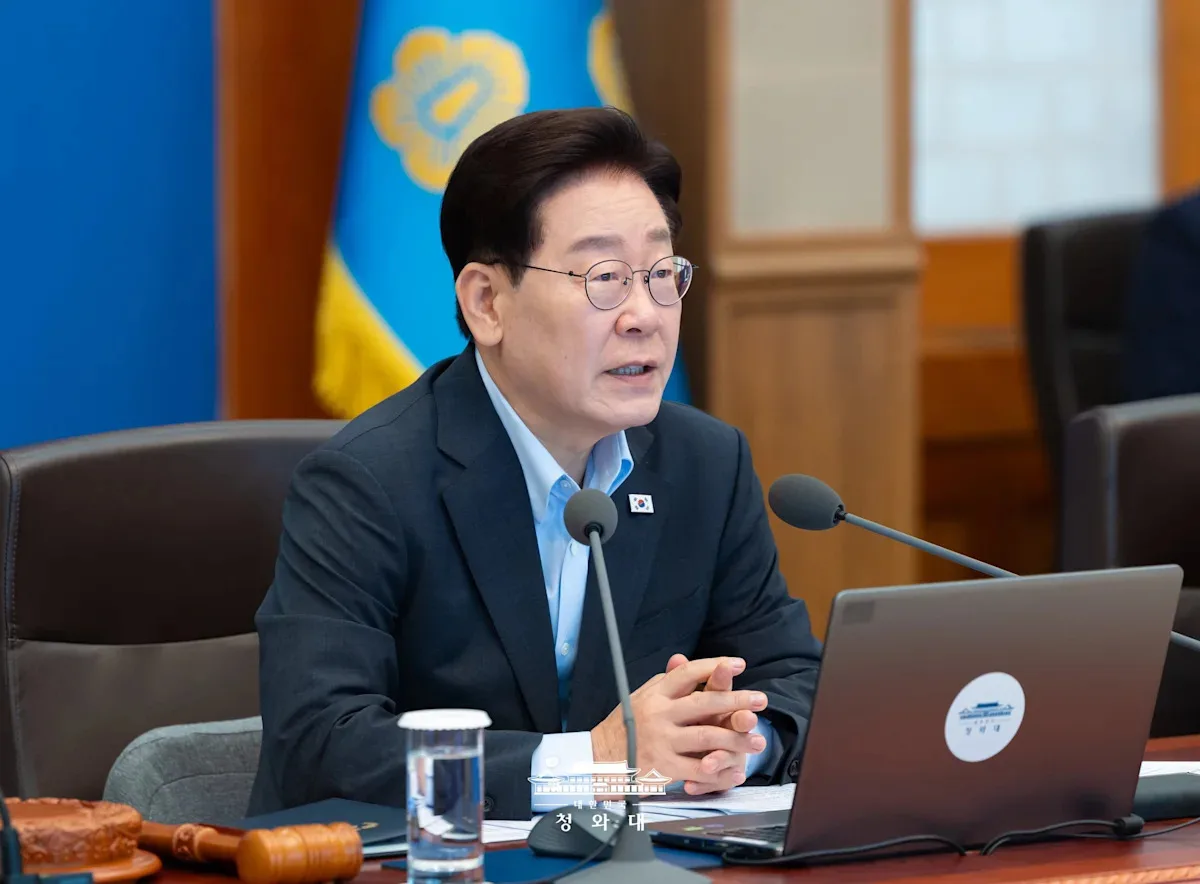
South Korean President Lee Jae Myung's approval rating dropped for the fourth consecutive week to 43.3%, the lowest level since he assumed office, according to a Realmeter poll conducted from August 3 to 7, 2026, surveying 2,514 adults with a ±2 percentage point margin of error and 95% confidence level [1, 2, 3, 4, 5, 6]. Lee's disapproval rating rose sharply to 53%, up 2.5 points from the previous week [1, 2, 3, 4, 5, 6].
The decline in Lee's support was most pronounced in major regions including Seoul, where it fell 5.9 points, and in Daegu and North Gyeongsang (-5.5 points) as well as Busan, Ulsan, and South Gyeongsang (-4.8 points) [2, 3]. Support also weakened significantly among older voters, with the 70-plus age group dropping 5.6 points and the 60s age group down 5.3 points [2, 3].
Realmeter attributed the fall to several factors. Controversies over real estate tax reforms targeting owners of high-priced and non-owner-occupied homes to stabilize the housing market triggered public concern over tax burdens. "The latest tax reform targets owners of high-priced homes and non-owner occupied properties to stabilize the housing market, but has raised concerns about increased tax burden," Realmeter said [1, 2, 3, 4, 5, 6]. In addition, amendments to the Criminal Procedure Act aim to reduce prosecutors' direct investigation powers, which also dented Lee's popularity [1, 4, 5, 6]. Lee's recent remarks on South Korea's three military coups involving Army Academy graduates, in which he noted no one had been held accountable, further stirred public unease [1, 4, 5, 6].
Economic uncertainty weighed on public sentiment, especially after a recent stock market crash that affected retail investors. A prolonged heatwave added to the negative mood, contributing to the approval rating decline, according to Realmeter [4, 5].
Despite the drop in presidential approval, Lee's Democratic Party continues to lead in party support with 44.6%, compared to 37.6% for the opposition People Power Party [2, 3].
Poll results were publicly released on August 10, showing Lee’s approval rating at the record low of 43.3% [1, 2, 3, 4, 5, 6]. Future polling will reveal whether Lee's rating stabilizes or continues to decline amid the ongoing controversies and economic challenges.