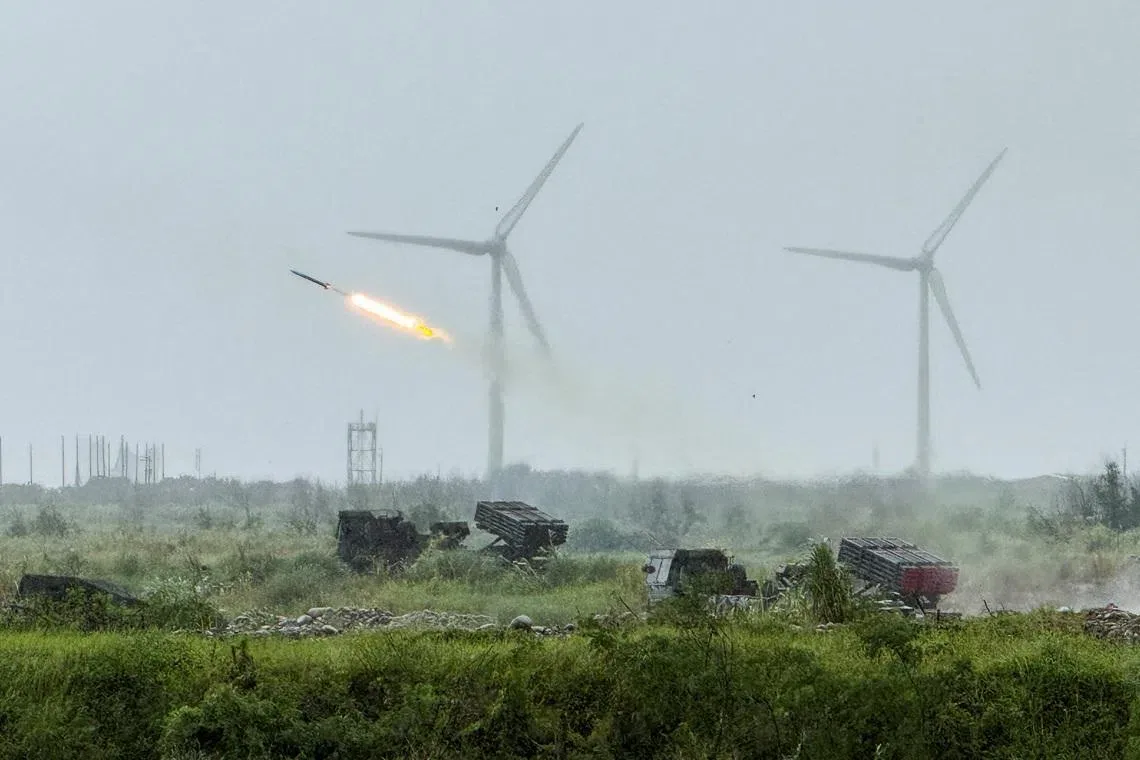
Taiwan’s military carried out a coastal drill on June 9, 2026, simulating the destruction of an invading Chinese amphibious force along a 20-kilometer stretch near Taichung in central Taiwan [1, 2]. The exercise involved firing rockets, artillery, anti-tank missiles, and mortars from eight positions simultaneously to stop a beach landing [1, 2].
The drill used domestically developed Thunderbolt-2000 rocket systems for the first live fire in seven years, emphasizing long-range suppression and mobility, alongside US-made Paladin howitzers and other weapons [1]. Rocket commander Liao Neng-cheng said, "Previously, we would usually enter the position one week in advance and complete firing preparations. This time, however, we arrived at the position only one day before and carried out the relevant position preparations," highlighting shorter preparation times [1].
Artillery commander Ong Yih-ming said the exercise differs from past drills by abandoning fixed, routine formations for more realistic operations: "We are no longer conducting heavy artillery firing in a fixed, routine formation as before" [1].
China views Taiwan as its territory and has not ruled out using force for reunification, with Chinese military forces operating daily around Taiwan’s waters and airspace [1, 2]. Taiwan rejects Beijing’s sovereignty claims and insists only its people can decide their future [1].
The coordinated drill from eight coastal positions was meant to better prepare Taiwan’s forces to repel amphibious invasions from China while increasing unpredictability and realism in training [1, 2].