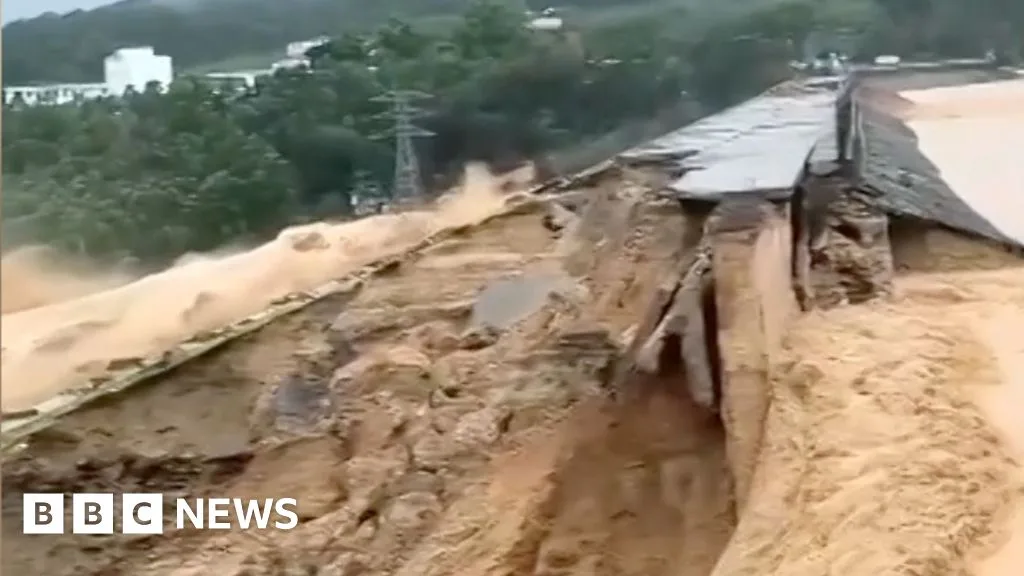
Typhoon Maysak made landfall in China’s southern island province of Hainan on July 3, before moving inland to Guangxi region where it caused severe flooding beginning July 6 [1, 2, 3]. A 50-meter breach formed in two sections of the Liulan Reservoir dam in Hengzhou, Guangxi, sending torrents downstream and overwhelming local waterways [1, 4]. At least 40 rivers and waterways flooded, damaging nearly 13,000 acres of agricultural land and causing multiple reservoirs to overflow or breach [4, 5].
The city of Nanning faced severe flooding due to dam bursts and heavy rain, prompting evacuation and raising its emergency flood response to the highest level. Wei Jiang, Nanning’s deputy mayor, said, "About 55,000 people were already affected by floods in Nanning, and waters were overflowing or breaking through barriers at at least three reservoirs" [6, 2, 3, 4]. In total, approximately 130,000 people were evacuated from Guangxi and surrounding areas due to the flooding and dam failures [4, 7, 5].
Officials reported at least 39 deaths attributed to Typhoon Maysak-related flooding in Guangxi as of July 9, including 26 deaths linked specifically to dam failures in Nanning [7, 5]. Minister of Water Resources Li Guoying warned that "the safety of reservoirs and embankments in the affected areas faces a severe test" due to heavy rainfall and prolonged flooding [4]. Chinese authorities deployed over 8,000 personnel and nearly 6,000 boats in rescue operations across Guangxi and surrounding regions [7]. Several animals escaped from Guigang Zoo due to flood damage, and authorities cautioned the public to avoid approaching them [7].
Meanwhile, severe tornadoes and windstorms struck central China’s Hubei province around July 6-7, killing at least 17 people, injuring hundreds, and damaging thousands of homes [8, 9, 10, 11]. Wind speeds reached up to 149 km/h, with trucks lifted and buildings demolished in one of the rare tornado events reported in the region. Wang Xiaoling, a Hubei meteorological bureau expert, said, "Tornadoes are extremely rare in Hubei... The last tornado in the province was in May 2021" [10]. One person remained missing in Hubei following the storms [9, 4, 11].
As Maysak’s effects devastated southern and central China, a second typhoon, Bavi, approached eastern China from July 6 to 9. It was forecast to bring strong winds and heavy rain to eastern provinces including Jiangsu and Shandong [2, 3, 8, 11]. President Xi Jinping instructed rescuers to "go all out" in emergency operations responding to the disasters [11].
The latest figures as of July 9 report 39 dead from floods in Guangxi and 17 dead from storms in Hubei. Rescue and recovery efforts continue in the affected regions amid ongoing flood warnings and preparations for Typhoon Bavi.