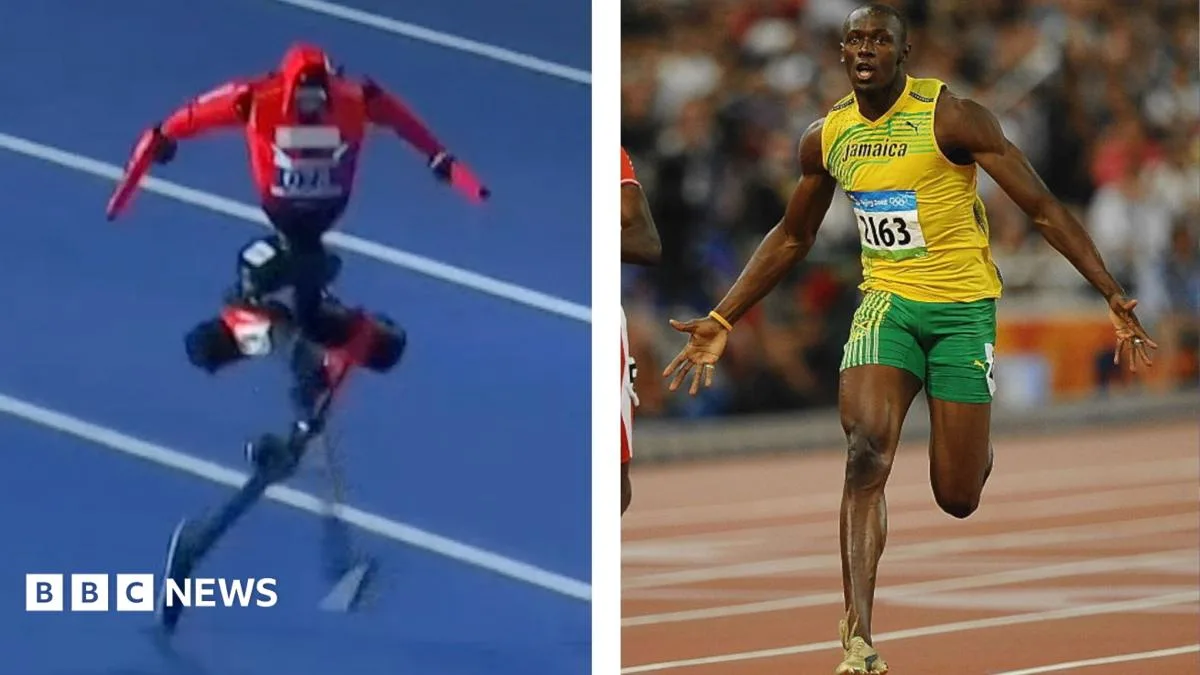
Chinese humanoid robots Lightning and Tiangong Ultra surpassed Usain Bolt’s 100m human sprint record and the men’s high jump record at the 2026 World Humanoid Robot Games held in Beijing.
In a preparatory test ahead of the event on August 22, Lightning, developed by smartphone maker Honor, ran 100 meters in 9.32 seconds, beating Bolt’s 9.58 second world record set in 2009 and reaching a peak speed of 14.5 meters per second [1, 2, 3, 4, 5]. However, during the official preliminary heats at the games, Tiangong Ultra ran 100 meters in 9.39 seconds, finishing first in the heat and beating Lightning’s time of 9.47 seconds, both surpassing Bolt’s record [6, 7, 8, 9, 10, 11]. The event marked the second edition of the World Humanoid Robot Games, with over 2,000 robots from 16 countries competing in 51 sports and tasks including sprinting, football, boxing, dancing, weightlifting, and tug-of-war [1, 6, 7, 10, 11].
In addition to sprinting, Tiangong Ultra broke the human men’s high jump record by clearing 2.88 meters at the games, exceeding Javier Sotomayor’s 2.45 meter record set in 1993 [7, 12, 11].
Earlier in April 2026, Lightning won the Beijing half-marathon (21 kilometers) in 50 minutes and 26 seconds, faster than the elite men’s human world record pace. At that time, Lightning measured 169 cm tall with 95 cm legs. Researchers later lengthened its legs by 10 cm to 105 cm to improve performance for the games [1, 6, 2, 3, 5].
Despite these record-breaking feats, robot athletes often collided with thick mats or walls during races and sometimes required stretcher assistance, unlike human runners [6, 12, 11].
Spectators expressed mixed reactions. Beijing resident Li Yanfeng said she was initially skeptical of AI but came to see the games as an “unstoppable” development [11]. Others like Hou Yali noted the races test speed but not intelligence or real-world tasks [10], while Yang Shangzheng called it “amazing” that robots can perform traditional human sports [11].
The World Humanoid Robot Games continue to showcase the rapid advancements in robotics and AI applied to physical competition. The next events and finals in the 51 disciplines will proceed through the competition week at the National Speed Skating Oval in Beijing [1, 6, 7].