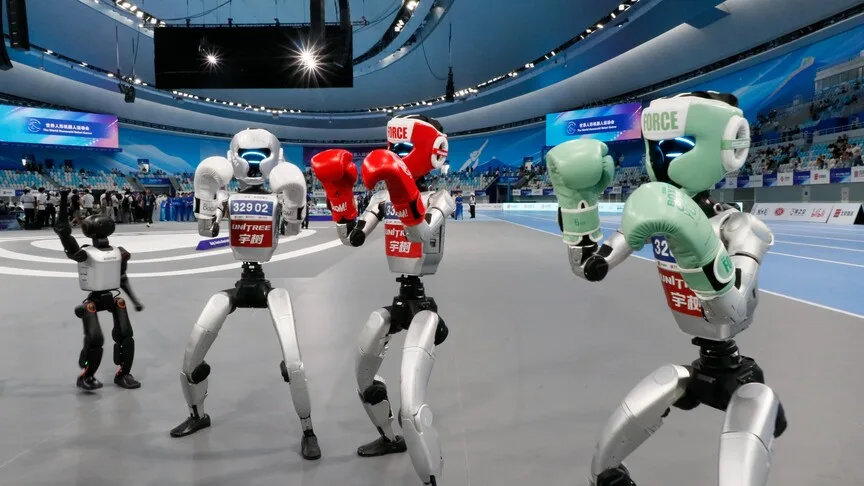
The second World Humanoid Robot Games opened on August 22, 2026, in Beijing at the National Speed Skating Oval, featuring 2,056 robots from 666 teams across 16 countries competing over five days [1, 2, 3, 4]. The event includes 51 events with 1,301 competitions spanning sports, artistic, and scenario-based challenges [2, 3].
China's teams dominated the medal tally, nearly sweeping all prizes and showcasing rapid growth in the country's humanoid robot industry aided by home advantage [1]. Chinese President Xi Jinping has prioritized robotics as a key advanced manufacturing sector since 2015, calling it the "crown jewel" of industrial strategy [1]. Government subsidies, tax incentives, cheaper components, and improved supply chains since 2021 have accelerated China’s robotics development [1].
A highlight was a Chinese humanoid robot developed by Unitree reaching a top speed of 12.66 meters per second, surpassing Usain Bolt's world record running pace [2]. In the 100-meter race, a robot clocked 9.39 seconds, breaking human records but struggling to decelerate properly after the finish line [4]. New challenges this year tested hand dexterity through tasks like screwing bolts, bottle opening, and bead picking [1].
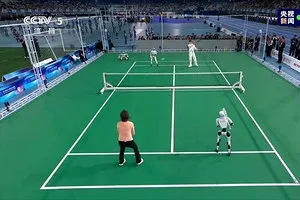
Competitions included diverse sports such as soccer, boxing, obstacle courses, gymnastics, badminton, table tennis, and tug of war [1, 3, 4]. Robots demonstrated abilities to dribble, pass, shoot, and recover from falls in football matches, though their movement still lagged behind humans [3, 4]. Olympic table tennis champion Ding Ning noted, "I could feel the robot's strong learning ability; when adjusting return height, it adapted accordingly" [3].
Student participant Zeng said robot sports "bring embodied intelligence into the public eye, showing technology development and helping integrate robots into daily life" [4]. Team leader Gao Xin emphasized improved remote operation and movement control with a goal of "human-machine unity" [4].
The games have evolved from low-cost college competitions in 1999-2014 to a global platform showcasing robotics innovation and benchmarking performance under realistic conditions [1, 2]. The event runs through August 26, concluding the five-day international competition in Beijing [1, 4].