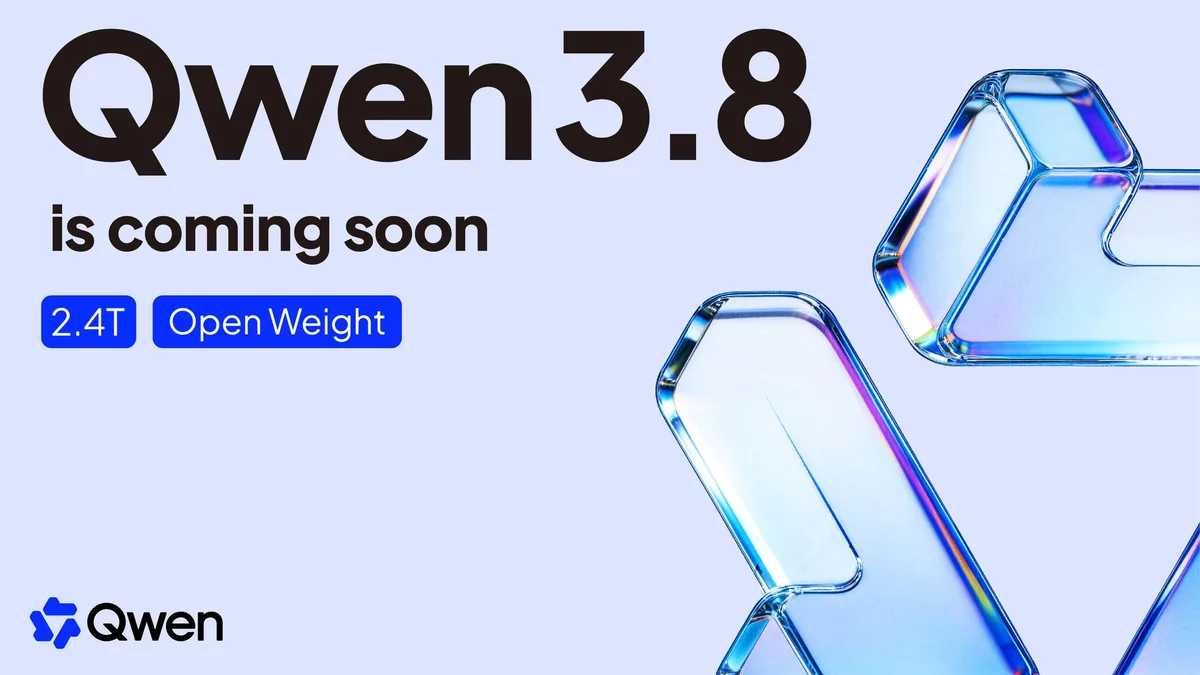
Alibaba released the preview version of its flagship AI model Qwen3.8-Max on July 19, 2026, making it accessible via its coding platforms Qoder and QoderWork [1, 2, 3, 4]. With 2.4 trillion parameters, Qwen3.8-Max is among the most powerful AI language models available today [1, 2, 5, 4]. Alibaba stated, "Qwen3.8 Max has 2.4 trillion parameters and is one of the most powerful models available today, second only to Fable 5," highlighting its position just behind Anthropic's top-tier AI [5]. The company added on social media that the model "is continuously evolving" and will soon be released as open-weight, allowing developers free access to download and modify it [2, 3, 6].
Qwen3.8-Max shows notable improvements over Alibaba's previous generation, Qwen3.7-Max, particularly in code engineering and professional office tasks [4]. This advancement aims to enhance productivity in technical and professional domains.
At the same time, Chinese AI startup Moonshot AI launched its open-weight Kimi K3 model with 2.8 trillion parameters on July 17, 2026, surpassing Qwen3.8-Max in size and drawing strong global demand [1, 6, 4, 7]. Kimi K3 holds one of the largest parameter counts among open models worldwide and has outperformed some U.S. AI models on benchmark tests [6, 4, 7]. Although Kimi K3 is larger, Alibaba maintains that in terms of overall performance, Qwen3.8-Max remains second to Anthropic's Fable 5 without explicitly claiming superiority over Kimi K3 [1, 2, 5, 6].
Alongside Qwen3.8-Max, Alibaba recently introduced Qwen-Image-3.0, the third-generation foundation model for image generation. It supports up to 4,500 token inputs and 12 languages, broadening the scope of multimodal AI for diverse applications [8, 7].
Alibaba's formal preview launch on July 19 followed Moonshot's release of Kimi K3 two days earlier, while Qwen-Image-3.0 was announced on July 21, marking a rapid series of AI technology rollouts by the company [3, 6, 4, 7].
Alibaba plans to release Qwen3.8-Max as an open-weight model soon, expanding access for developers and researchers to build and collaborate using its large-scale AI platform [1, 2, 3, 6].