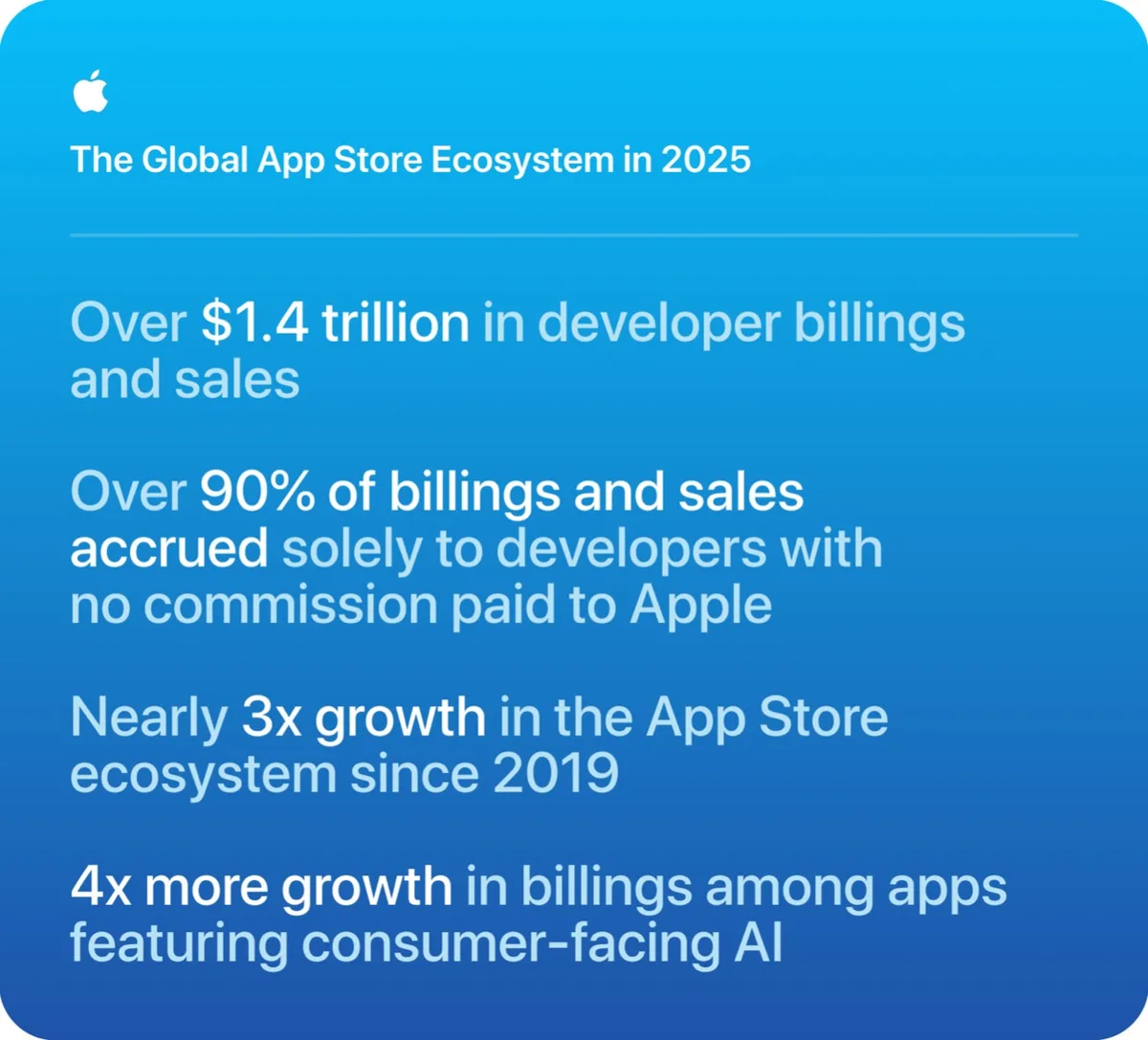
Apple's App Store ecosystem facilitated more than $1.4 trillion in developer billings and sales globally in 2025, setting a record high for the platform [1, 2, 3, 4, 5, 6, 7, 8]. Over 90% of these transactions involved no commission fees paid to Apple, reflecting a large volume of sales in physical goods and services [1, 4, 7, 8].
The total includes roughly $1.1 trillion from sales of physical goods and services such as grocery, food delivery, travel, and retail, while digital goods and services contributed about $149 billion. In-app advertising generated an additional $151 billion last year [1, 4, 7, 8].
The App Store had over 850 million average weekly users across 175 countries and regions, demonstrating its wide reach and engagement [1, 2, 4, 7, 8]. Since 2019, the App Store ecosystem nearly tripled in size worldwide, with billings and sales more than doubling in China and more than tripling in the US and Europe over the past six years [1, 2, 4, 7, 8].
Artificial intelligence continued to drive growth within the top apps. In 2025, over 40 of the top 100 apps featured consumer-facing AI capabilities, and these AI apps’ revenues grew roughly four times faster than others in the top 100 [1, 2, 4, 5, 6, 7, 8]. AI is increasingly integrated into health and fitness, photo and video editing, and productivity applications [2, 5, 6, 7, 8].
Apple supports developers globally through Developer Centers located in the US, China, India, Singapore, and soon Berlin, alongside worldwide developer academies and programs aimed at nurturing innovation [7, 8]. Apple CEO Tim Cook said, “開發者是 App Store 活力的來源,而今年達成的這項重要里程碑,正是他們無限創意的最佳展現。我們始終致力於提供開發者打造未來所需的工具、技術和值得信賴的平台。開發者攜手打造出各式 app,豐富全球使用者的生活。” He added, “Apple將持續提供開發者打造未來所需的工具、技術與可信賴平台,協助開發者推出更多能豐富使用者生活的app.” [7, 8]
Apple is set to highlight new AI-related features and tools at its Worldwide Developers Conference (WWDC), starting June 9, 2026 [1, 6, 7, 8].