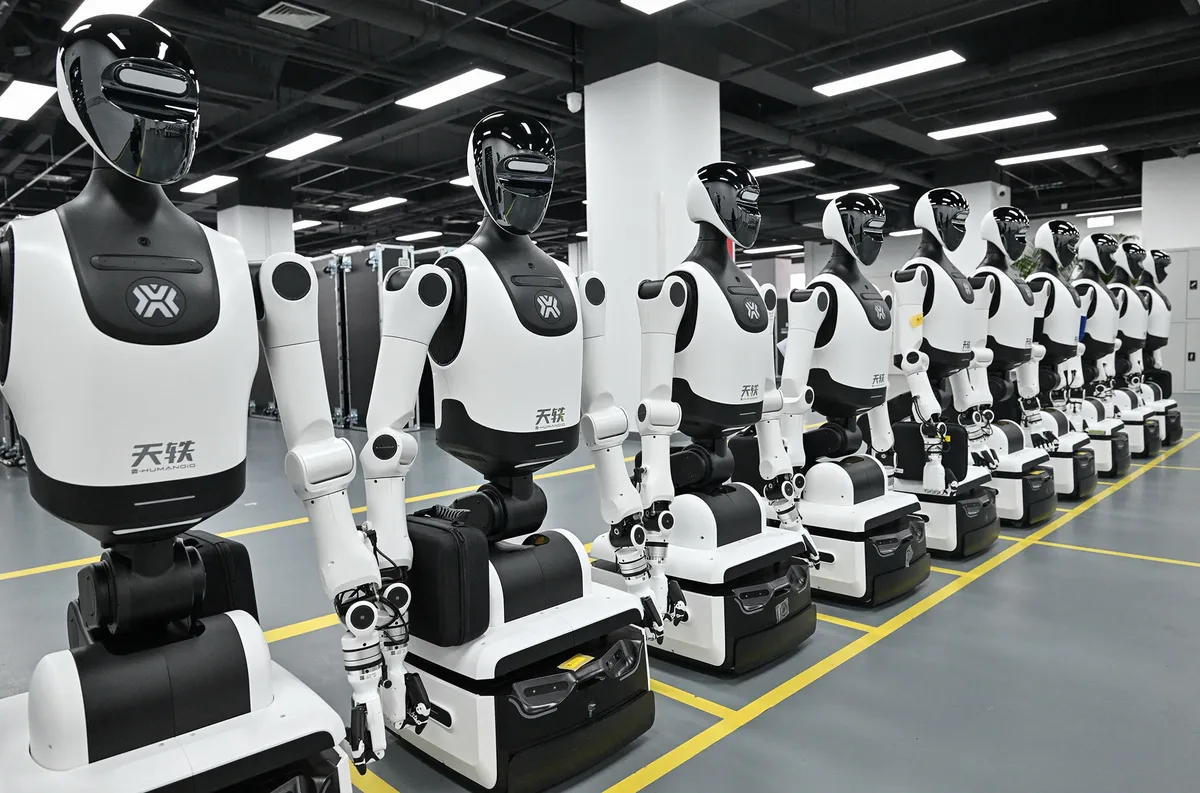
China's labor force is projected to shrink by 37 million people within the next decade, posing major challenges for its economy, according to Barclays research [1, 2]. The UK's investment bank estimates that humanoid robots deployed in China by 2035 could offset as much as 60% of this labor decline, partially filling critical workforce gaps [1, 2].
With an assumed labor participation rate of 65%, Barclays projects the cumulative installation of humanoid robots in China will reach around 24 million units by 2035, accounting for about 4% of the workforce [1, 2]. This forecast is based on optimistic assumptions about robot utilization, depreciation rates, and the domestic market’s ability to absorb such advanced technology, the analysts said [2].
China’s manufacturing sector comprises about a quarter of its economy, underlining the importance of addressing labor shortages in that area [1, 2]. The country’s population, currently around 1.4 billion, faces demographic pressures after birth rates hit a record low last year — the lowest since 1949 — and the working-age population continues to shrink [2]. The ratio of working-age people to those over 65 stands at about 4 to 1 today but is expected to halve over the next 20 years, intensifying labor supply constraints [2].
Barclays fixed income thematic research head Zornitsa Todorova said, "The expected productivity gains in the coming years can only offset a small part of the anticipated labor decline and are unlikely to fully counter China's demographic headwinds" [2]. The analysts also cautioned that their 60% offset estimate represents an upper bound scenario rather than a guaranteed outcome [2].
They emphasized that productivity improvements alone are unlikely to fully offset the shrinking labor force, reinforcing the economic rationale for accelerating automation and robotics adoption [2].
By 2035, the intersection of demographic trends and technological deployment will be critical. Barclays predicts that humanoid robots could play a key role in maintaining China's labor capacity in the face of demographic shifts [1, 2].