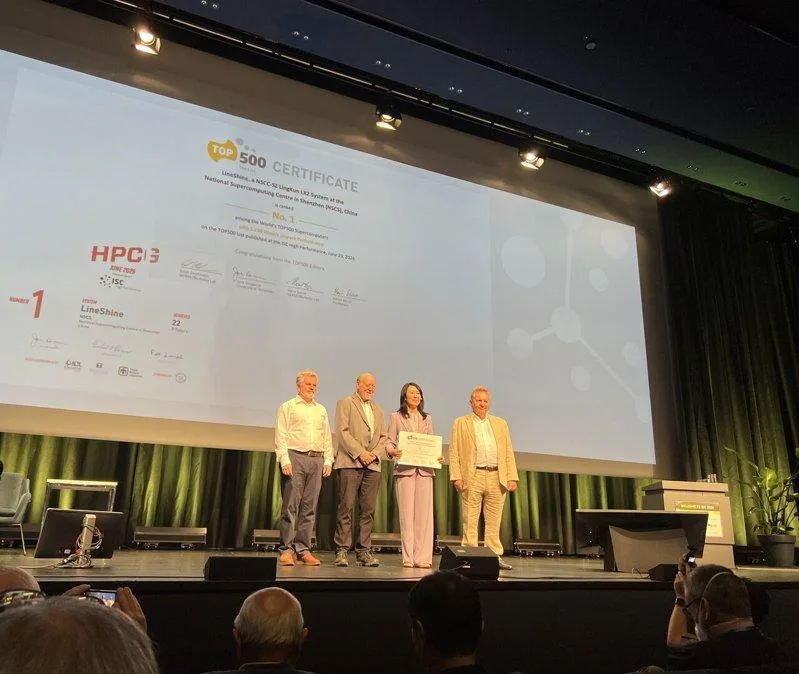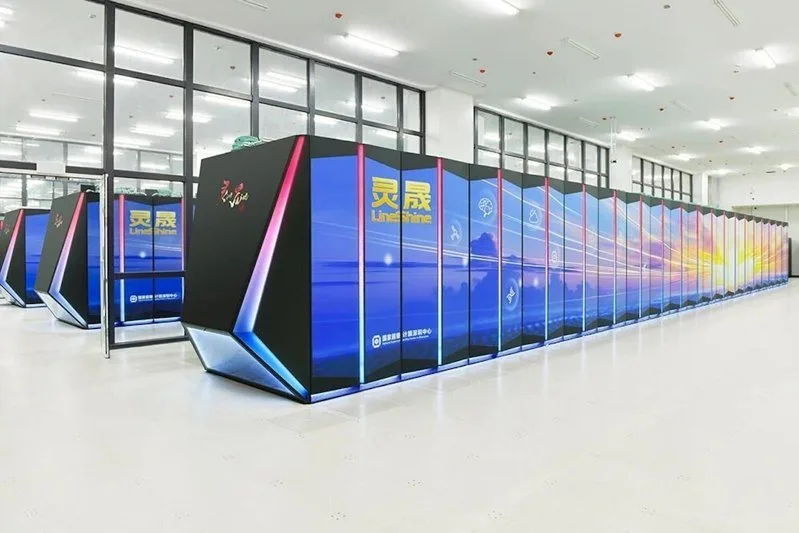
China's domestically developed LineShine supercomputer topped the global TOP500 supercomputing list released on June 23, 2026, achieving sustained double-precision floating point performance of 2.19 exaflops (2.19EFlops) [1, 2, 3]. It is the first Chinese supercomputer to rank number one since 2017 [1, 4].
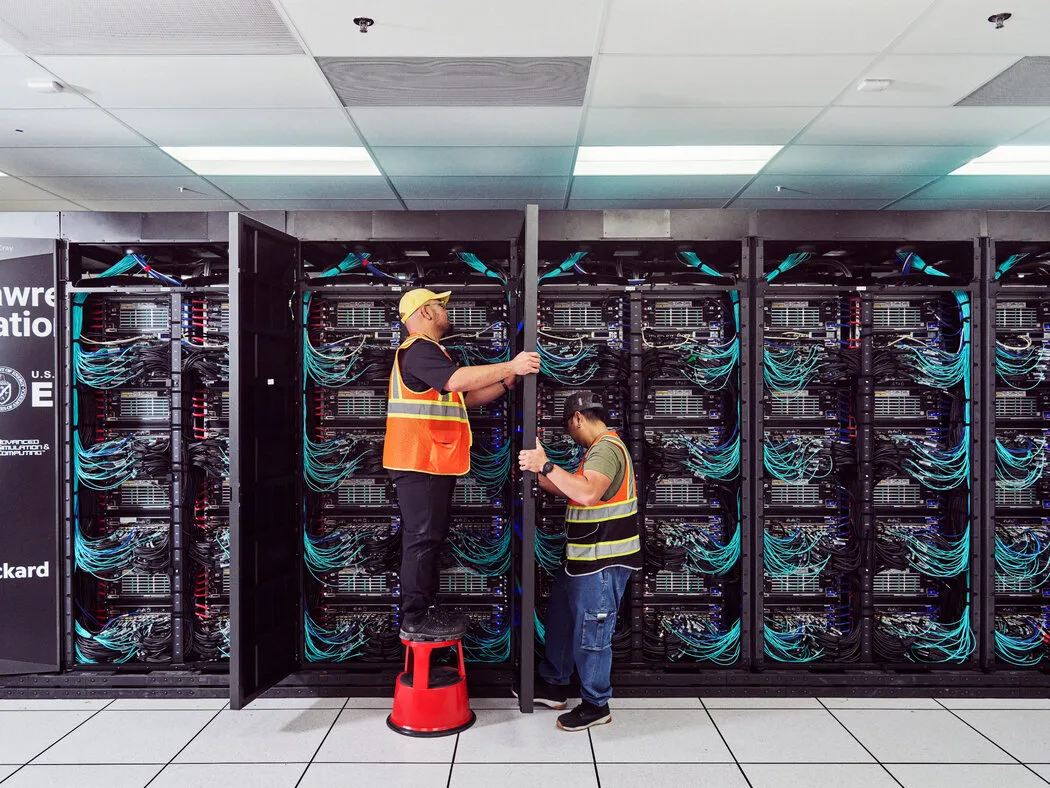
Located at the National Supercomputing Center in Shenzhen, LineShine outperformed the previous leader, the US Lawrence Livermore National Laboratory's El Capitan, by more than 20% in the rankings [1, 4]. El Capitan had held the top position since November 2024 [1].
The system's architecture relies exclusively on standard CPUs without GPUs, unlike most leading supercomputers which use graphics processing units for acceleration [1, 4]. LineShine integrates GPU-style task acceleration and dedicated circuits within its chip design, running nearly 14 million computing cores housed in 90 hardware cabinets [1, 4]. It employs China's self-developed LX2 processors with high bandwidth memory (HBM) integration, boosting memory bandwidth about 10 times over traditional CPUs [5, 6].
The supercomputer consumes approximately 42.2 megawatts of power [3]. Chinese designers say it supports scientific research in atmospheric and ocean simulation, materials science, drug development, brain science, AI, and large language model inference [5]. Lu Yutong, the chief designer, said the breakthrough is not just topping rankings but building a self-controlled advanced computing ecosystem [5].
US export restrictions on advanced GPUs and semiconductor manufacturing equipment pushed China to develop CPU-based architectures like LineShine [1, 6]. Jack Dongarra of University of Tennessee called LineShine "a very impressive system" for surpassing GPU reliance and said its design "may find a better path to integrate AI and traditional scientific tasks" [1, 4].
Experts caution the TOP500 list mainly measures traditional high-performance computing and does not fully reflect AI-specific capabilities [1, 6, 7]. Massive AI supercomputers built by US cloud providers such as Microsoft, Amazon, Google, and Elon Musk’s xAI are excluded from TOP500 rankings [1, 7]. Jimmy Goodrich from UC Global Conflict and Cooperation noted LineShine's achievements but said these cannot match the scale of large AI supercomputers in the US. He urged stricter US export controls on CPUs aimed at China, calling it a regulatory loophole [1].
LineShine’s debut on the TOP500 list was announced at the ISC 2026 supercomputing conference [2, 5]. Future developments in supercomputing performance and AI integration remain to be seen.