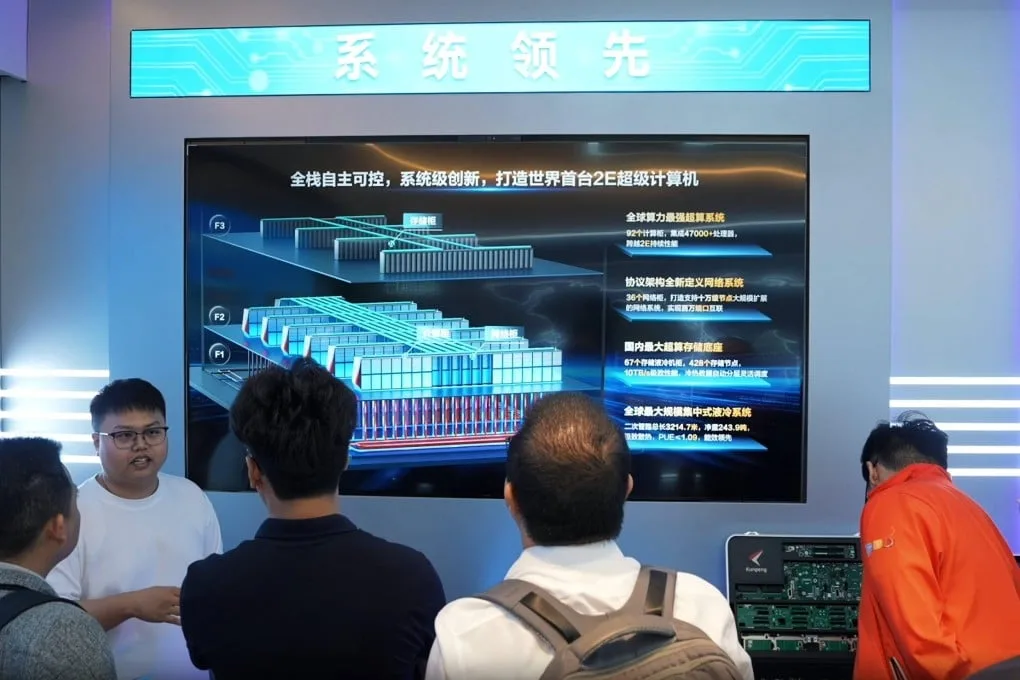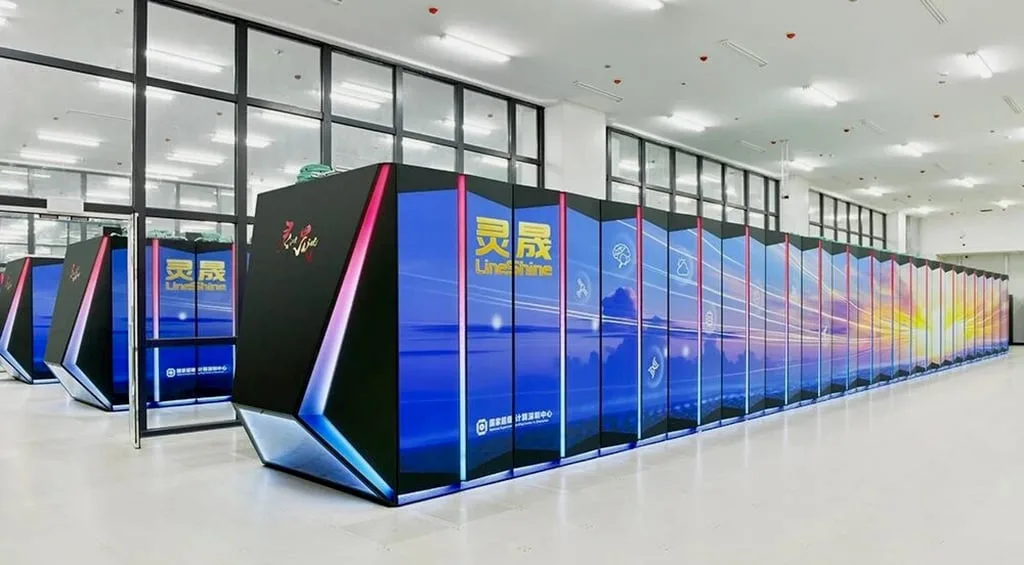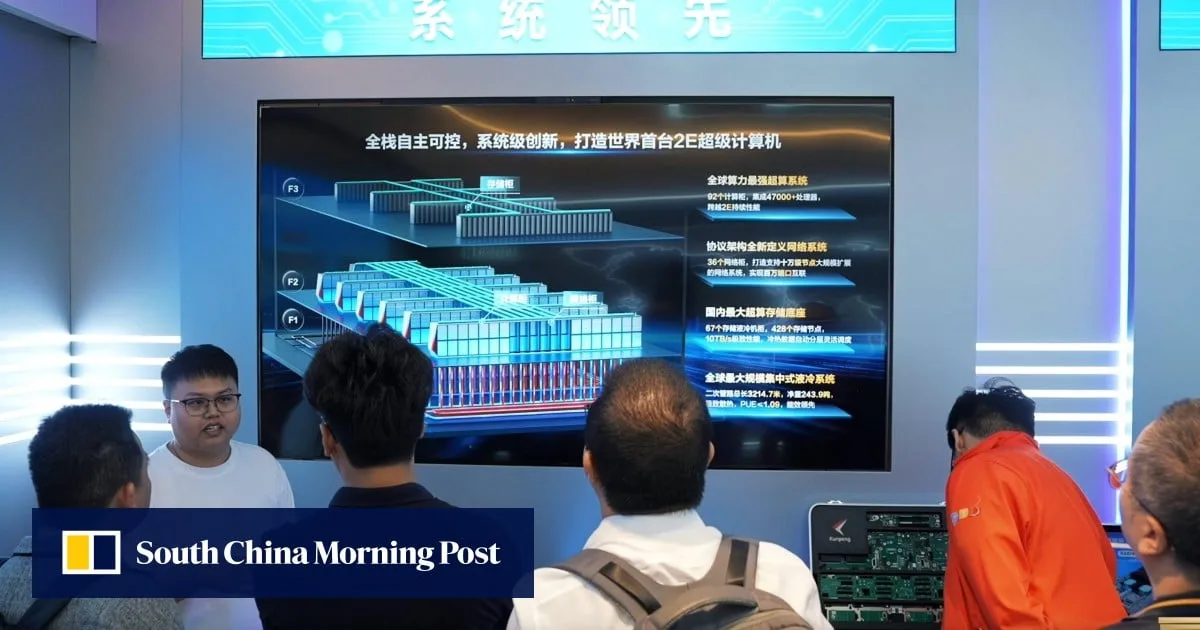
China’s LineShine supercomputer, installed at the National Supercomputing Centre in Shenzhen, claimed the top spot in the June 2026 TOP500 ranking of the world’s fastest supercomputers [1, 2, 3]. It achieved a Linpack benchmark of about 2.198 exaflops, exceeding the previous leader, the US El Capitan system, which performed at 1.809 exaflops [2, 3, 4]. Jack Dongarra, a prominent expert on supercomputing benchmarks, said, "This is the first time a computer with only CPUs has reached exascale," emphasizing that LineShine surpassed the two exaflops barrier using general-purpose central processing units without relying on graphics processing units (GPUs) [2].
LineShine relies on domestically produced Chinese chips, reflecting China’s drive for technological independence amid tighter US export controls on advanced semiconductor manufacturing tools [1, 5, 6]. The system consumed about 42.2 megawatts of power and demonstrated an efficiency of approximately 52.07 gigaflops per watt during its benchmark run [3, 7]. The supercomputer’s advancement marked China’s re-entry to the TOP500 list after a temporary pause since 2023 due to export restrictions [1, 6].
El Capitan, housed at Lawrence Livermore National Laboratory in California, is used primarily for US government nuclear weapons research and held the fastest supercomputer title since November 2024 until June 2026 [1, 5, 4]. Other exascale systems in the top five are Frontier (third), Aurora (fourth), and Jupiter (fifth), rounding out the five known computers achieving over one exaflop performance globally [3, 4, 7].
Experts note that while LineShine leads traditional Linpack benchmarks suited for scientific simulations, it ranks only fourth on AI-specific workload tests, trailing systems optimized for artificial intelligence tasks [1, 5, 8]. Analysts such as Jimmy Goodrich pointed out that many powerful AI-focused supercomputers operated by cloud providers like Microsoft, Amazon, and Google do not participate in the TOP500 ranking [5, 8]. Goodrich added, "If the hyperscalers submitted their systems, this 'world’s fastest' would not crack the top five," while also noting skepticism that China wants to downplay the effects of export controls [1].
Addison Snell commented, "I’m not surprised it ranked first. What surprised me is that they submitted this system and want recognition for it," highlighting the strategic significance of China’s participation [1]. Jack Dongarra further said, "China can adapt to develop its own version of technology as good as – or maybe even better than – existing technology, despite US export controls," framing LineShine’s rank as a milestone in chip design and self-sufficiency [2].
The TOP500 list has been published biannually since 1993, ranking supercomputers by their LINPACK benchmark performance, a long-standing measure of scientific simulation capability [4, 6]. The June 2026 release saw a total of five exascale supercomputers worldwide, spanning Asia, North America, and Europe [3, 7].
China’s LineShine will maintain its status as the world’s fastest supercomputer until the next TOP500 update, scheduled for November 2026.