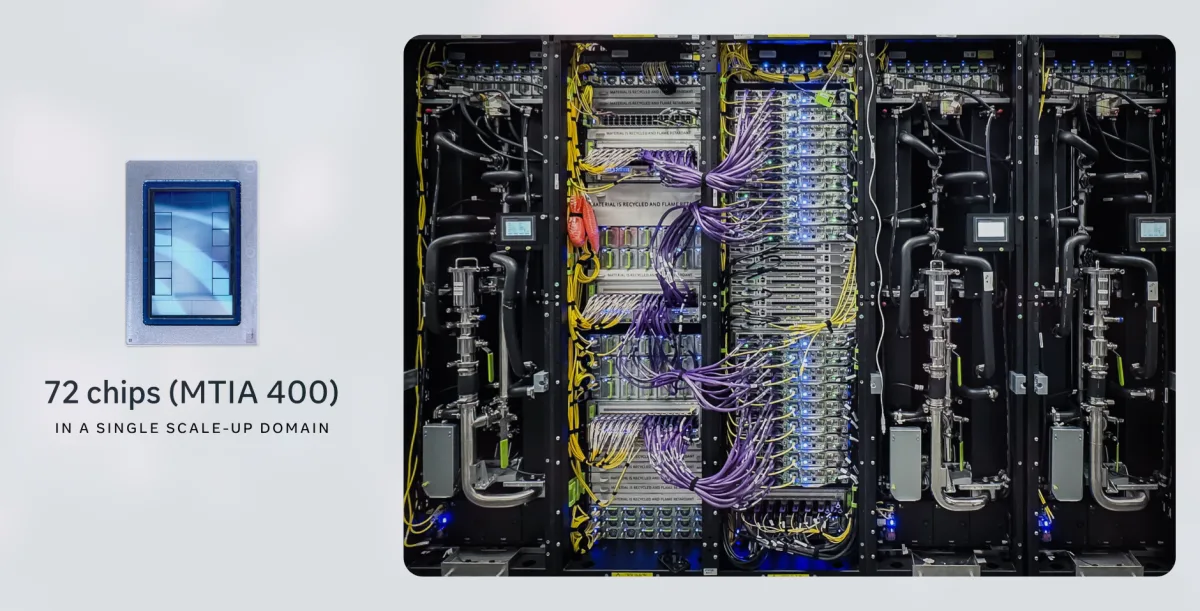
Meta will start producing its internally designed AI chip, code-named Iris, in September 2026, with manufacturing handled by Taiwan Semiconductor Manufacturing Company (TSMC) [1, 2, 3, 4, 5, 6, 7, 8]. The chip is part of Meta’s fourth-generation Meta Training and Inference Accelerators (MTIA) project aimed at data center AI workloads [1, 3, 4, 6, 7, 8]. Meta completed about six weeks of testing on Iris with no major issues found, marking a key milestone for the project [1, 3, 4, 6, 7, 8].
Unlike fully replacing GPUs from Nvidia and AMD, Iris is intended to augment existing processing power to handle AI tasks like content ranking, recommendation, and generative AI across Meta’s platforms including Facebook, Instagram, and WhatsApp [1, 3, 4, 9, 6, 8]. An internal memo cited by Reuters noted that adopting the latest GPUs across Meta's large infrastructure has been a "heavy lift," adding time and cost, which partly motivated Meta’s push for custom chips [1]. Meta is working closely with Broadcom on Iris’s chip design while relying on TSMC for production [1, 3, 10, 4, 9, 5, 11, 6, 7, 8].
Meta plans to launch a new AI chip roughly every six months through 2027, faster than the typical annual cadence in the industry. A March announcement said each MTIA generation builds on the prior using modular chiplets and faster deployment cycles [1, 3, 10, 4, 6, 7, 8]. Meta aims to double AI computing capacity from 7 gigawatts planned for 2026 to 14 gigawatts by 2027, substantially expanding its AI infrastructure power [1, 2, 3, 4, 11, 6, 7, 8].
The company expects to spend up to $145 billion on AI infrastructure in 2026 alone, a large share of big tech’s total AI investment [1, 4, 6, 8]. To support data center growth, Meta secured multi-year supply agreements with Samsung for memory chips, Sandisk for flash storage, and Sumitomo Electric for fiber-optic equipment [1, 2, 4, 5, 6, 8]. Industry-wide shortages of memory chips and AI components continue to drive up costs, a phenomenon known as "chipflation" [4, 5, 6, 8].
Mike Gualtieri, VP and analyst at Forrester, said reliance on other companies for AI chips limits leadership. He noted hyperscalers like Meta and SpaceX design their own chips to stay competitive on model costs [4].
Meta’s next major step is the planned volume production start of the Iris AI chip in September 2026 by TSMC [1, 2, 3, 4, 5, 6, 7, 8].