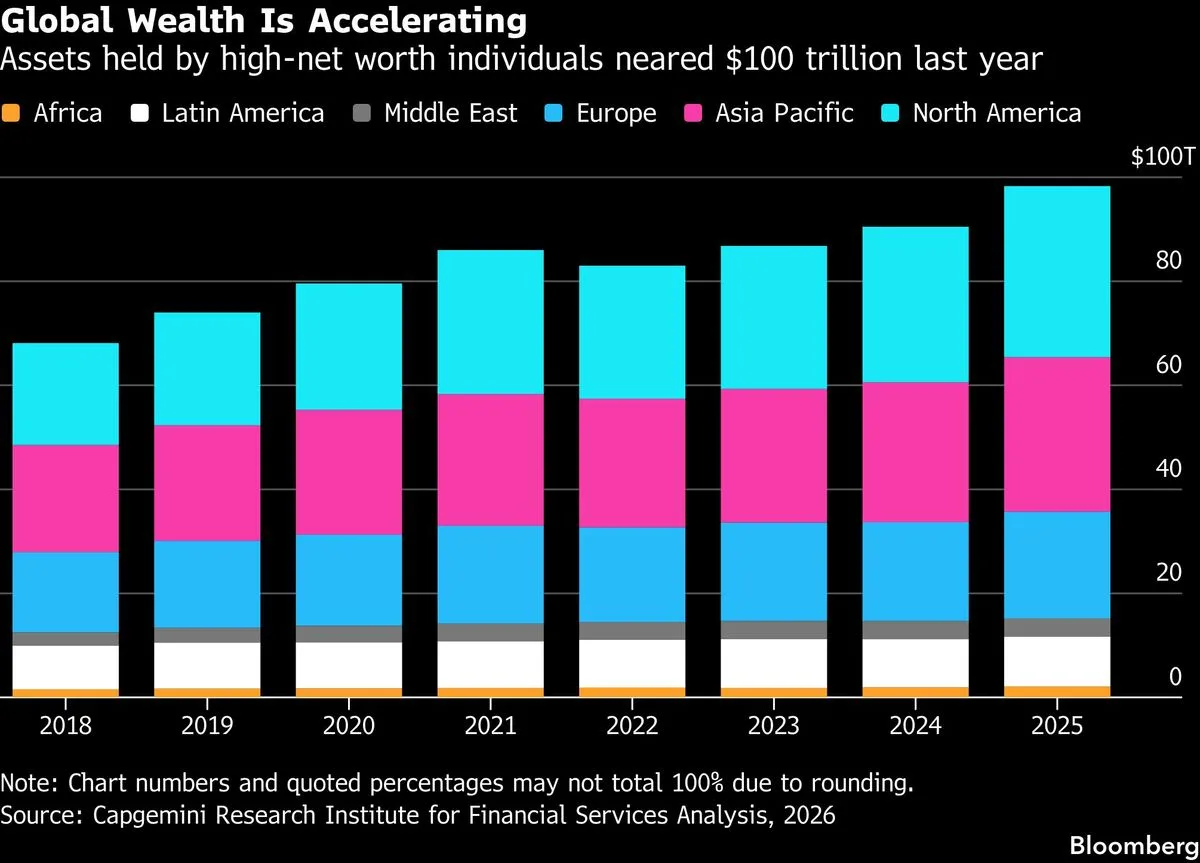
The number of global millionaires increased by almost 2 million in 2025, reaching a total of 25.3 million, according to recent reports [1, 2]. Total wealth held by high-net-worth individuals climbed to approximately US$98.3 trillion in the same year [1, 2].
Ultra-high-net-worth individuals, defined as those with at least US$30 million in assets, grew their ranks to 250,000 while rapidly increasing their wealth [1, 2]. Although they represent just 1% of all millionaires, ultra-rich individuals hold 35% of the total millionaire wealth. "They have access to investments and opportunities that aren't afforded even to the millionaires next door, whether it be pre-IPO investments or private markets," said Gareth Wilson of Capgemini [2].
The United States led wealth growth with roughly 730,000 new millionaires added in 2025, pushing the US total to about 8.7 million millionaires [1, 2]. In the Asia-Pacific region, wealth grew fastest, posting 10.5% gains. Japan, China, Korea, and Taiwan were key contributors to the region’s 9.4% rise in millionaire population, supported in part by strong demand in the semiconductor sector [1, 2]. The Asia-Pacific region's rapid wealth increase contrasts with the Middle East, where the number of high-net-worth individuals contracted by 1.4% amid falling oil prices and ongoing regional conflicts [1].
Stock market rallies driven by optimism surrounding artificial intelligence were a primary driver behind the surge in wealth globally, according to analysts [1]. Jared Murphy of BlackRock described the total wealth pool as "an enormous and overwhelming sum of money, and frankly, a huge opportunity" [1].
The next significant update on high-net-worth individuals is expected with 2026's global wealth reports, due early next year.