The National Stock Exchange of India (NSE) is seeking a valuation of up to 5.26 trillion rupees (approximately US$55 billion) for its upcoming initial public offering (IPO), aiming to set a record in India’s capital markets [1, 2, 3].
NSE plans to market about 148.9 million shares, roughly 6% of the company, through secondary sales by existing shareholders. The shares are priced in a range of 2,000 to 2,100 rupees each [1, 2, 3]. This transaction could raise around 315 billion rupees, surpassing the 278.7 billion rupees raised by Hyundai Motor India’s 2024 IPO, the previous record for Indian IPO fundraising [1, 2].
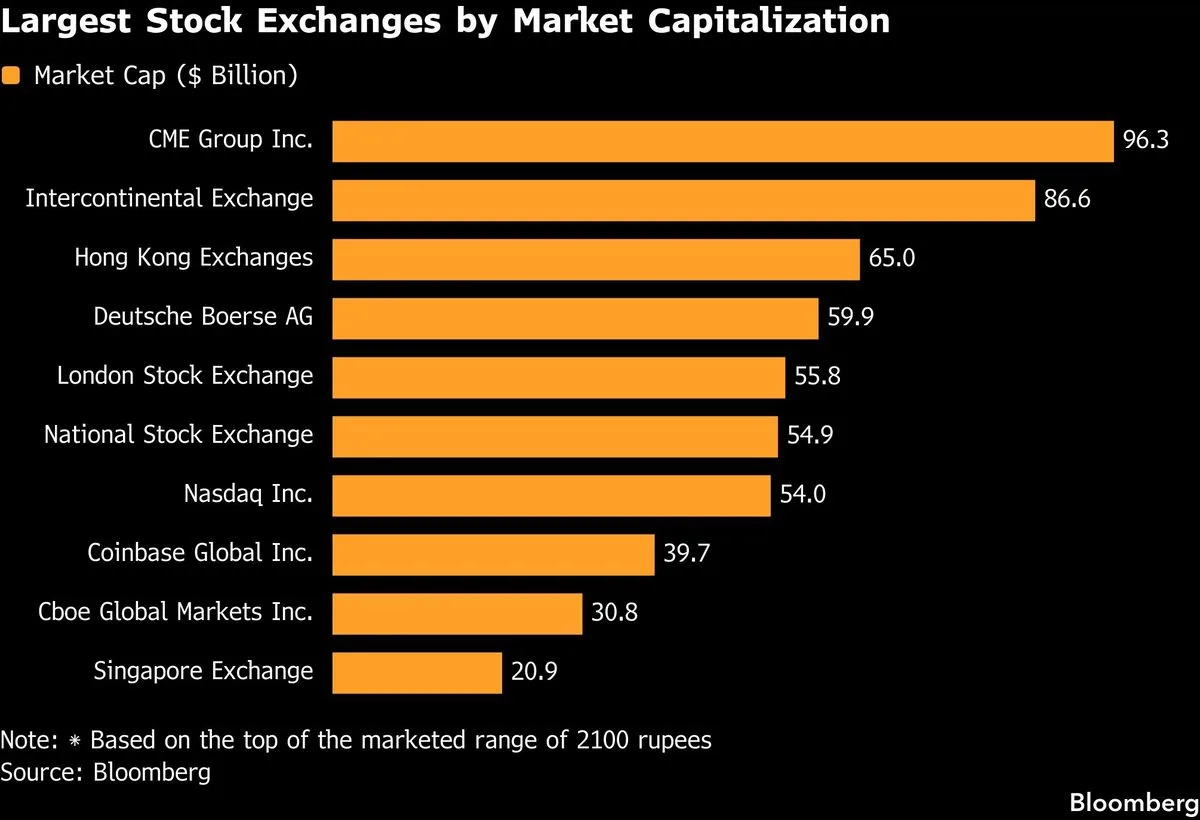
The proceeds from the IPO will go primarily to existing shareholders, not the NSE itself [3]. NSE is India’s largest stock exchange and one of the world’s largest derivatives exchanges by trading volume [1, 3]. At the target valuation, it would rank sixth globally among stock exchange operators, behind London Stock Exchange Group Plc and ahead of Nasdaq Inc. [1, 2].
The IPO roadshow has visited major financial centers worldwide, including Boston, New York, San Francisco, London, Singapore, and Hong Kong. Top global investors such as BlackRock, Capital Group, GQG Partners, Janus Henderson, and Allspring Global Investments have participated in meetings [1, 2].
However, regulatory approval from the Securities and Exchange Board of India (SEBI) for the draft prospectus has been delayed by about three weeks due to updates in the list of selling shareholders, which now includes SBI Capital Markets Ltd. [1, 2]. NSE first filed the draft prospectus in June 2026 [1, 2].
The IPO is now expected to launch in the second half of September 2026 [1, 2, 3]. This timing follows the completion of the global roadshow and pending SEBI clearance.