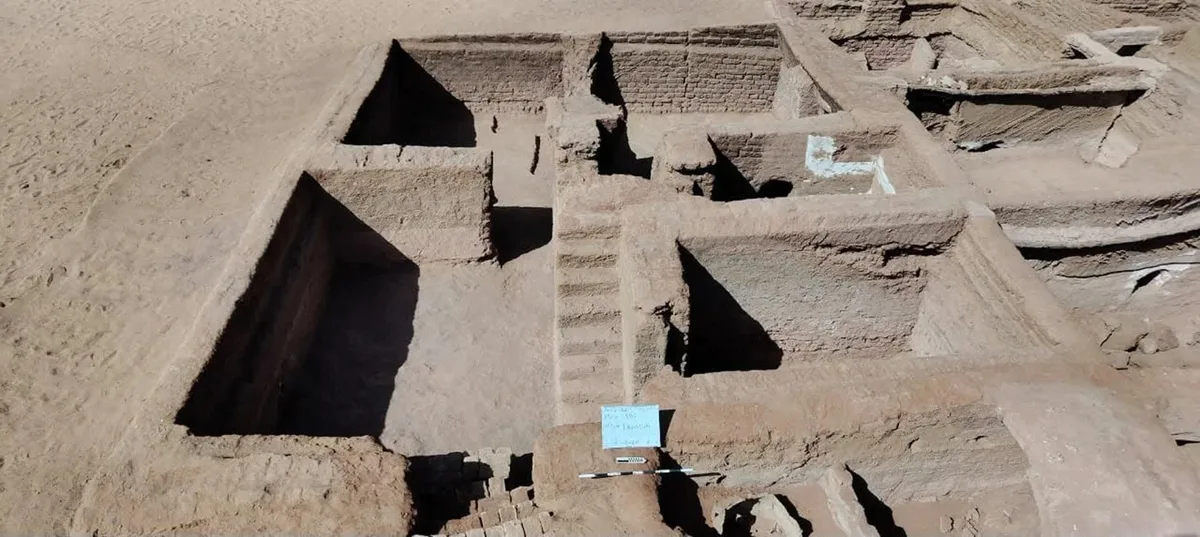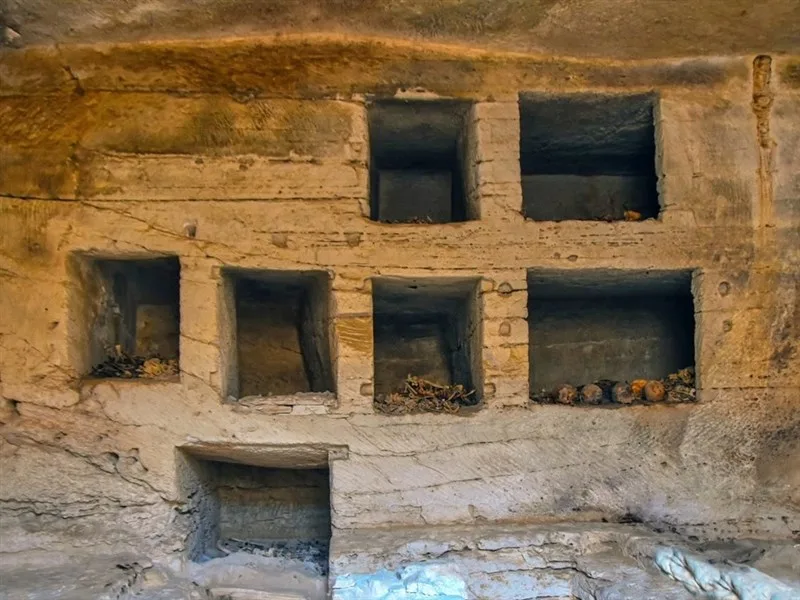
Egyptian archaeologists have uncovered 18 Greco-Roman tombs nearly 2,000 years old along the Mediterranean coast at Marina El-Alamein, around 100 kilometers west of Alexandria [1, 2]. The tombs were found with original stone blocking slabs intact. Among the finds was a granite sarcophagus measuring about 2.5 meters long, still sealed with its lid, indicating the graves remained undisturbed for two millennia [1, 2, 3].
Inside the tombs, archaeologists discovered human remains accompanied by pottery, amphorae, and a collection of 24 gold funerary objects placed near several skeletons, shedding light on burial customs and beliefs about the afterlife in the Greco-Roman period [1, 2, 3, 4]. The Marina El-Alamein site corresponds to the ancient city of Leukaspis, a Mediterranean port city that thrived from the Hellenistic into Byzantine times [1, 2]. Since the archaeological site was first discovered during construction in 1986, a total of 44 tombs have been documented at Marina El-Alamein [1, 2, 3].
Separately, archaeologists revealed a Byzantine-era settlement at Ain al-Sabil in Egypt’s western desert, within the New Valley Governorate [2, 3]. The city dates to around the 4th century AD and features a planned street grid, public squares, residential buildings, and a centrally located basilica-style church. Two watchtower ruins on the outskirts suggest defensive measures were in place; archaeological team leader Masoud said, "The basilica from the mid-4th century overlooks the main streets, and two watchtower ruins guarded the city outskirts" [3].
About 200 ostraca inscribed in Coptic and Greek were found at Ain al-Sabil, along with bronze and gold coins, some dating to the reign of Roman Emperor Constantius II (337-361 AD) [2, 3, 4]. This site is on UNESCO's tentative World Heritage list [2, 3].
The Egyptian Tourism and Antiquities Ministry stated, "This discovery reveals details about daily life, urban development, and economic activities during the Byzantine Empire in Egypt," highlighting the significance of the finds [2]. Egypt is using such archaeological discoveries to support tourism, a key source of foreign currency alongside revenues from the Suez Canal and remittances [2, 3, 4].
The discoveries at Marina El-Alamein and Ain al-Sabil were publicly announced by Egypt’s Tourism and Antiquities Ministry on July 4, 2026 [2, 3, 4]. Excavations and studies are set to continue at both sites.