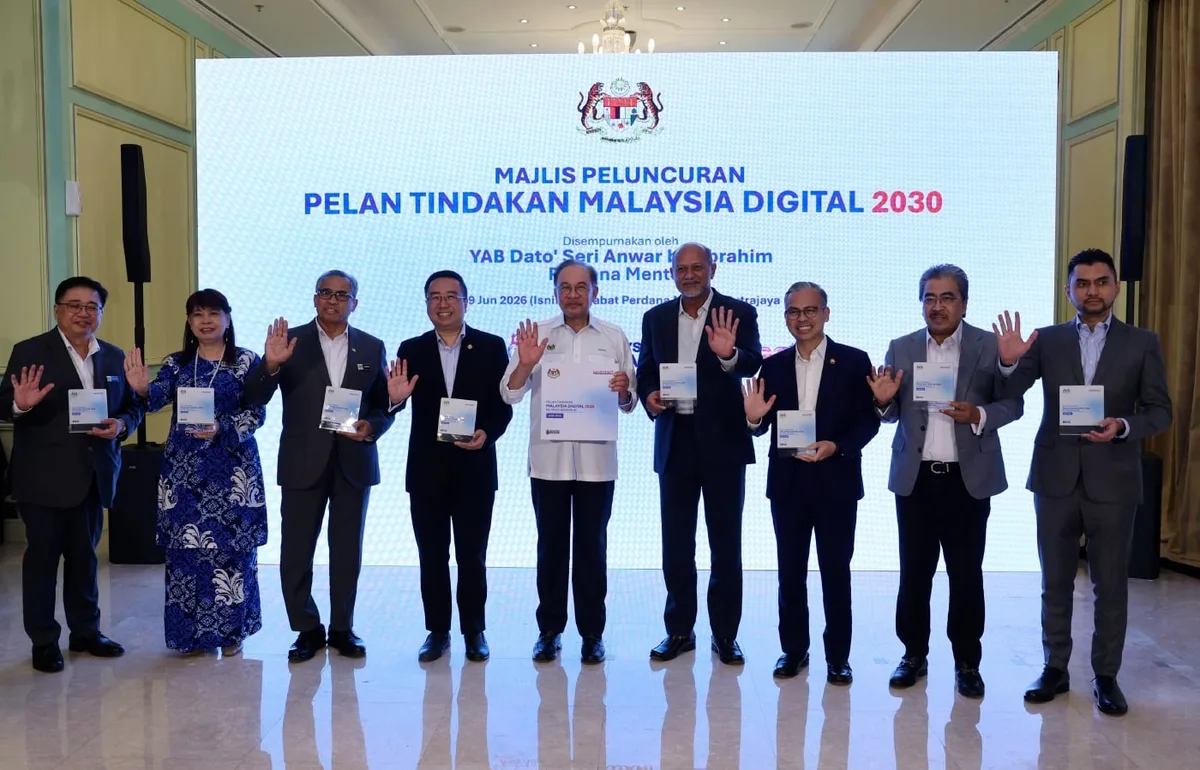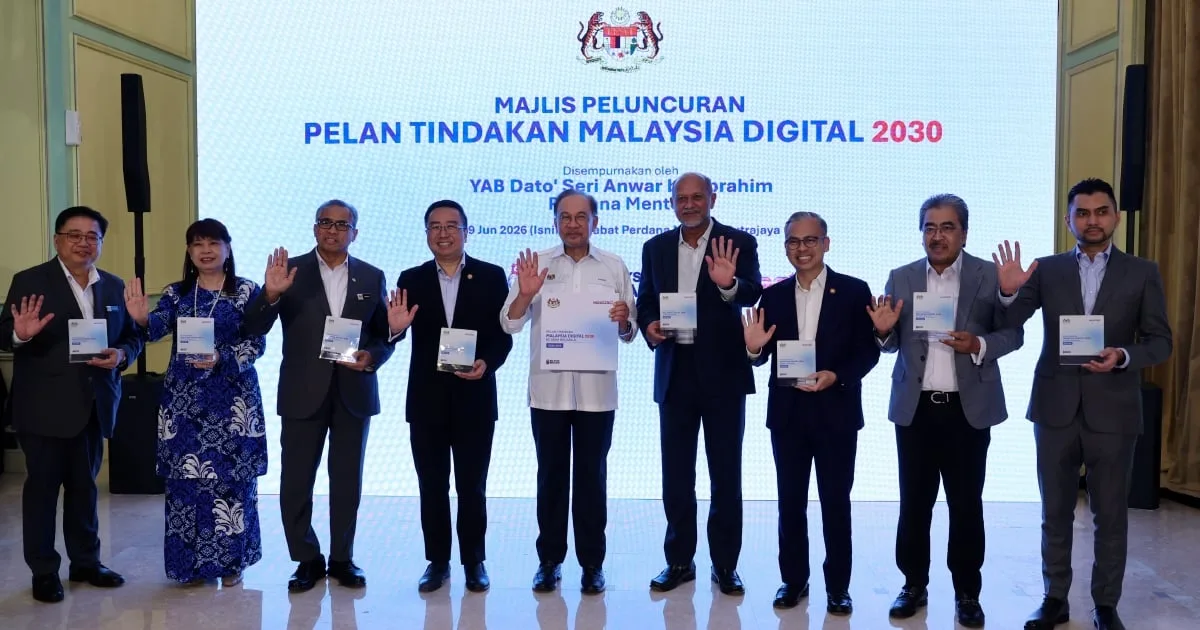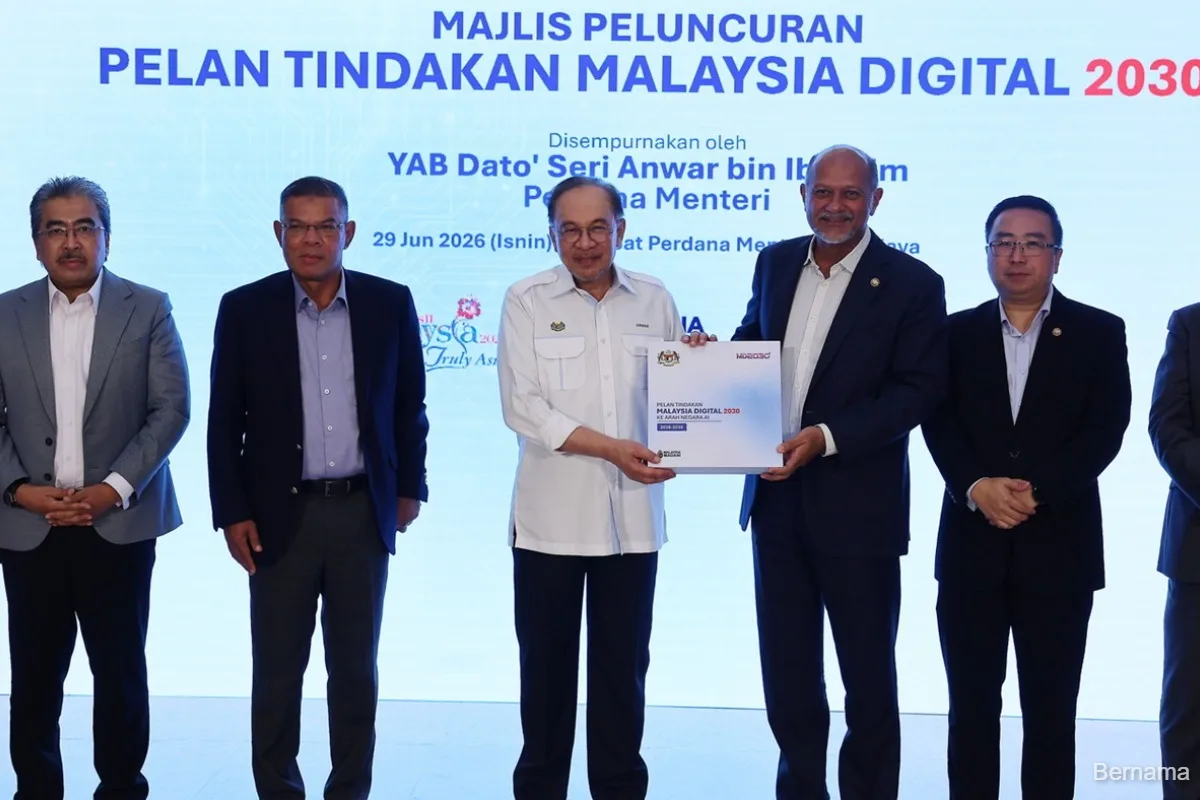
Prime Minister Datuk Seri Anwar Ibrahim launched the Malaysia Digital 2030 (MD2030) national action plan on June 29, 2026, to transform the country from a technology consumer into a home-grown innovation producer by 2030 [1, 2, 3, 4, 5, 6].
MD2030 targets raising the digital economy’s contribution to Malaysia’s GDP to 30% by 2030 and creating 500,000 high-value digital jobs within the same timeframe [1, 2, 3, 4, 5]. The plan also aims to generate RM4.5 billion in public sector savings through digitalisation and deliver 95% of government services fully online end-to-end by 2030 [1, 2, 3, 4, 5].
The Digital Ministry will lead MD2030 efforts, pushing the 'Towards an AI Nation 2030' agenda [1, 2, 3, 4, 5]. The plan is structured around seven strategic pillars: government, economy, infrastructure, talent, society, trust and security, and innovation. Each pillar is led by designated cluster heads including Shamsul Azri for government, Johari Abdul Ghani for economy, Fahmi for infrastructure, R. Ramanan for talent, Nancy Shukri for society, Gobind Singh Deo for trust and security, and Chang Lih Kang for innovation [1, 2, 3, 4, 5].
The government pillar focuses on improving public service delivery by establishing GovTech Malaysia [1, 2, 3, 4, 5]. The economy pillar seeks to position Malaysia as a regional digital innovation and trade hub by promoting 'Made by Malaysia' products and accelerating technology adoption in high growth, high value sectors [1, 2, 3, 4, 5]. Infrastructure priorities include nationwide high-quality internet connectivity and sustainable infrastructure such as data centres and smart cities [1, 2, 3, 4, 5].
Talent development aims to prepare the workforce for the digital economy through comprehensive policies and to strengthen Malaysia’s role as a digital talent hub [2, 4, 5]. The society pillar plans to institutionalize the Malaysia Digital Inclusion Index, empower rural communities, and deploy digital solutions with social impact [5]. Trust and security efforts will be guided by the National Data Council and a national digital trust strategy from 2026-2030 [5]. Innovation will focus on building strong R&D, commercialization, and ecosystem links to support Malaysia’s shift to a digital technology creator [5].
Implementation will involve coordination among various agencies including the National AI Office, GovTech Malaysia, Malaysia Digital Economy Corporation, CyberSecurity Malaysia, MyDIGITAL, and the 4IR Centre Malaysia [5]. Prime Minister Anwar stressed the need for organized, disciplined implementation to benefit people, strengthen business competitiveness, and build an inclusive AI nation by 2030: “我们的当务之急是确保每一项倡议皆以有组织、有纪律且有效的方式落实,从而造福人民,加强企业竞争力,并推动大马在2030年成为具包容性的AI国家。” [6]
He emphasized maintaining human judgment at the core of decision-making despite advances in AI: “因此,我们必须确保,即使机器变得更加强大和精密,人类的判断仍须处于决策的核心。” [7] Anwar also highlighted the ongoing drafting of an AI Governance Act to regulate human-machine coexistence alongside cybersecurity and data protection laws [7].
Following the launch of MD2030, Ant Group opened its Global Development Center in Kuala Lumpur’s Tun Razak Exchange on July 1, 2026, reinforcing Malaysia’s fintech hub status aligned with the AI nation vision [7, 8]. Ant Group CEO Han Xinyi said, “随著蚂蚁国际全球发展中心在吉隆坡正式启用,我们已准备好支持马来西亚‘2030年人工智能国家’愿景及国家数位化进程。” [8]
Ant Group plans to invest in developing world-class AI talent and Malaysia-origin AI commercial solutions to contribute to the 2030 goals [8].