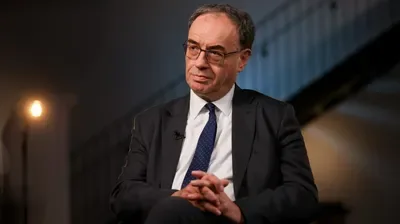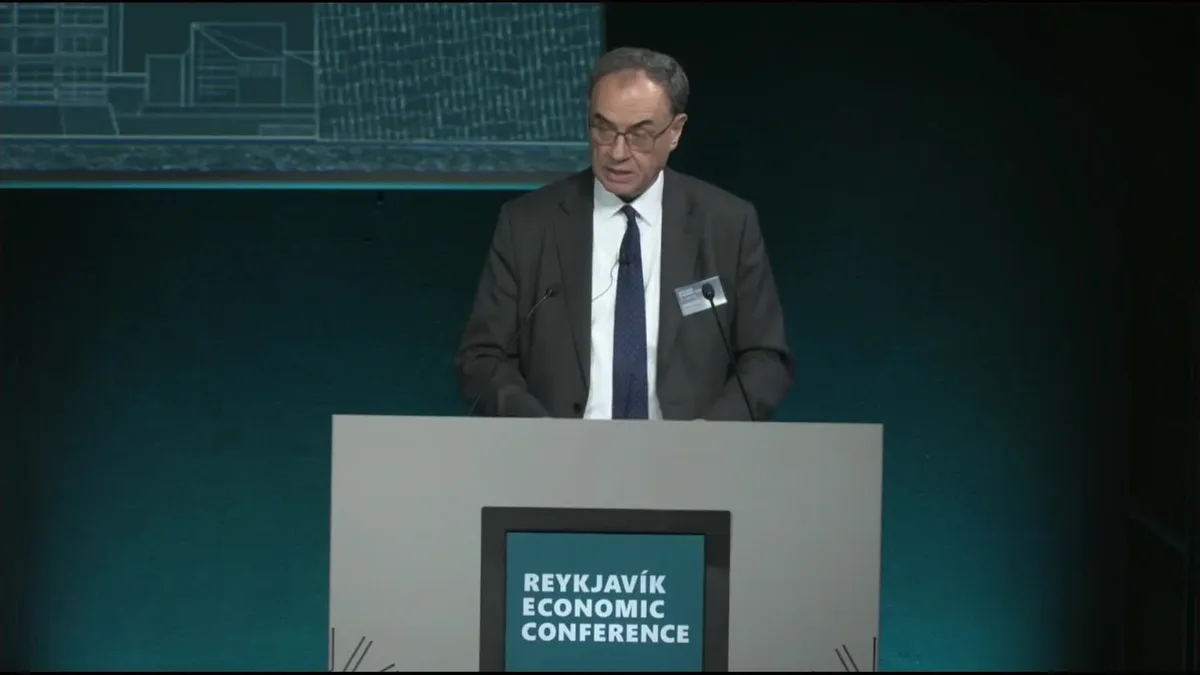
Bank of England Governor Andrew Bailey said the central bank could temporarily tolerate inflation above its 2% target to support the weak UK economy, as long as second-round price effects do not appear [1, 2, 3]. Bailey outlined this stance on May 29 in Reykjavik, emphasizing that the softness in the real economy and the uncertainty caused by the Iran war justify a flexible approach to inflation [1, 2, 3]. "Given the context of softness in the real economy and uncertainty around the scale and duration of the shock, tolerating temporarily above-target inflation to provide some support for the real economy is an appropriate way to approach the trade-off," he said [1]. He added that tolerance would decrease if signs of sustained inflationary effects begin to emerge [2].
The Bank of England's Monetary Policy Committee kept interest rates on hold at 3.75% as of April 30, 2026, awaiting more clarity on economic developments [2, 3]. However, markets now expect a 0.25 percentage point increase to 4% by December 2026, reversing earlier bets on rate cuts following the Middle East tensions [2, 3]. Bailey noted that monetary policy has already tightened by effectively removing rate cuts from consideration, which is impacting borrowing costs for UK homeowners and businesses despite no formal hike [2, 3].
Mortgage and borrowing costs have climbed as lenders recalibrated expectations in response to the uncertainty around Iran, adding economic pressure [2, 3]. Bailey stressed the importance of closely monitoring the Middle East situation and adjusting policy as needed. "We have to monitor the situation in the Middle East and how it affects the UK economy and inflation very closely and adjust policy as required," he said [2].
The BoE's flexible stance on inflation comes amid global economic uncertainty, including developments in the US where Kevin Warsh became Federal Reserve chair on May 22, influencing expectations of steady US interest rates [2]. The Bank’s inflation target remains at 2%, but the current approach aims to balance inflation control with economic support during unpredictable times [1, 2, 3]. The next scheduled review of interest rates will determine if policy changes are needed based on evolving conditions.