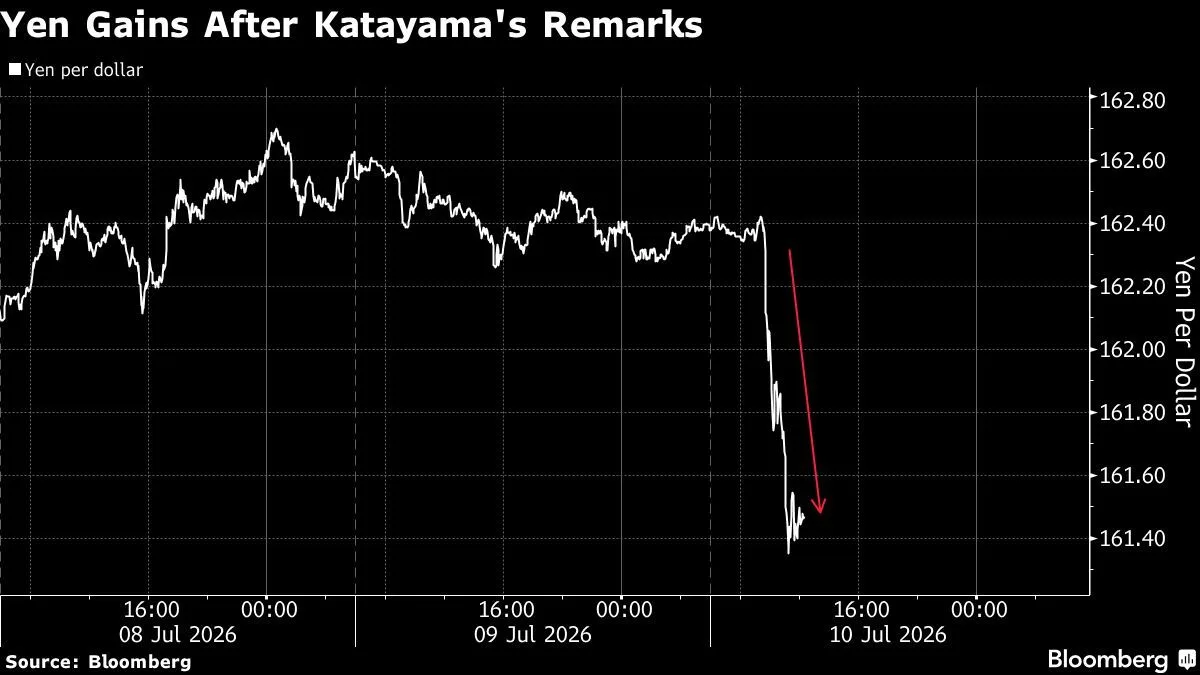
Japan's Finance Minister Satsuki Katayama on July 10, 2026, urged pension funds, including the Government Pension Investment Fund (GPIF), to substantially increase investments in domestic financial assets [1, 2, 3]. The GPIF, one of the world's largest pension funds, manages about ¥293.6 trillion (approximately $1.81 trillion) in assets, with roughly 50% currently allocated to foreign investments [2, 3, 1].
Following the announcement, the Japanese yen strengthened about 0.6%, trading near 161.3 to 161.7 yen per US dollar, reversing a near 40-year low against the greenback [1, 4, 5, 3]. This move also pushed down the euro and British pound against the yen, and weighed on the US dollar broadly [1, 4, 5].
Japanese government bond markets reacted with 30-year yields dropping about 10 basis points after the call for greater domestic investment [6, 3]. Market analyst Fabien Yip of IG said a shift in GPIF's strategic allocation away from its 50% foreign holdings to more domestic assets "would definitely create a lot more inflows for domestic assets," which supports the currency as well as equities and bonds [1]. He added, "With the currency situation we’re seeing, with yen at close to 40-year lows against the dollar...trying to change the issue structurally...would be supportive of the currency in the longer term" [1].
Katayama emphasized the government's intention "to encourage households, as well as pension funds including the GPIF, to increase their investment in Japanese financial assets," and said, "we want to ensure that the public can directly benefit from Japan’s economic growth" [2, 3]. The government plans to pursue policies aimed at boosting allocation to domestic financial assets among both households and pension funds [2, 3].
GPIF is overseen by the labor ministry, not finance, so altering its investment strategy requires an established process that takes time [2]. Japan is the world’s largest foreign holder of US Treasuries, with about $1.2 trillion in holdings, and nearly $5 trillion of Japanese capital is invested abroad overall [2].
The government’s push to increase domestic investment is seen as an effort to create stronger inflows supporting the yen and Japan's financial markets. The next steps will likely involve setting concrete policy frameworks to achieve these shifts in investment patterns.