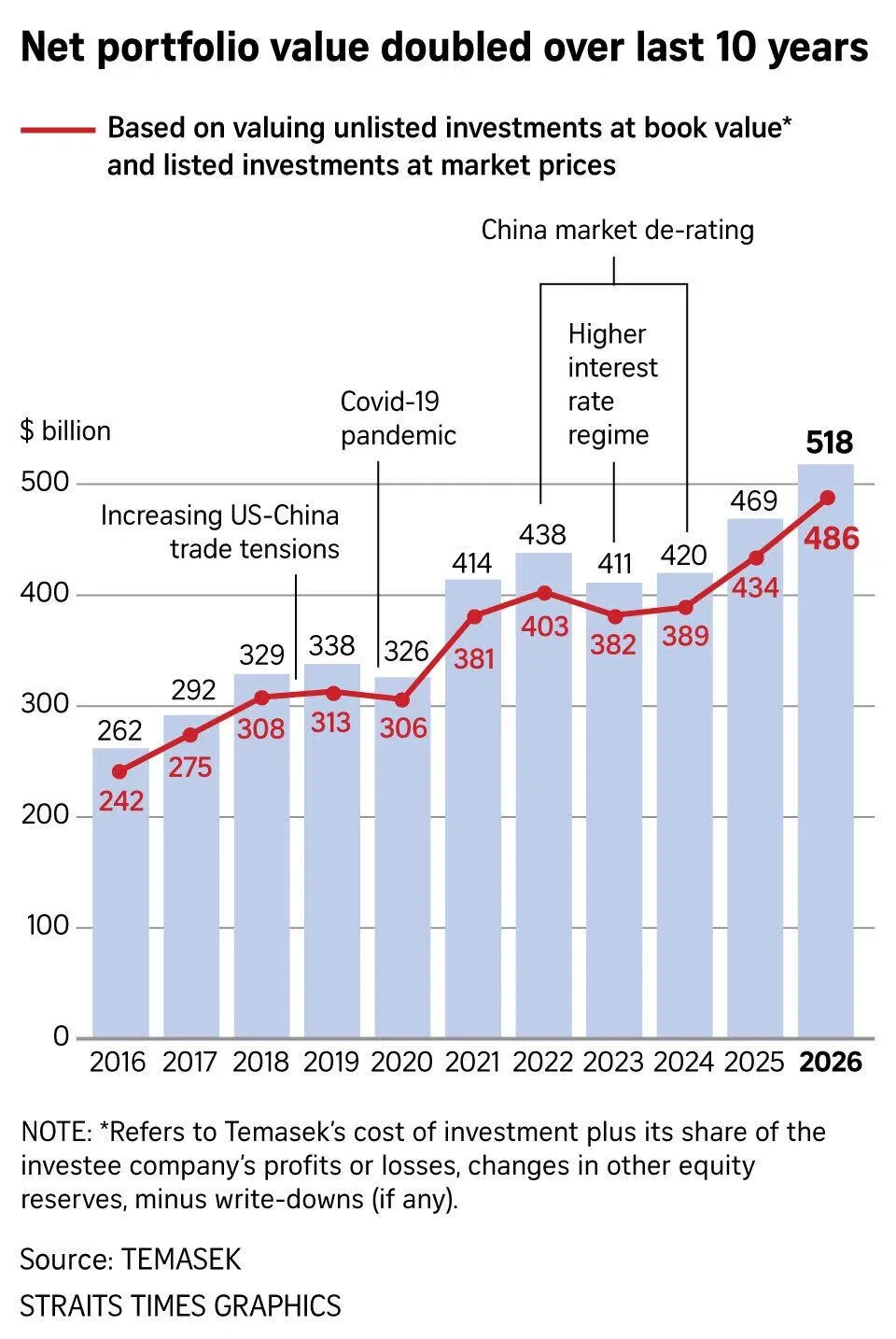
Temasek Holdings’ net portfolio value reached a record S$518 billion (US$401 billion) as of March 31, 2026, up 10.5% from the previous year, the company announced on July 8, 2026 [1, 2, 3, 4, 5, 6]. This growth was slower than the prior year’s 11.9% increase and was affected by the outbreak of conflict in the Middle East starting February 28, 2026, which reduced the portfolio value by about 2% [1, 2, 3, 4, 5, 6].
The Middle East conflict mainly disrupted energy supply chains and impacted Europe more than direct exposure to Middle Eastern markets. Temasek’s portfolio has about 12% exposure to the Europe, Middle East, and Africa (EMEA) region, with the majority concentrated in Europe [2, 3, 4]. Temasek Global Investments President Nagi Hamiyeh said, "Temasek does not have much direct exposure to the Middle East," reflecting the regional risk spread [2].
Despite the geopolitical challenges, Temasek reported a one-year total shareholder return (TSR) of 10.5% for the financial year 2025-26, although a stronger Singapore dollar reduced returns by around two percentage points [1, 5, 6]. Over the last 20 years, Temasek’s average TSR stands at 6.8% [2, 3, 4].
Temasek invested S$51 billion and divested S$31 billion during the financial year, generating net investments of S$20 billion [1]. Significant divestments included the sale of Dutch company Axia Vegetable Seeds, Schneider Electric India stake, and a controlling stake in US-based Global Health Exchange [1, 6]. Earlier in February 2026, ST Telemedia sold an 82% stake in its data centre business for S$6.6 billion to KKR and Singtel [5]. Singapore-listed companies such as DBS, Singtel, and Singapore Airlines were key contributors to portfolio growth [1, 5, 6].
Temasek has been expanding its footprint in the Middle East, opening its first office in Abu Dhabi in 2025 through its asset-management arm Seviora and partnering with Abu Dhabi’s sovereign wealth fund L’IMAD [2, 3, 4]. Chia Song Hwee, Temasek Global Investments CEO, said the conflict "has created investment opportunities as infrastructure needs to be renewed, but more importantly, new infrastructure needs to be built to address the resiliency of the supply chain, including exports" [2].
Temasek’s exposure to China decreased as a percentage of the portfolio from 24% in 2016 to 17% in 2026, though the absolute value increased by S$10 billion over the last year [6]. The firm is also shifting its portfolio focus, aiming to increase private credit investments from 2% to 5% in the next five years and boost AI-related exposure from 6% to 15% by 2031, investing in companies like Anthropic and OpenAI [2, 3, 4, 6]. It plans to grow its "core-plus" infrastructure, including renewable energy and decarbonisation technology, to 5% by 2031 [6].
Temasek’s share of sustainability-aligned investments fell to 9.5% of its portfolio in FY2026 from 11% the previous year, though the absolute value rose from S$46 billion to S$49 billion [7]. A spokesperson said the "vast majority of losses was recovered," reflecting confidence in the firm’s public market strategies for long-term performance [1].
Temasek’s next public update on portfolio performance will be due with its FY2026-27 results next year.