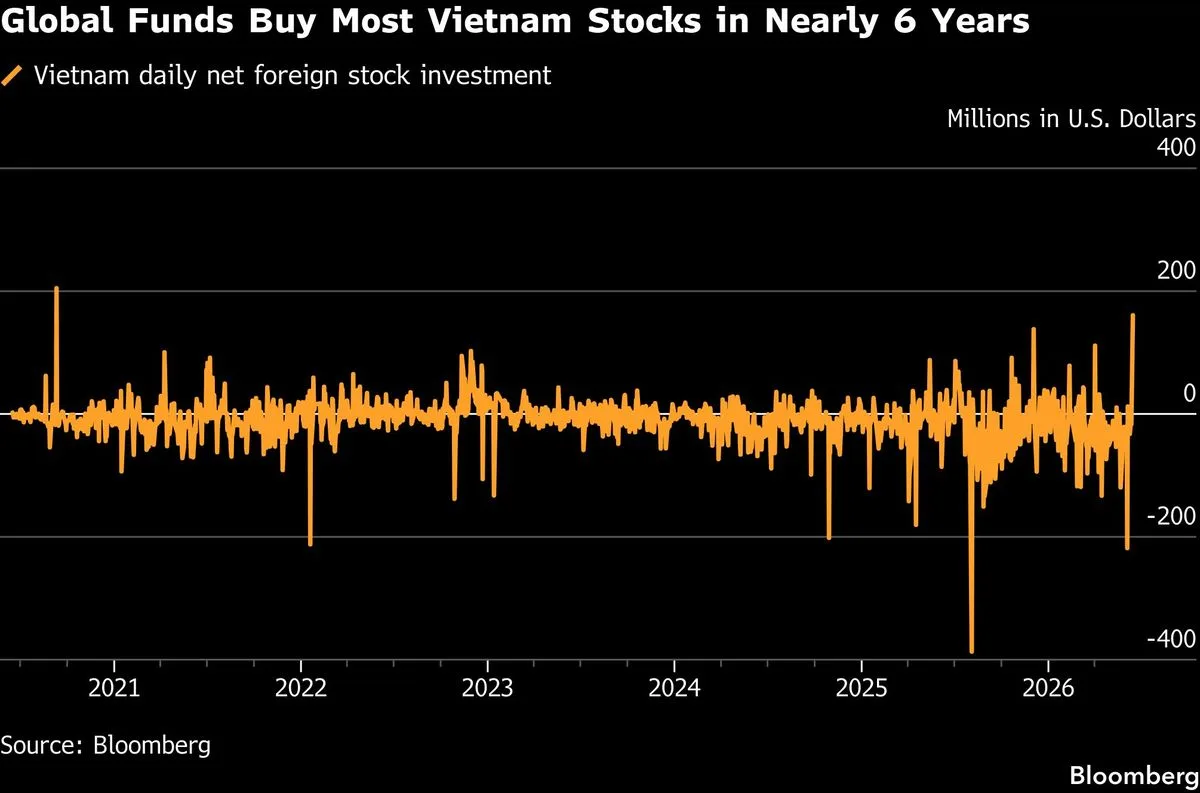
Vietnamese shares experienced their largest daily foreign inflows in nearly six years on June 15, when foreign investors purchased a net US$160.4 million worth of stocks—the biggest since September 10, 2020 [1, 2].
This surge came amid a broader wave of buying across several Asian emerging markets, including Malaysia and the Philippines, following the reopening of the Strait of Hormuz by the US and Iran [1, 2]. According to Quynh Cao, head of institutional business at VNDirect Securities Corp., “De-escalation in the Middle East and Vietnam’s own underperformance have created a textbook re-entry set up for foreign capital. Positioning was already tight and it doesn’t take much to flip that” [1].
Despite this rebound, foreign investors have sold a net US$2.6 billion of Vietnamese equities so far in 2026 [1, 2]. This comes after a record withdrawal of US$4.8 billion in 2025 amid heightened geopolitical tensions and a rotation toward faster-growing markets [1, 2]. During this period, FTSE Russell upgraded Vietnam from frontier-market to emerging-market status, reflecting its growing investment appeal [1, 2].
The sustainability of renewed foreign inflows is uncertain. Cao noted, “The caveat is durability – a fragile deal that keeps oil prices elevated reintroduces exactly the inflation and FX pressure that drove foreigners out in the first place” [2]. Elevated oil prices risk reigniting inflation and currency pressures that could undermine investor confidence [1, 2].
The June 15 inflow is the first concrete sign of return interest after years of outflows. Market watchers will closely track geopolitical developments in the Middle East and oil price trends to assess whether foreign buying in Vietnam can continue to gain momentum [1, 2].