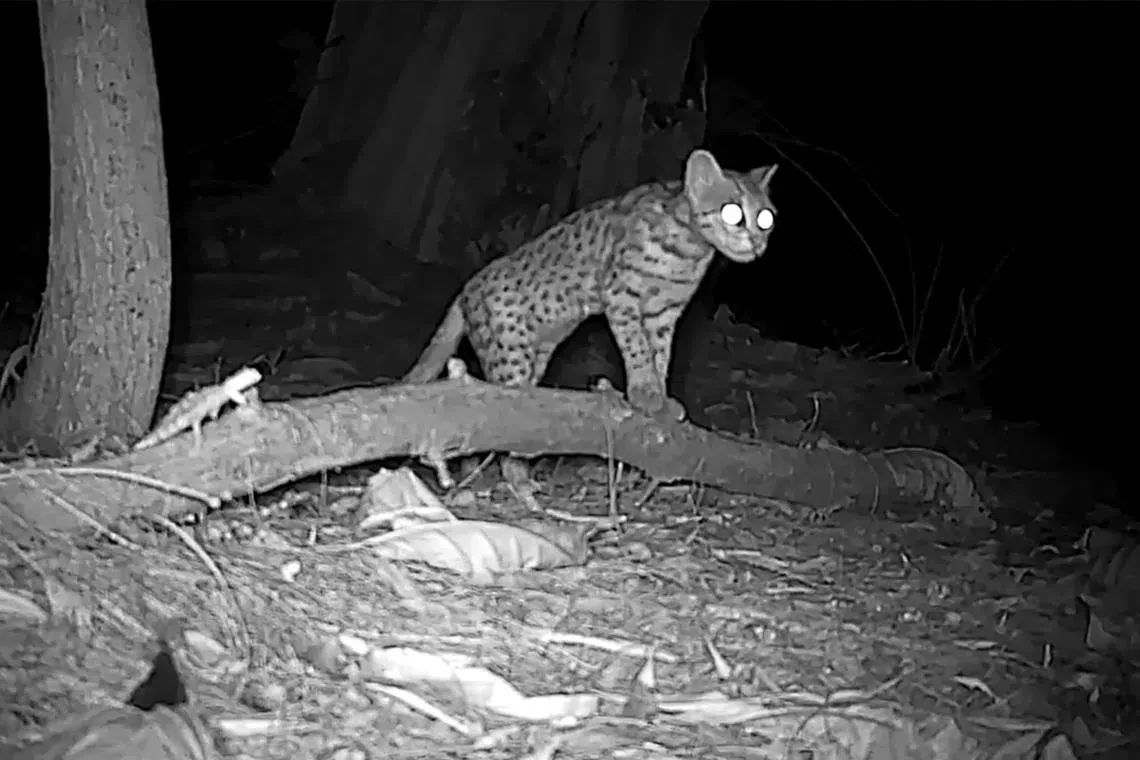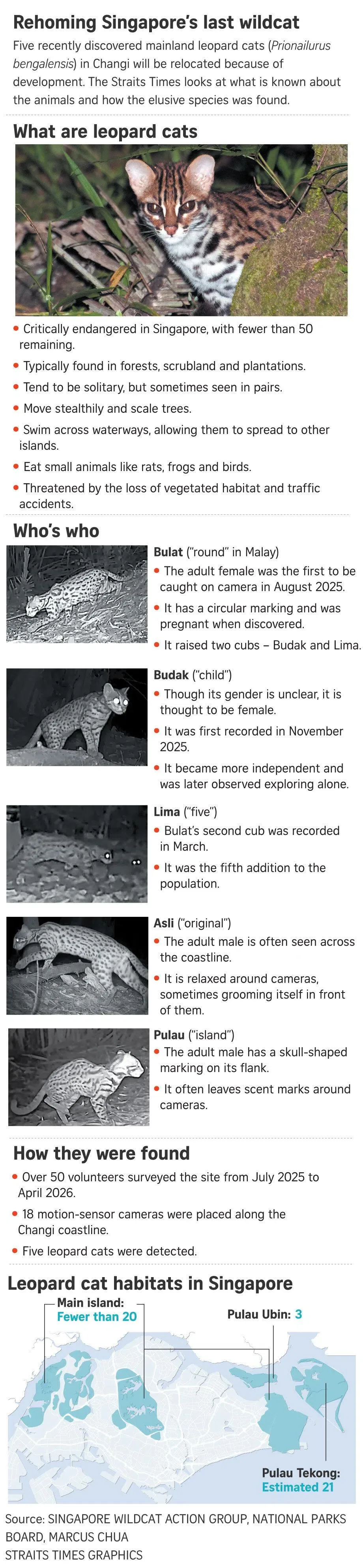
NParks and the Singapore Wildlife Animal Group (SWAG) announced plans to relocate five mainland leopard cats living in Changi’s coastal forest from the second half of 2026 to safeguard them from habitat loss and development threats [1, 2, 3].
The leopard cats in Singapore are critically endangered, with fewer than 50 individuals estimated to live mostly on Pulau Tekong, Pulau Ubin, and in the Western Catchment Area [1, 2, 3]. The discovery of leopard cats in the Changi area was first recorded in January 2019 after one was killed in a road accident, marking the first known presence there [1, 2, 3].
From July 2025 to April 2026, SWAG led a rapid survey involving more than 50 volunteers and 18 motion-sensor cameras to confirm the leopard cat population and study their behavior in Changi [1, 2, 3]. SWAG co-founder Vilma D'Rozario said, "The group confirmed that five leopard cats lived in the area, which included the first cubs spotted in more than a decade" [1].
The relocation aims to reduce threats such as vehicle collisions and shrinking habitat that jeopardize the survival of the Changi leopard cats [1, 2, 3]. NParks and SWAG withheld details of the relocation sites to prevent poaching risks [1, 2, 3].
Mammal scientist Marcus Chua described the emergence of this small Changi population as "an encouraging sign that leopard cats can persist if their habitats are protected in Singapore" [1]. Zhou Boyi, director of the terrestrial branch at NParks’ National Biodiversity Centre, said, "The survey is a prime example of a community-initiated science project that laid a strong foundation for biodiversity management plans" [1].
The Changi leopard cats likely originated from individuals that swam from nearby Pulau Tekong, though this has a medium level of confidence [1, 2, 3].
The relocation operation is scheduled to begin in the second half of 2026 following the survey concluded in April [1, 2, 3].