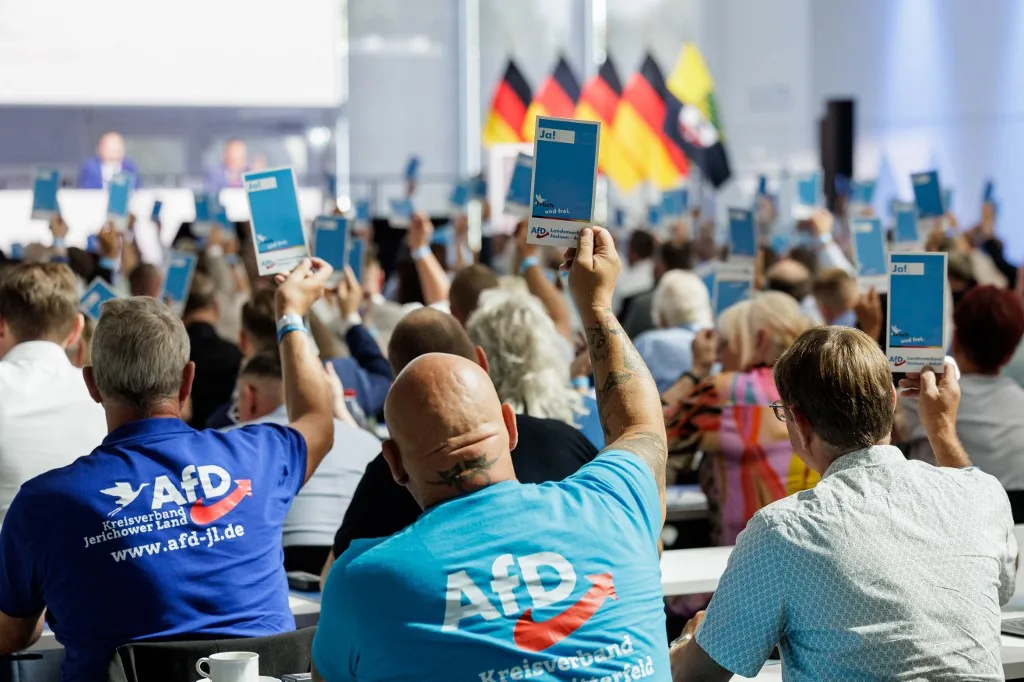
German lawmakers and anti-Kremlin activists accuse Russia of spreading disinformation to help the far-right Alternative for Germany (AfD) party ahead of two regional elections in eastern Germany scheduled for September 6 and 20, 2026 [1, 2, 3, 4]. The AfD currently leads polls in Saxony-Anhalt and Mecklenburg-Western Pomerania and aims to control a regional government for the first time since 1945 [1, 2, 3, 4].
Disinformation campaigns detected in June and July 2026 used fake posts and websites impersonating major media outlets such as AFP, ARD, and Deutsche Welle. The false content sowed division between eastern and western Germany, smeared mainstream parties, and accused politicians of corruption and sex offenses [1, 2, 3, 4].
Anti-Kremlin group Antibot4Navalny has monitored these campaigns, linking them to Matryoshka, a Kremlin influence operation known for political disinformation. An activist said, "We have been monitoring Matryoshka on a daily basis for about 2 1/2 years...there is no other plausible explanation for these campaigns" [1]. Notably, the campaigns did not target the AfD or the small pro-Russian far-left party BSW [1, 2, 3, 4].
Konstantin von Notz, a Green party MP and vice-chair of Germany's intelligence oversight committee, said, "Russia and the far-right are obviously 'sharing the work' and these methods are quite common in today's elections" [2]. Marc Henrichmann, chairman of the committee, described Russia's efforts as a "cognitive war" to spread fear and division in Germany [2].
The AfD denies acting as Russian agents. Candidate Sigmund said, "Seeking reasonable understanding with other countries does not mean you are in their service. Germany's interests are our compass" [3]. The Russian embassy called the accusations "absurd and laughable" and warned that Europe is on a dangerous path not aligned with citizens' interests [4].
The first wave of disinformation surfaced in June 2026, using fake AFP sites to foster east-west division. A second wave appeared in July impersonating ARD and Deutsche Welle to accuse politicians of crimes [1, 2, 3, 4].
State elections in Saxony-Anhalt and Mecklenburg-Western Pomerania are set for September 6 and 20, 2026, respectively [1, 2, 3, 4].