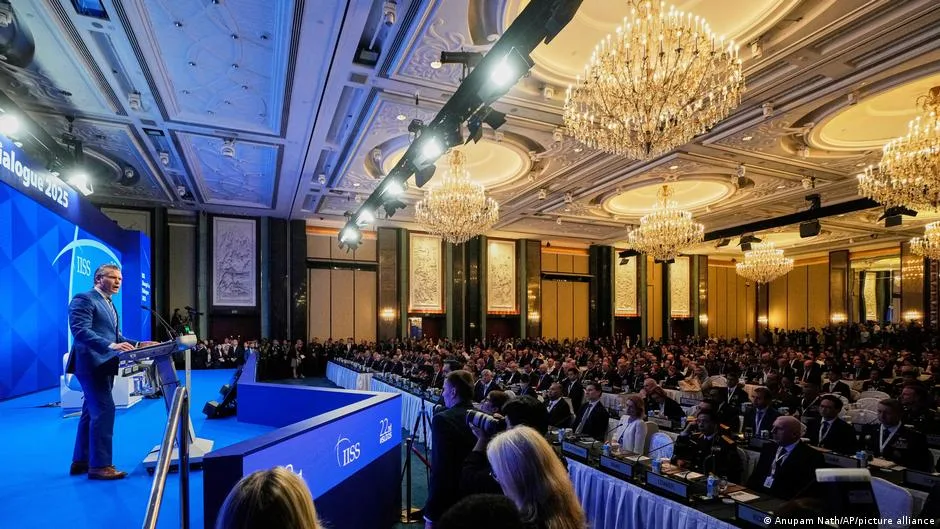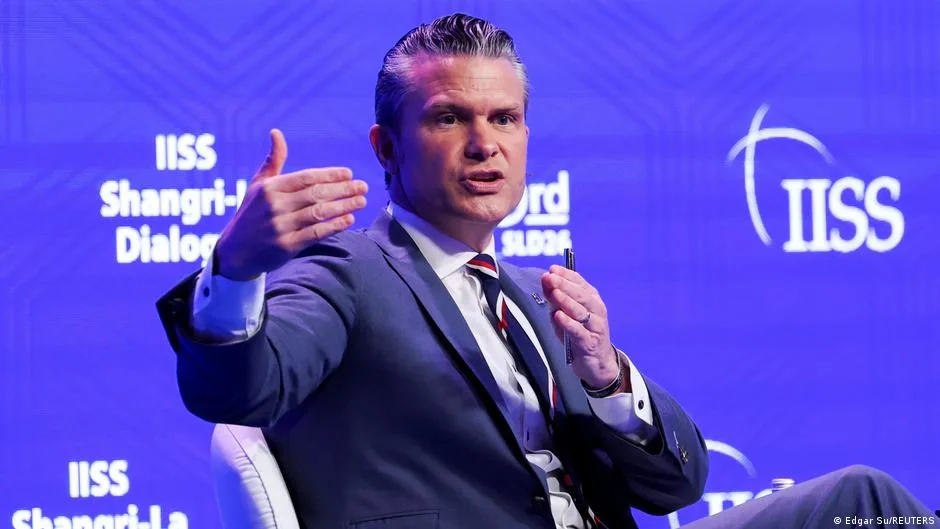
The Shangri-La Dialogue 2026 convened in Singapore on June 1, with defense ministers, military officials, and security experts from around the world discussing deteriorating security in the Asia-Pacific region [1, 2, 3]. The meeting took place amid recent conflicts including a brief war between India and Pakistan in May 2025, a Thailand-Cambodia conflict that ended December 2025, intensified Pakistan-Afghanistan clashes in February 2026, ongoing civil war in Myanmar, and tensions in the South China Sea [1, 2, 3].
US-China rivalry dominated discussions as China’s expanding military shifts the regional balance of power [1, 2, 3]. Vietnamese President and Communist Party General Secretary To Lam called for managing interstate competition "within a legal framework" to keep it "limited, responsible, and predictable," saying a "sustainable regional order cannot be built on constant fear and mutual distrust" [1]. Singapore Prime Minister Lawrence Wong warned, "The reality in this changed world is that there will be more volatility — we will be facing storm after storm" [1].
Military spending surged to $681 billion in 2025 across Asia-Pacific, according to SIPRI data cited at the talks [2, 3]. US Defense Secretary Hegseth announced plans for $1.5 trillion in US defense spending and urged Asian allies to boost their own capabilities, saying "many allies have allowed their defense capabilities to shrink" [2, 3]. US officials praised countries such as South Korea, Philippines, Australia, Singapore, Malaysia, Thailand, Vietnam, and India for recognizing that "only strength ensures peace" [2, 3].
Germany has increased defense cooperation with Asia-Pacific nations and recently amended its constitution to allow higher military spending [2, 3]. Australian Deputy Prime Minister Richard Marles said "security is utterly linked to development. Where there is prosperity... that is in itself a contributor to stability and peace" [1]. Mirjana Spoljaric, chair of the International Committee of the Red Cross, cautioned that "large-scale purchases and production of weapons... ultimately cause loss of lives and materials" which must be accounted for in defense budgets [2].
The dialogue came weeks after US President Trump and Chinese President Xi Jinping met in mid-May 2026 and agreed on a "constructive strategic stability" framework for US-China relations [2, 3]. Notably, US Defense Secretary Hegseth did not mention Taiwan in his 2026 speech, unlike in 2025 when he highlighted China’s military focus on Taiwan [2, 3]. Former Chinese diplomat Cui Tiankai said China "fundamentally opposes any quantity of arms sales to Taiwan" and views further deliveries as destabilizing [2, 3]. The fate of a previously approved $14 billion US arms sale to Taiwan, halted by Trump in May 2026, remains undecided [2, 3].
Analyst Bilahari Kausikan said US support remains essential for Asia to balance China and Europe to contain Russia but noted that smaller countries can pursue "cooperation according to their interests" [2, 3]. Japan is expanding partnerships with Australia, Philippines, India, New Zealand, and Singapore to counterbalance China’s rise [2, 3]. Philippine Defense Secretary Gilberto Teodoro Jr. affirmed the US, Japan, Australia, New Zealand, Canada, and France are allies supporting deterrence, with partnerships continuing to grow [2, 3].