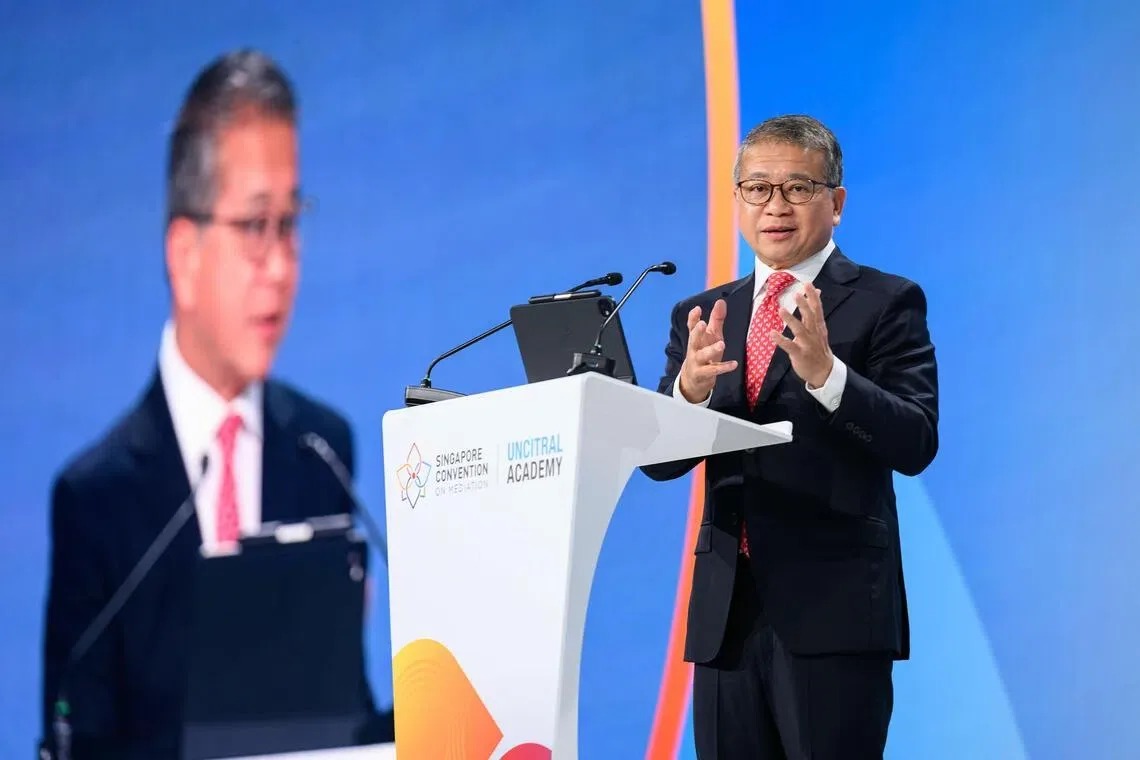
Singapore announced on August 25 its bid to host the proposed Multilateral Investment Tribunal (MIT), a new international forum for resolving disputes between foreign investors and sovereign states [1, 2, 3, 4, 5]. The announcement came from Law Minister Edwin Tong at the UNCITRAL Academy Conference in Singapore.
The MIT is being negotiated under the United Nations Commission on International Trade Law (UNCITRAL) as a replacement for the current ad hoc arbitration system dealing with investor-state disputes. UNCITRAL's Working Group III has been developing the tribunal’s draft statutes and an appellate mechanism since 2017 [4, 5]. Tong emphasized, “The question is not whether investment disputes will arise, but whether there is a credible, trusted institution to resolve them.” He added Singapore’s bid “reflects commitment to doing our part in building an institution that is credible” [1, 4].
Investor-state cases have risen sharply, with more than half of treaty-based cases since 1987 initiated in the last decade. Critics of the existing system highlight inconsistent decisions, arbitrator independence concerns, and fears of regulatory chill, especially as states increasingly regulate public health, energy security, climate change, and national security [1, 2, 3, 4, 5]. Tong warned against a system “where size and power make right,” calling it “completely untenable for a country like Singapore” [1].
Singapore qualifies as a strong host due to its neutral and stable legal environment and its mature dispute resolution ecosystem encompassing arbitration, mediation, and adjudication [4, 5]. The next UNCITRAL meeting to address remaining procedural issues for the tribunal and appellate mechanism is scheduled for October 2026 [4, 5].