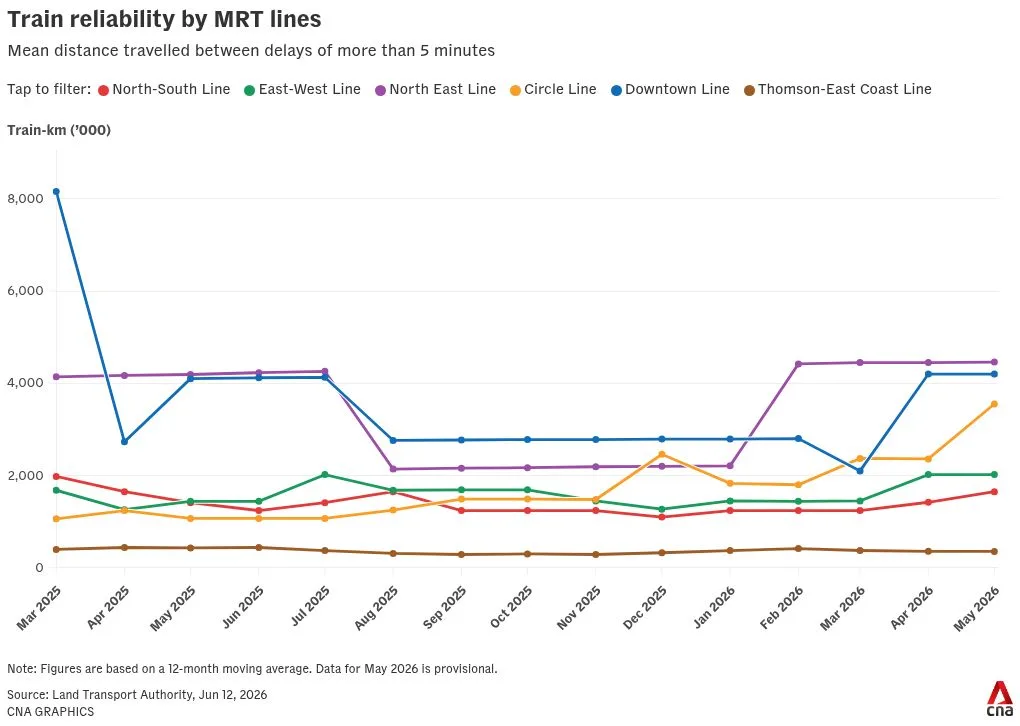
Singapore's MRT network achieved a mean kilometres between failures (MKBF) of 2.5 million train-km in May, up from 2.22 million train-km in April [1, 2, 3, 4, 5]. The Circle Line recorded the largest improvement, with MKBF rising 50% from about 2.36 million train-km to 3.55 million train-km over the same period [1, 2, 3, 4, 5]. The Land Transport Authority said, “The improvement in Circle Line reliability is significant and reflects the sensitivity of mean kilometres between failure to small variations in number of delays at this level of performance” [2].
The North-East Line remained the most reliable line in May, posting an MKBF of around 4.46 million train-km, slightly higher than the previous month [1, 2, 3, 4, 5]. The Downtown Line also stayed stable, with MKBF about 4.2 million train-km, while the East-West Line held steady at approximately 2.02 million train-km [1, 2, 3, 4, 5]. The North-South Line showed modest improvement, with MKBF increasing from roughly 1.42 million train-km in April to 1.65 million train-km in May [1, 2, 3, 4, 5].
In contrast, the Thomson-East Coast Line (TEL) suffered a major disruption on May 3 due to a signalling fault linked to a signal test performed the previous night by manufacturer Alstom [1]. The fault caused over three hours of service disruption and at least one delay exceeding 30 minutes [1, 2, 3, 4, 5]. TEL’s reliability dipped and is excluded from the overall MRT MKBF calculation. The Land Transport Authority said, “Due to ongoing construction on Thomson-East Coast Line's fifth phase, its operational performance will need more time to stabilise and improve after full line opening” [1].
The Light Rail Transit (LRT) network also improved reliability in May, with several LRT lines posting better MKBF figures [1, 3, 4, 5]. Notably, no delays exceeding 30 minutes occurred on the five mature MRT lines or LRT system during the month [2, 3, 4, 5]. However, overall MRT train punctuality declined slightly compared to April [1, 3, 4, 5].
The next major update on MRT reliability will come after the full opening of the TEL’s fifth phase later in 2026, when operational performance is expected to stabilise [1].