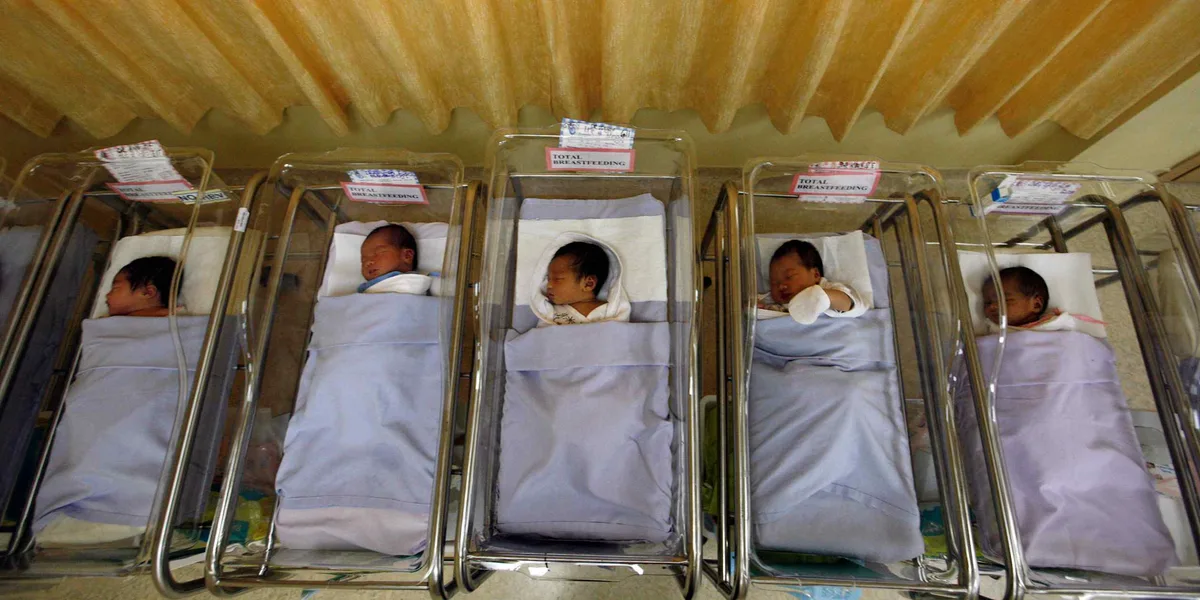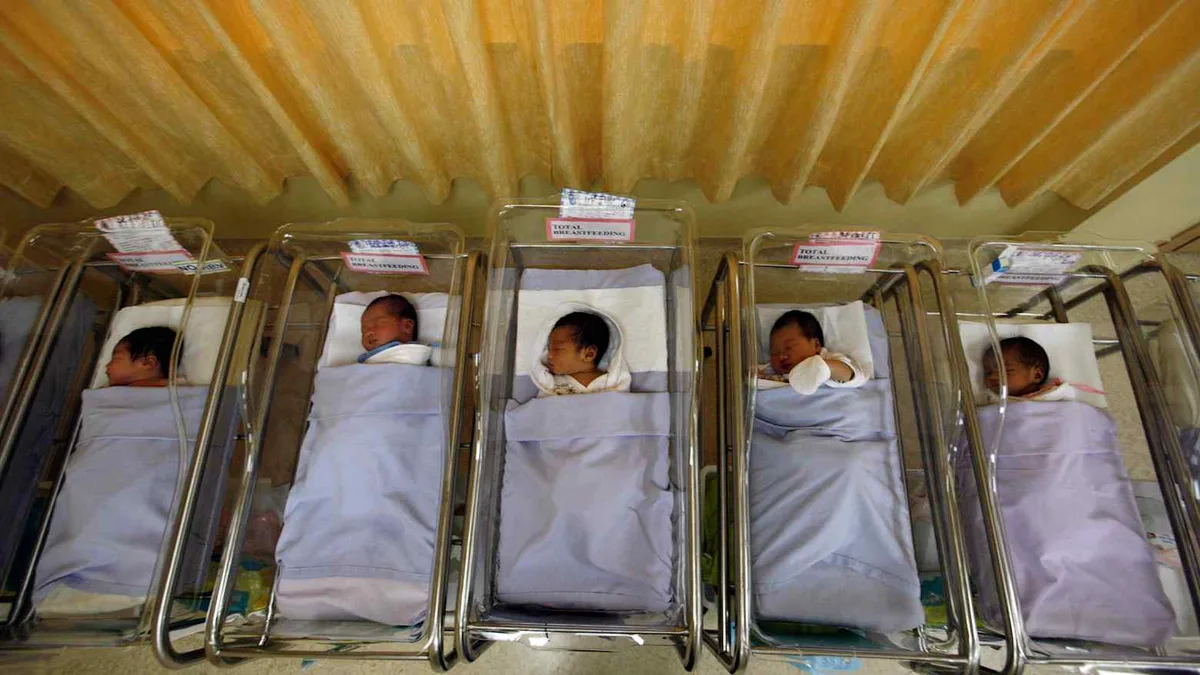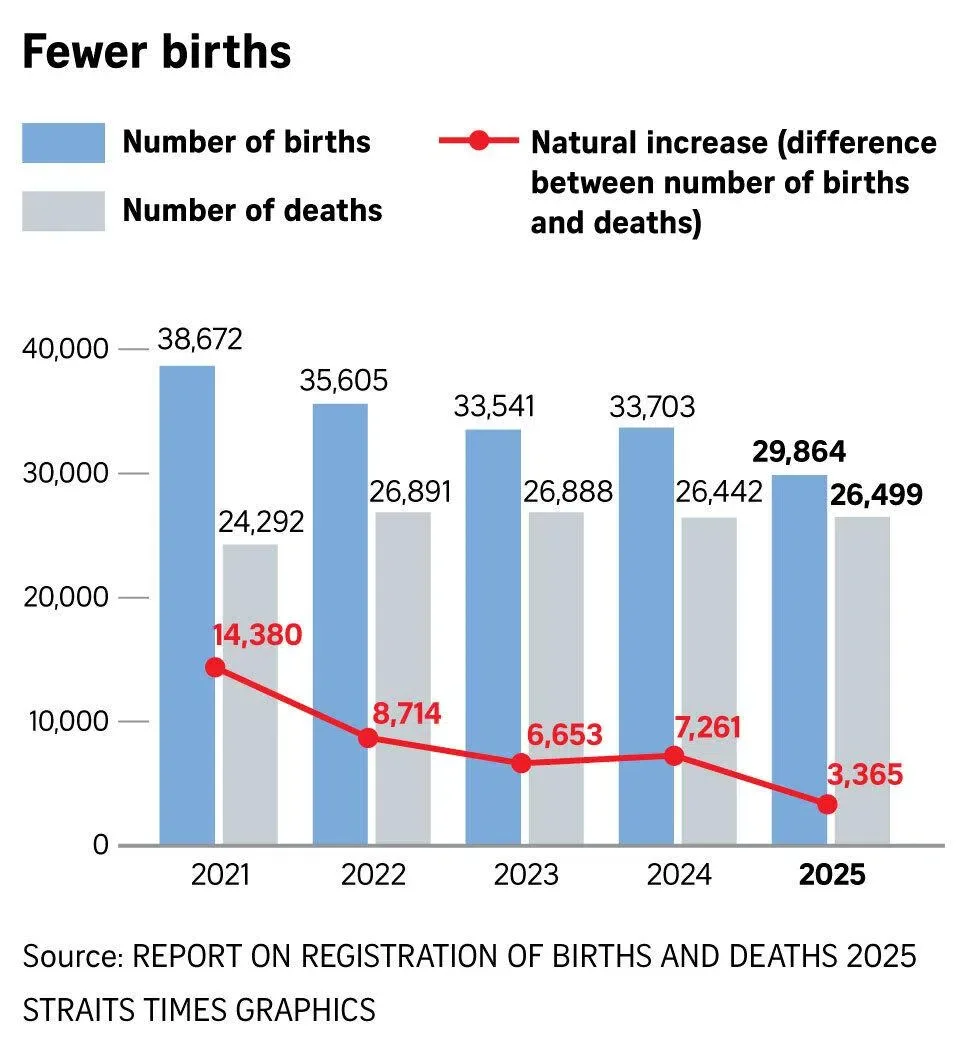
Singapore’s total births in 2025 fell sharply to 29,864, down 11.4% from 33,703 in 2024, hitting the lowest annual number since the city-state’s 1965 independence [1, 2, 3, 4, 5, 6]. The Immigration and Checkpoints Authority confirmed the births fell below 30,000 for the first time since independence in a report released on July 27, 2025 [1, 2, 3, 4, 5].
Deaths in Singapore rose slightly by 0.2% to 26,499 in 2025 from 26,442 the year prior, narrowing the natural population increase significantly due to fewer births and a modest rise in deaths [1, 2, 3, 4, 5]. The crude birth rate dropped from 7.4 live births per 1,000 residents in 2024 to 6.5 in 2025, while the crude death rate remained steady at about 6.0 deaths per 1,000 residents [4].
Deputy Prime Minister Gan Kim Yong warned that if the total fertility rate (TFR) remains at the historic low of 0.87 recorded in 2025, "it would become practically impossible over time to reverse the trend, as Singapore would have fewer women who can bear children" [1, 2, 3, 4, 5]. He stated, "With birth rates falling at an unprecedented pace, Singapore’s citizen population may start to shrink by the early 2040s without new interventions" [1].
The TFR fell from 0.97 in 2023 and 2024 to a record low of 0.87 in 2025, the smallest on record [1, 2, 3, 4, 5]. The government emphasizes balancing support for Singaporeans forming families with managing immigration to supplement the low birth rate, Gan said: "While the Government’s top priority is to continue supporting Singaporeans in forming families, we also need a carefully managed immigration flow to augment our low birth rate" [2].
In 2025, 87% of babies born had at least one Singaporean parent, totaling approximately 26,071 births [1, 2, 3, 5]. The median age of first-time mothers increased to 32.1 years, up from 31.3 in 2021. Around two-thirds of first-time mothers held university degrees, about one in five had A-levels or technical diplomas, and roughly one in 10 had O-level or lower qualifications [1, 2, 3, 4, 5].
By ethnicity, Chinese residents recorded a natural decrease with more deaths than births in 2025, while Malay, Indian, and other groups saw natural population increases [4].
Singapore recorded 55,725 births in its year of independence, 1965, the highest annual figure on record [1, 2, 3, 5]. The stark 2025 numbers illustrate a decades-long decline.
The government and policymakers will continue monitoring birth and death trends closely as population forecasts suggest citizen numbers could decline by the early 2040s without new measures addressing fertility and immigration [1, 2, 3, 5].