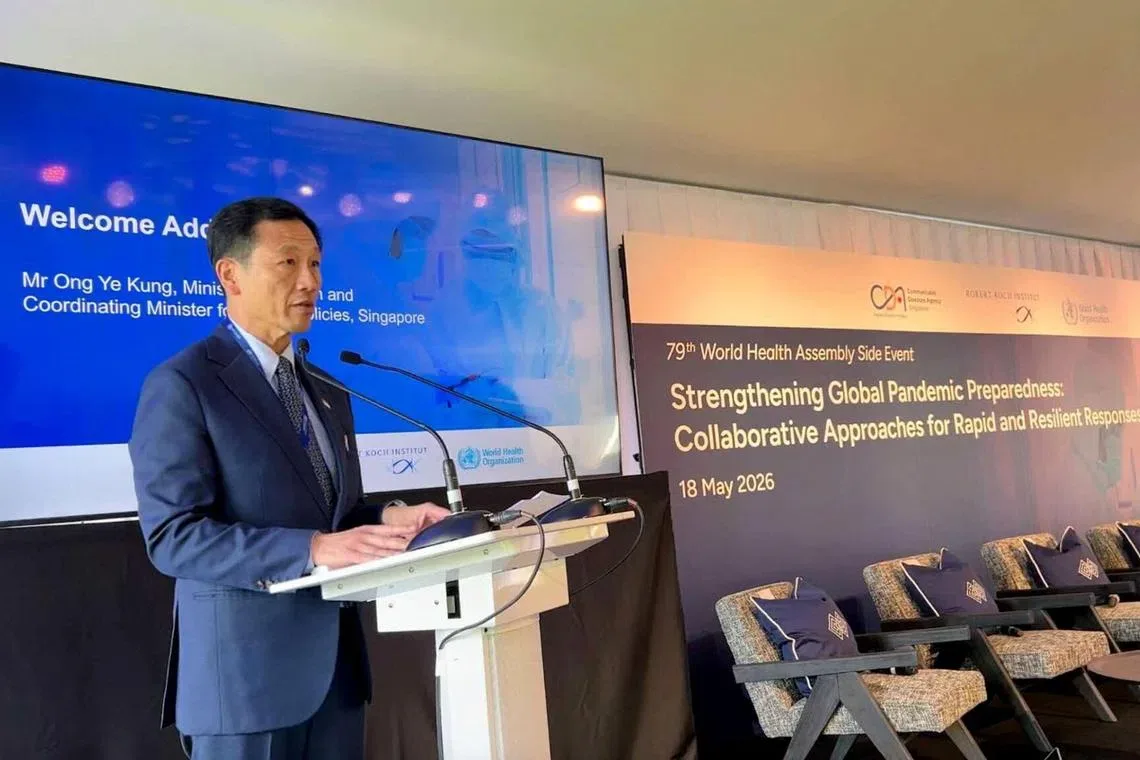
Minister for Health Ong Ye Kung said the risk of a new pandemic remains high despite the end of the Covid-19 crisis, and future outbreaks could be more devastating. He spoke on May 19 in Geneva at a global pandemic preparedness and response event held alongside the 79th World Health Assembly, organised by Singapore’s Communicable Diseases Agency (CDA), the Robert Koch Institute, and WHO [1, 2, 3, 4].
Ong cited WHO’s recent declaration of an Ebola outbreak in the Democratic Republic of the Congo and Uganda as a public health emergency, along with hantavirus infections in other regions, as evidence that infectious diseases continue to emerge. He said, "These are timely reminders that infectious disease threats continue to emerge and evolve" [2].
Highlighting the role of modern aviation in spreading pathogens rapidly, Ong called on key aviation hubs such as Singapore to detect, sequence, and share new pathogen data continuously. He added, "The world cannot lapse into complacency or let its attention drift as it edges closer to the next pandemic" [4].
To help global efforts, Singapore pledged to share new pathogen information "freely, quickly and transparently, with no strings attached," Ong said [1]. Singapore has formed wide-ranging international health partnerships to facilitate information sharing.
At the same WHA event, Singapore’s Ministry of Health signed a memorandum of understanding (MOU) on health cooperation with the Philippines and another with Finland, focusing on community care for seniors and health technology. The Communicable Diseases Agency Singapore plans to sign an MOU with China’s National Disease Control and Prevention Administration [1, 2, 3, 4].
Ong stressed that pandemic preparedness relies on fast vaccine development, citing the Coalition for Epidemic Preparedness Innovations’ (CEPI) goal of producing vaccines within 100 days, quicker regulatory approvals, and building a global vaccine manufacturing network to avoid inequalities [1, 2, 3, 4].
The hostilities of recent outbreaks, international partnerships, and vaccine initiatives aim to boost the world’s ability to respond swiftly to future infectious threats.