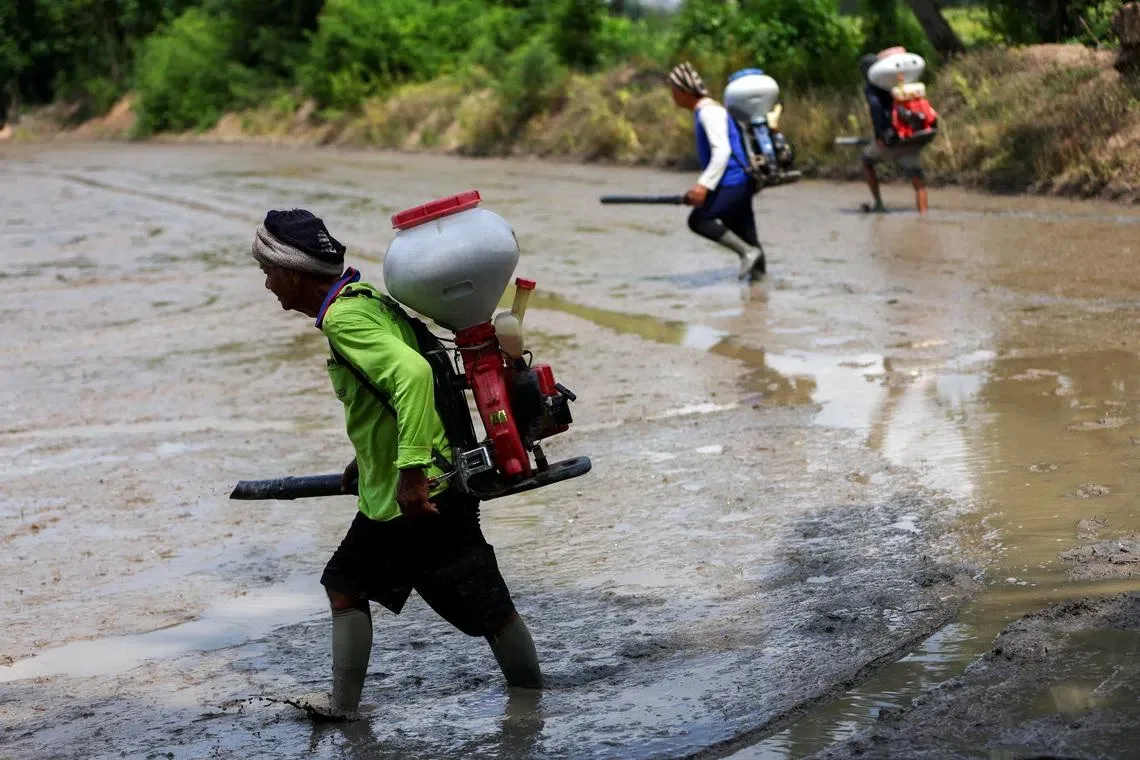
Thailand's agricultural sector faces a deepening debt crisis driven by a surge in fuel and fertilizer costs linked to the Iran war, combined with falling rice prices that have squeezed farmers' incomes [1, 2]. Retail diesel prices in Thailand soared by more than 60% at their peak, while fertilizer costs increased by over 30%, adding heavy burdens on farmers' operating expenses [1, 2].
Rice export prices reached an 18-year low last year, with current prices around 7,800 baht per ton, well below the roughly 10,000 baht per ton farmers say would ease their financial strain [2]. Chaon Taiupok, a Thai rice farmer, said, "Once they won and formed the government, they disappeared," reflecting frustration with the government's response [1].
More than half of the 3.73 million agricultural borrowers from state banks are trapped in a debt cycle, unlikely to clear debts before retirement, according to Bank of Thailand research [2]. Thailand’s overall household debt stands at 86.7% of GDP, one of the highest ratios in Asia, limiting the government's ability to provide further stimulus [1, 2]. Finance Minister Ekniti Nitithanprapas called the situation "a cost-of-living crisis," emphasizing fiscal constraints given high household debt levels [1, 2].
Prime Minister Anutin Charnvirakul won a landslide election in February 2026 with strong rural support but has seen approval ratings decline amid the worsening crisis. A May poll by Suan Dusit University showed 57% of respondents had little or no expectations of government performance, down from 68% optimism in March, with 78% demanding urgent action on living cost inflation [1, 2].
The government launched a 176 billion baht ($5.4 billion USD) consumer subsidy program under a 400 billion baht loan law this year, but opposition parties have challenged it legally, and many farmers say the subsidy of about 1,000 baht per rai is insufficient against soaring costs [2]. Deputy government spokesperson Ploythalay Laksameesaengjan said the government aims to introduce further support "to support people and boost confidence in its work" while blaming higher oil prices on factors outside Thailand's control due to the war [1, 2].
Thailand’s economy is further hampered by low growth, weak domestic demand, and slow-recovering tourism, compounding the pressures on rural households [1, 2].
Farmers remain under significant financial stress as rice prices stay below levels needed to ease debts. The government faces mounting pressure to implement more effective relief measures in the coming months.