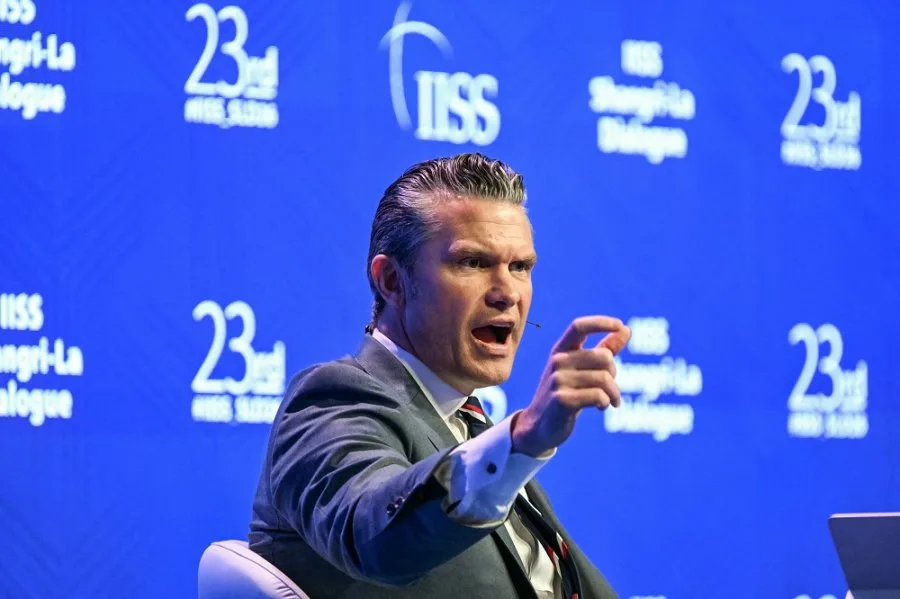
US Defense Secretary Pete Hegseth urged Asian allies to raise their defense spending to 3.5% of GDP during the Shangri-La Dialogue summit held in Singapore from May 29 to 31, 2026 [1, 2]. He said the increase was necessary to counter China’s growing military influence, warning that dominance by a single power in the Pacific would destabilize regional balance [1, 3].
Addressing the summit on May 30, Hegseth stressed that the era of the US subsidizing defense spending for wealthy allied countries had ended. "We need partners, not protected states. Without everyone bearing the burden, there will be no strong alliance. No more freeloading," he said in remarks carried by multiple sources [4, 2]. He also signaled that the US would adjust cooperation with allies who failed to meet defense commitments, declaring, "Allies refusing to step up will face clear shifts in how we cooperate" [4].
Hegseth praised Asian partners including South Korea, Japan, Australia, and the Philippines for their growing military investments and efforts to modernize defense capabilities. "South Korea’s continued investment in its defense budget is a decisive step reflecting their recognition of the current situation," he said [5]. However, he sharply criticized New Zealand’s plan to raise defense spending from 1% to 2% of GDP as insufficient, labeling it freeloading and saying, "2% is not enough, so 2% means freeloading" [4, 6].
On the broader Western alliance, Hegseth publicly rebuked NATO and European countries for failing to meet pledged defense spending targets, recalling last year’s commitment by NATO members to reach 5% of GDP but noting many admitted they would struggle to hit that goal [7, 6].
Hegseth also stated that the US has sufficient weapons stockpiles and capability to restart conflict with Iran if necessary [1]. He highlighted improving military communications with China, saying US-China military relations were better than in years with frequent exchanges [1, 3].
Responding to Hegseth, Taiwan’s defense minister Gu Li-hsiung affirmed Taiwan’s commitment to strengthening its self-defense and continuing close military cooperation with the US. "Taiwan will continue to enhance self-defense capabilities and maintain close military exchanges and cooperation with the US to uphold regional peace and stability," Gu said [8].
The Shangri-La Dialogue brings together defense officials from across the Indo-Pacific to discuss security issues. Hegseth’s call to raise Asian defense spending to 3.5% of GDP sets a concrete target for US allies in the region amidst growing concerns over China’s military expansion.
The US government is expected to continue pressing allies to meet spending goals and will likely follow through on consequences for noncompliance outlined by Hegseth. The next major review of allied defense contributions will coincide with the upcoming ASEAN Defence Ministers Meeting later this year [1, 2].