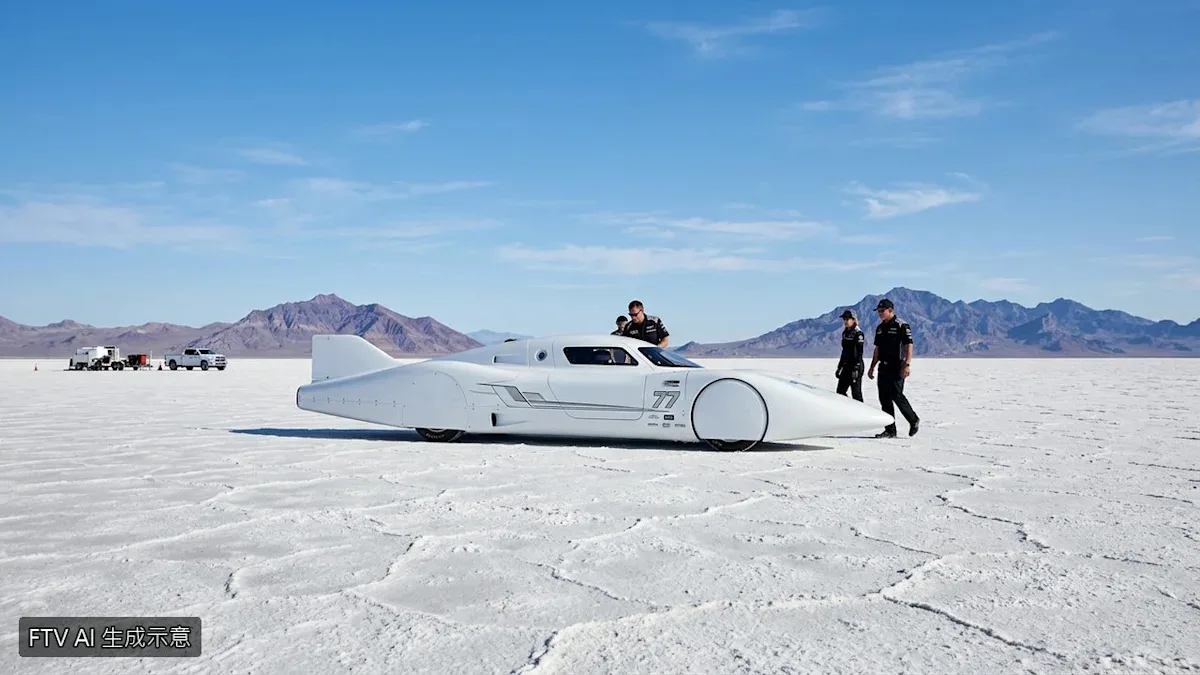
Andy Green, former RAF pilot and holder of the 1997 land speed record, will attempt to set a new hydrogen-powered land speed mark in the JCB Hydromax car this August at the Bonneville Salt Flats in Utah [1, 2, 3]. The 32-foot (9.7-meter) Hydromax uses two hydrogen internal combustion engines adapted from diggers, producing up to 1,600 horsepower with zero carbon emissions except water vapor [1, 2, 3].
Green previously set the current record of 763.035 mph in the jet-powered Thrust SSC, and now aims to beat the diesel land speed record of 350.092 mph set 20 years ago by the JCB Dieselmax, which he also drove [1, 2, 3]. Initial test runs this June at RAF Wittering reached speeds of 177 mph on a 2.7-kilometer runway, showing promising performance for the hydrogen car [1, 2, 3].
Green described the Hydromax as the “coolest zero-carbon racecar ever created” and said the project highlights "the next generation of technology, the future of the internal combustion engine" [1, 2, 3]. He added, “360 (mph) will look quite fast from where I’m sitting as well,” underscoring the challenge ahead [2].
The Bonneville Salt Flats track has been reduced to 9-10 miles in length due to environmental degradation, shortening the distance for the record attempt [1, 2, 3]. After the runs, the Hydromax will deploy parachutes and brakes to stop within just over two miles [1, 2].
JCB launched the Hydromax project in June 2025 with partners Prodrive, Ricardo, and Xtrac and has invested roughly £100 million (about $132 million) developing hydrogen internal combustion engines [1, 2, 3]. The company also plans to open a $500 million factory in San Antonio, Texas, employing 1,500 people later this year [1, 2, 3].
The FIA has sanctioned the attempt, ensuring official recognition if the record is achieved [3]. The land speed record attempt is scheduled for August 2026.