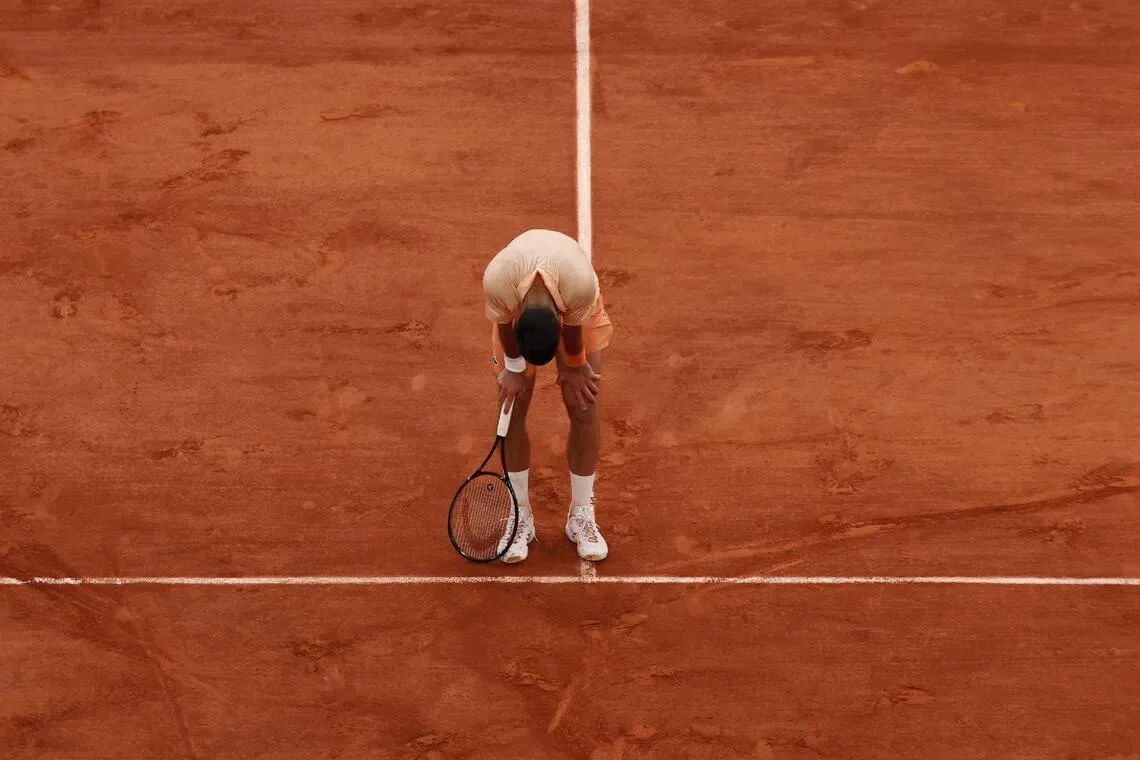
Novak Djokovic, 36, with 24 Grand Slam titles, faced 19-year-old Joao Fonseca in a marathon match lasting 293 minutes and stretching to five sets at the Paris clay court tournament on August 20, 2026 [1, 2, 3, 4, 5]. The match included 331 points, with just 19 aces and 2 double faults; the remainder were extended rallies demanding high endurance and strategy [1, 2, 3, 4, 5].
The Paris clay surface slows the ball considerably due to its sticky consistency, making the rallies especially gruelling and requiring players to grind through long exchanges. The conditions force players into physically and mentally demanding battles where spin, stamina, and control come to the fore [1, 2, 3, 4, 5]. One participant was so physically taxed that they left the court in a wheelchair despite winning their match [1, 2, 3, 4, 5].
Rallies on Paris clay are described as a dialogue or act of defiance between players, involving complex strategy and physical exertion. Former Indian pro Somdev Devvarman described it as “so much fun” with elements such as drop shots, lobs, and intense cat-and-mouse play, all heightened on clay courts [1]. Meanwhile, Poland's Iga Swiatek said, “You need to have this feeling in your head that you’re not going to miss a ball,” though she acknowledged players do sometimes make incomprehensible errors [1].
Long rallies define tennis at Paris. For example, a 21-shot exchange filled with dynamic net play draws strong crowd interaction and intensity [1]. Historically, some Paris rallies have stretched for minutes; a famous rally lasting 2 minutes and 18 seconds was contested between Bjorn Borg and Guillermo Vilas, compared to William Faulkner’s famously long 1,200-word sentence [1, 2, 3, 4, 5].
The auditory atmosphere on the clay courts reveals players’ physical effort, including the sound of sliding and exertion as they chase down each ball [1, 2, 3, 4, 5]. Djokovic’s recent match exemplified these grueling challenges as he and Fonseca engaged in a relentless tactical battle over nearly five hours [1, 2, 3, 4, 5].