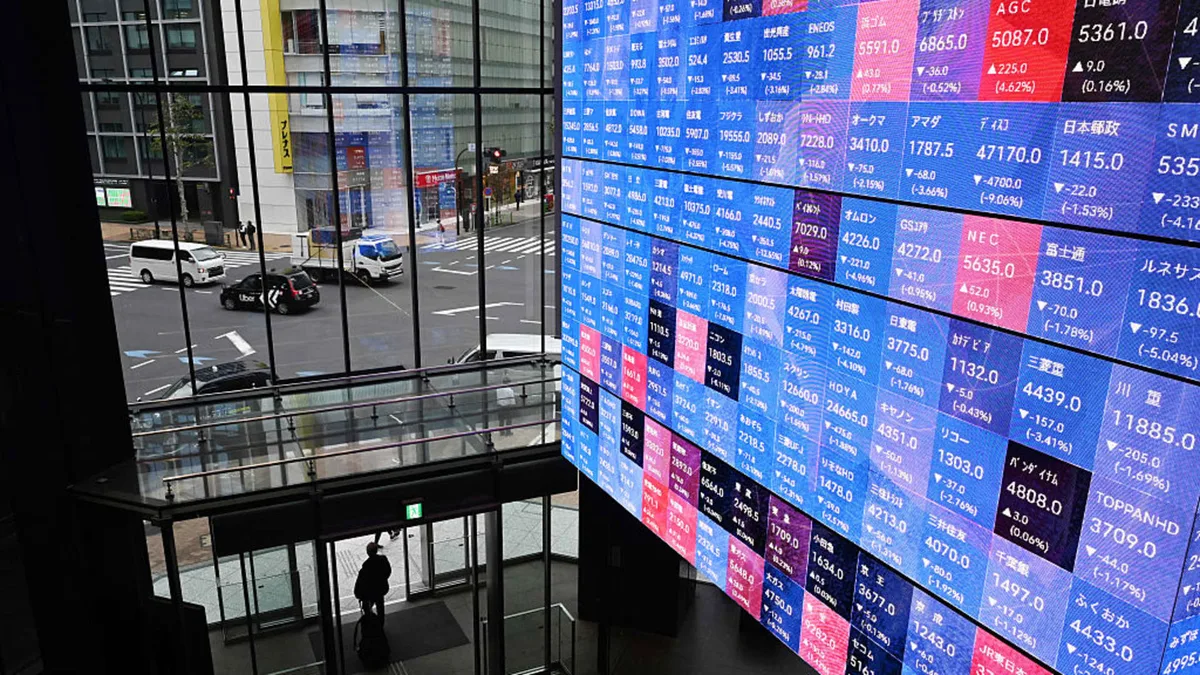
Asian stocks began trading cautiously on June 2, 2026, with MSCI’s broad Asia-Pacific index outside Japan dropping 0.5% [1, 2]. South Korea’s shares fell 2% after opening higher, while Japan’s Nikkei 225 slid 0.7% that day [1]. On June 1, the Nikkei 225 had increased 0.17% but the Topix index declined 0.3%, reflecting mixed market conditions the previous day [3]. South Korea’s Kospi added 0.6% on June 1, though its small-cap Kosdaq index dropped 1.58% [3]. Hong Kong Hang Seng index futures traded below previous closes on both June 1 and June 2 [3, 2].
Market jitters came amid renewed doubts over U.S.-Iran peace negotiations. On June 1, former President Donald Trump said he was "in no hurry" to finalize a deal, stressing careful negotiation over speed by saying, "if you’re going to be in a hurry, you’re not going to make a good deal" [3]. However, on June 2 he took a sharper tone on CNBC, stating he "couldn’t care less" if the talks collapsed and described the drawn-out negotiations as "very boring" [2].
Oil prices held steady near US$95 per barrel as Lebanon announced a partial ceasefire between Hezbollah and Israel, easing some Middle East tensions that affect markets [1]. At the same time, technology optimism remained strong in the U.S. with the S&P 500 closing at record intraday highs on both June 1 and June 2, fueled by hopes for artificial intelligence growth [1, 2]. Alphabet revealed plans to raise US$80 billion through equity offerings, including investments from Berkshire Hathaway, to expand its AI infrastructure [1]. Additionally, AI suppliers in Asia gained ground following Anthropic’s confidential US IPO filing, potentially valued at a trillion dollars [1].
The conflicting signals from geopolitics and tech optimism created a volatile mood across Asia-Pacific markets. Investors faced mixed regional performances after gains on June 1 gave way to declines on June 2, signaling uncertainty over short-term direction [1, 3, 2].