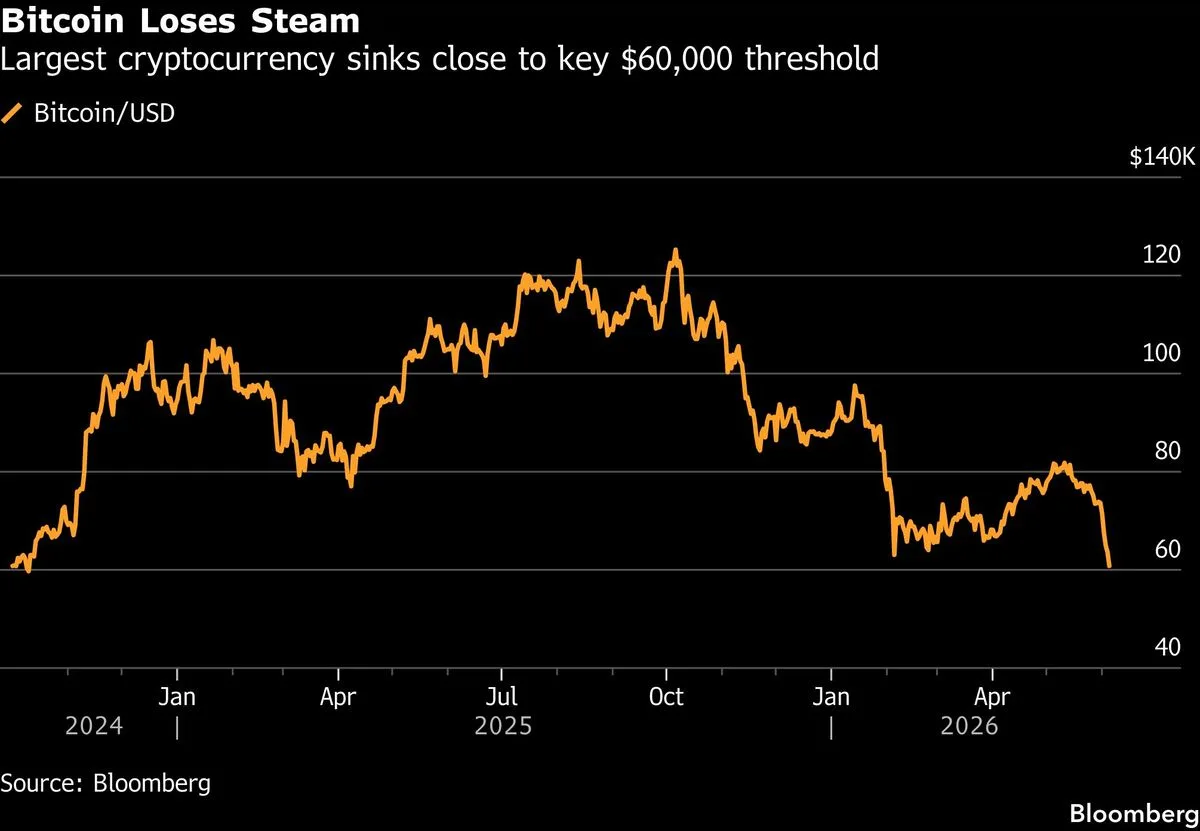
Bitcoin fell below the key psychological level of $60,000 on June 6, 2026, reaching around $59,770, its lowest price since October 2024 before former President Trump’s reelection [1, 2, 3]. This capped the cryptocurrency’s longest losing streak since August 2025, with at least six consecutive days of decline in early June [4, 1, 5].
The price drop marks a roughly 50% decline from Bitcoin’s all-time high above $126,000 in October 2025. Over the past year, it has dropped about 36%, as the global crypto market lost an estimated $600 billion since mid-May 2026 [6, 1, 7, 8, 2].
Bitcoin first broke below $70,000 on June 2 at around $67,700, a level last seen in April 2026. It then slid further to between $61,000 and $63,000 on June 4-5, nearing prices from early 2026 and before Trump’s 2024 reelection [6, 4, 1, 9, 7, 5, 8, 10]. Early on June 5, Bitcoin briefly dropped under $60,000 to about $59,840 before recovering slightly, then fell below the threshold again on June 6 [1, 2, 3].
One major catalyst for the selloff was Strategy Inc’s sale of 32 bitcoins (around $2.5 million) in late May to fund dividend payments. This was the company’s first sale since December 2022 and surprised investors, as Strategy is the largest institutional Bitcoin holder, still retaining over 843,000 bitcoins at an average cost near $75,000 each [9, 11, 10, 2, 3]. Emma Bernuau of Eurosagency noted the symbolic significance: "The market had generally considered that Strategy had no intention of selling its bitcoin and would continue accumulating regardless of market conditions" [3].
Strategy’s sale shook investor confidence and triggered accelerated liquidations of leveraged long positions, worsening the downward pressure on Bitcoin prices [9, 11, 8]. US-listed Bitcoin ETFs also experienced record net outflows, with nearly $4.4 billion pulled out over 13 sessions in late May and early June 2026 [4, 9, 5, 11].
Investors are reportedly rotating out of cryptocurrencies into hot tech stocks, AI-related IPOs such as SpaceX, and other equities, reducing demand for digital assets [4, 7, 11, 8]. Stéphane Ouellette of FRNT Financial said, "Part of the extreme selloff may come from retail investors cashing out to prepare for upcoming high-profile IPOs in AI and tech" [4]. Syz Group CIO Charles-Henry Monchau added that speculators are shifting money to AI stocks and memory chips, especially in South Korea [8].
Other major cryptocurrencies like Ethereum have dropped similarly, with Ether reaching lows last seen in April 2025 [4, 1, 5]. Duke University’s Cam Harvey cautioned that Bitcoin’s role as a short-term inflation hedge is being questioned, saying, "The degree of randomness is very high, which will lead to potential disappointment" [6].
Bitcoin’s next key levels to watch will be whether it can hold above the $60,000 floor or if further losses extend the current streak. Market participants remain cautious amid ongoing global uncertainties and sector rotation.